Keppel Reit open to more development exposure
A potential opportunity is participation in its sponsor's redevelopment of two freehold office towers at Hoe Chiang Road.

Kalpana Rashiwala
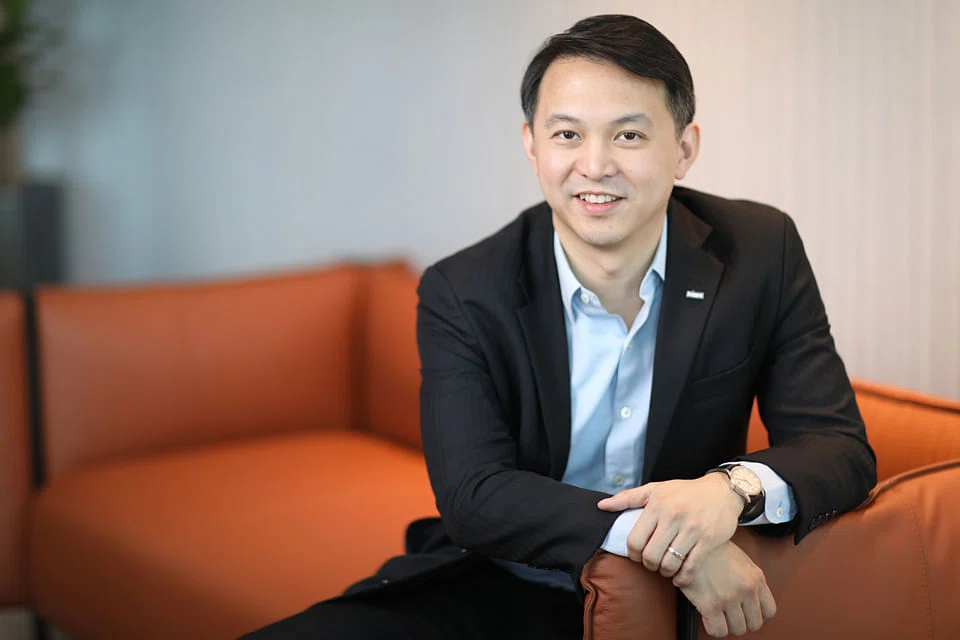
KEPPEL Reit Management's chief executive, Paul Tham, is open to stepping up development activity for the trust as part of its ongoing strategy to boost yields.
The trust - which owns about S$8 billion of CBD Grade A office properties in Singapore, Australia and South Korea - has in the past teamed up with its joint-venture partners in Australia for development projects.
The latest example would be 311 Spencer Street in Melbourne, where Keppel Reit has a 50 per cent stake in the project being developed by Cbus Property, one of Australia's leading property investors and developers.
The 40-storey freehold Grade A office project is slated for completion in the second quarter of next year, when the Victoria Police will begin its 30-year lease of the entire property.
Following 311 Spencer Street's completion, Keppel Reit can have up to S$800 million of property development exposure (based on a development limit of 10 per cent of the Reit's deposited property).
One potential development opportunity in Singapore that could surface for Keppel Reit is if and when its sponsor, Keppel Land, decides to redevelop two freehold office towers in Hoe Chiang Road into a mixed development, say, an office and residential project.
Keppel Reit used to own the two properties, which were formerly known as Keppel Towers and GE Towers, before divesting them in 2010 to Keppel Land in exchange for a one-third stake in the first phase of Marina Bay Financial Centre (MBFC).
The towers, now known as Keppel Towers and Keppel Towers 2, qualify for the Urban Redevelopment Authority's CBD Incentive Scheme unveiled earlier this year, offering up to 25 per cent additional gross floor area if they were to be redeveloped into a commercial and residential project.
"We are waiting for Keppel Land to finalise their plans, to see what kind of role we could potentially play," Mr Tham said in a recent interview with The Business Times. The advantage to Keppel Reit if it were to participate in the development at the outset, albeit only for the commercial component, would be a lower-entry cost (and hence a higher yield), against buying the office component in the project post-completion from Keppel Land, Mr Tham explained.
Keppel Reit has thus far not teamed up with its sponsor for a property development. Their earlier transactions involved Keppel Land selling its stakes in completed assets One Raffles Quay, MBFC and Ocean Financial Centre (OFC) to the Reit.
Mr Tham adds that any development projects will be more of a medium to long-term benefit to Keppel Reit.
In the more immediate term, growth is expected to come from positive rental reversion on its Singapore office portfolio, and through overseas acquisitions.
The trust's Singapore properties make up 81 per cent of its S$7.9 billion portfolio of assets under management (AUM).
In Australia, besides the half-stake in the 311 Spencer Street project, the Reit owns half stakes in 8 Exhibition Street in Melbourne, 8 Chifley Square in Sydney, 275 George Street in Brisbane and David Malcolm Justice Centre in Perth. In all, Australia accounts for 15.2 per cent of Keppel Reit's AUM.
The remaining 3.8 per cent is in Seoul, where the trust bought a 99.38 per cent interest in T Tower earlier this year for 252.6 billion won (S$301.4 million).
Mr Tham states that the Reit will remain predominantly Singapore based, but there is room to grow the combined Australia and South Korea share of AUM from the current 19 per cent to about 25-30 per cent in the near term - with the Singapore share coming down to 70-75 per cent. "Our primary focus for acquisitions is CBD offices in Melbourne, Sydney and Seoul."
Diversifying overseas is vital to Keppel Reit's strategy of boosting the blended yield for its portfolio and steadily growing distribution per unit (DPU).
The problem with the CBD Grade A office market in Singapore is that it offers low yields. "We like having exposure to South Korea and Australia, where leases tend to have built-in rental escalations," said Mr Tham.
"Singapore office cycles are so short," he noted. Leases here tend to be just three to five years - compared with five to 10 years in Australia. Hence the stability in income from the trust's Australian assets will help to buffer it from the volatility inherent in shorter office cycles here.
"Some of the divestments and reinvestment we have done in the past 12 months are really meant to push up our DPU numbers," said Mr Tham. Effectively the trust has switched from lower to higher-yielding assets.
Late last year, the Reit divested a 20 per cent stake in OFC in Singapore for S$537.3 million at an exit net property income yield of 3.1 per cent. In May this year , it redeployed some of the proceeds to the purchase of T Tower in Seoul at a higher 4.7 per cent entry yield. The trust's sale of Bugis Junction Towers, completed on Friday, was at 3 per cent yield.
Keppel Reit also set aside a portion of divestment proceeds from the sale of the OFC stake to continue its DPU-accretive unit buyback programme initiated in July 2018. As at Nov 26, 2019, a total of 85.3 million units - or about 2.5 per cent of the total units in issue before the start of the programme - have been purchased and cancelled.
The programme has garnered good feedback, particularly from US and European institutional investors. "It is immediately DPU accretive because we're buying below book value and it is good for unitholders," said Mr Tham.
Keppel Reit has used part of the capital gains from asset sales to smoothen out DPU.
It has also been driving individual asset performance with a proactive leasing strategy.
The trust achieved positive rental reversion of 14.8 per cent on all leases signed across its property portfolio in the first nine months of this year, an improvement from the positive 12.9 per cent for FY2018 and negative 4.4 per cent in FY2017. "We haven't had a lot of lease expiries over the last 12 to 18 months, so we could take a little bit more occupancy risk and push up rentals a bit more this year," said Mr Tham.
That said, he acknowledged that Singapore office leasing demand is not as strong as it used to be, say 12 months ago. The slowdown in the Singapore economy, US-China trade tensions, Brexit and the situation in Hong Kong have adversely affected business sentiment.
If demand remains soft, the saving grace would be the lack of supply from new CBD office completions in Singapore in the next two years.
But come 2022, market watchers are anticipating a surge in supply. "Keppel Reit has been proactively working with tenants to bring forward lease renewals or extend leases to minimise exposure to the increased expected supply in 2022," said Mr Tham.
He highlights that the silver lining from the economic slowdown is that the tenant retention across the trust's portfolio improved to 78 per cent for the first nine months of FY2019, from 64 per cent for the first six months of the year. With slower business, tenants become more reluctant to move to avoid incurring capital expenditure.
Another bright spot for Keppel Reit is that it can probably look forward to further positive rental reversion. The S$12.15 per square foot per month weighted average signing rent for the leases in the Reit's Singapore office portfolio concluded in the first nine months of FY2019 gives Keppel Reit "a fair bit of buffer" to the weighted average expiring rents of S$9.59 psf for 2020, S$9.53 psf for 2021 and S$10 psf in 2022, said Mr Tham.