Keppel seeks stronger valuations with reorganisation

The group plans to significantly scale its assets under management to S$200 billion by 2030

Yong Jun Yuan
Vivienne Tay

Yong Jun Yuan &

Vivienne Tay

Published Wed, May 3, 2023 · 08:45 AM
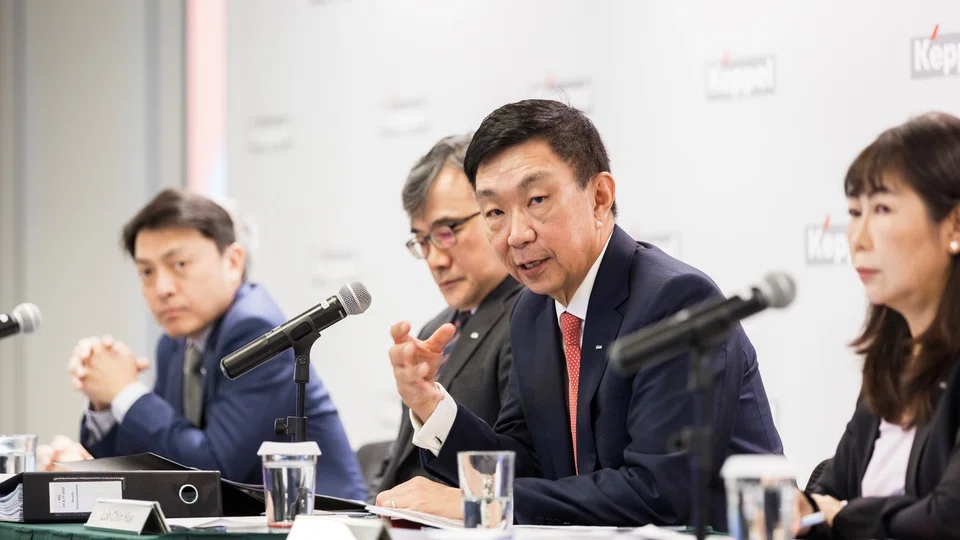
    • At the company’s media and analyst briefing, Keppel Corp chief executive Loh Chin Hua appealed to analysts to reassess the way they value the company.
    • At the company’s media and analyst briefing, Keppel Corp chief executive Loh Chin Hua appealed to analysts to reassess the way they value the company. PHOTO: KEPPEL

    KEPPEL Corporation will simplify its organisational structure into a new “horizontally integrated operating model” amid plans to transform into a global alternative real asset manager.

    The reorganisation will remove the group’s conglomerate structure in favour of one which comprises fund management, investment and operating platforms, Keppel said on Wednesday (May 3).

    Keppel Corp chief executive Loh Chin Hua said the group’s business model allows it to earn different streams of recurring fee income, which will enhance earnings resilience.  “Coupled with faster capital recycling, we will be able to scale up and drive the group’s growth without relying just on our balance sheet, allowing us to expedite the achievement of our 15 per cent return on equity target,” he added.

    At the company’s media and analyst briefing, Loh appealed to analysts to reassess the way they value the company.

    “I think that having the conglomerate structure doesn’t necessarily help us because it gives analysts another reason to value us as a conglomerate, so I think we want to change that,” he said.

    The fund management platform will focus on raising capital, while the investment platform will decide on how capital is deployed.

    The operating platform, meanwhile, will be created by integrating Keppel’s existing business units to drive further collaboration and synergies. This platform will also strengthen its engineering capabilities, technical know-how and drive innovation.

    Loh noted that the company will benchmark itself against the best global asset managers in the world. Still, he added that the company is “unique” for its capabilities in three horizontals – the infrastructure, real estate and connectivity sectors.

    “What Keppel offers is quite unique. It’s one package – an ability to invest, operate and manage this group of assets, that are real assets, with a very strong asset-management track record,” he said.

    Notably, analysts were also invited to a separate briefing with audit and consulting firm EY, in which “valuation principles and methodology” were discussed. They were told that components which have income-generating ability should be valued by price-to-earnings multiples.

    Such components include the asset management fees from the management of Keppel Infrastructure Trust, and the sale of electricity and gas.

    Loh said that the reorganisation will also give the company an opportunity to value-add to its assets across its business segments.

    He cited the example of the green hydrogen that Keppel Infrastructure has been sourcing. It will be readily taken by Keppel Telecommunications & Transportation as part of its data centre portfolio.

    With the restructuring, the company would like to emphasise the importance of its recurring income across its three horizontals, Loh added.

    “This is, again, part of our Vision 2030. As we move away from lumpy profits, we want to move more and more into earnings that are recurring, that will attract a higher multiple, rather than the market valuing (us) using price-to-book, or discount to revalued net asset value.”

    The group expects the new initiatives to translate into S$60 million to S$70 million in annual savings by 2026. It will progressively implement the reorganisation in the next 12 to 18 months.

    The restructuring will also look at Keppel’s legal structures, its internal processes and how its support functions can be further centralised and optimised, said Loh.

    Across the group, management incentives are also being refreshed to ensure closer alignment with the group’s overall performance and with the interests of Keppel’s shareholders and investors.

    Keppel plans to “significantly scale” its assets under management to S$200 billion by 2030, with a S$100 billion target by the end of 2026. This is double its S$50 billion in assets under management recorded at the end of 2022.

    It will continue to monetise its assets, with a goal to reach an asset monetisation of S$10 billion to S$12 billion by the end of 2026. This includes “unlocking value” from the group’s sizeable land bank.

    Loh said: “Just to be clear, I love the land bank because it’s really a (form of) value... It’s just that it doesn’t quite fit what we’re trying to do, so the question is, how do we monetise it?

    “Until it is monetised, the land bank sits on the balance sheet, produces no income (and) has a lot of holding costs. By virtue of the fact that we can monetise the land bank, we can reinvest into recurring income. That in itself will improve our returns.”

    Keppel said it will invest the proceeds from asset monetisation into new growth engines, leverage its asset-light model, and reward shareholders.

    Loh noted that the company has been consistently paying out between 50 per cent and 60 per cent of its earnings, and he does not expect that to change, barring any external environment changes.

    Phillip Securities research manager Peggy Mak said that she foresees Keppel positioning itself as a global asset manager, much like BlackRock, but for alternative real assets and real estate.

    She also noted that Keppel is following a “cradle-to-grave-to-afterlife model”. This is similar to how real estate investment manager CapitaLand Investment is structured, but on a larger scale.

    “Overall, we think Keppel’s focus has pivoted from asset gathering to asset optimisation, which is good for (its) balance sheet,” she said. “By having third-party investors, we think the returns from the investments would be more closely scrutinised, and the investment process more rigorous.”

    Still, it is too soon to predict how much value accretion could occur, she added.

    With the reorganisation, the company may be positioning itself alongside well-established global peers. This could include companies such as Canadian multinational investment manager Brookfields, which also focuses on infrastructure and real estate segments.

    As at 3.51 pm on Wednesday, the company’s shares were up 2.6 per cent, or S$0.16, at S$6.38.