Keppel’s real AI story isn’t the humanoid robot
Keppel’s agentic AI that picks data centre sites and spots breakdowns is already paying its way

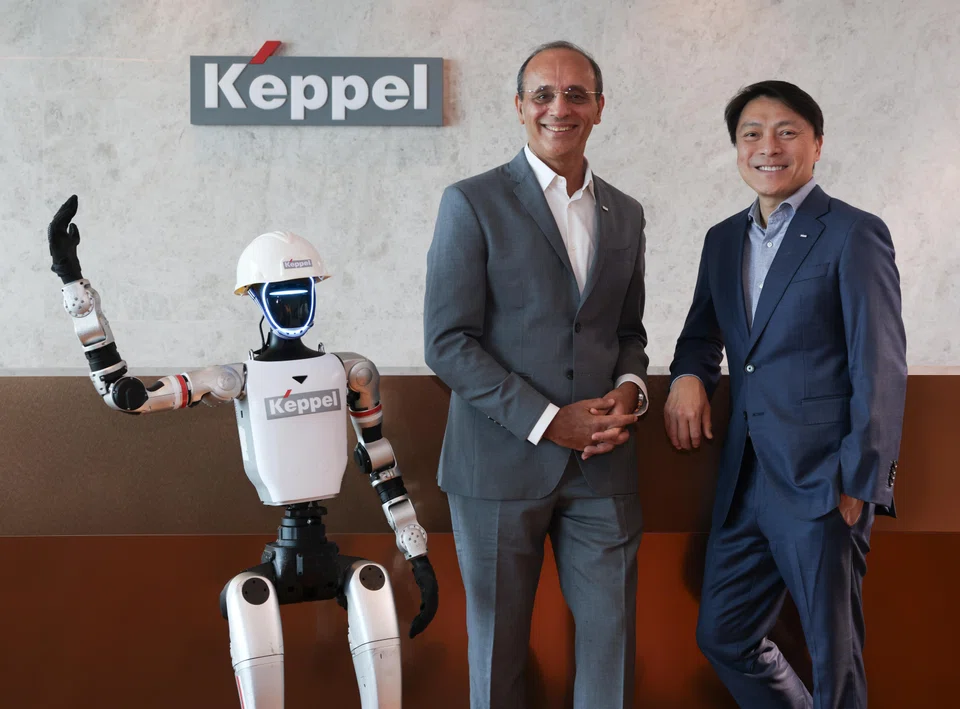
[SINGAPORE] When Keppel trots its embodied artificial intelligence robots into the room, it feels like stepping into a futuristic movie set.
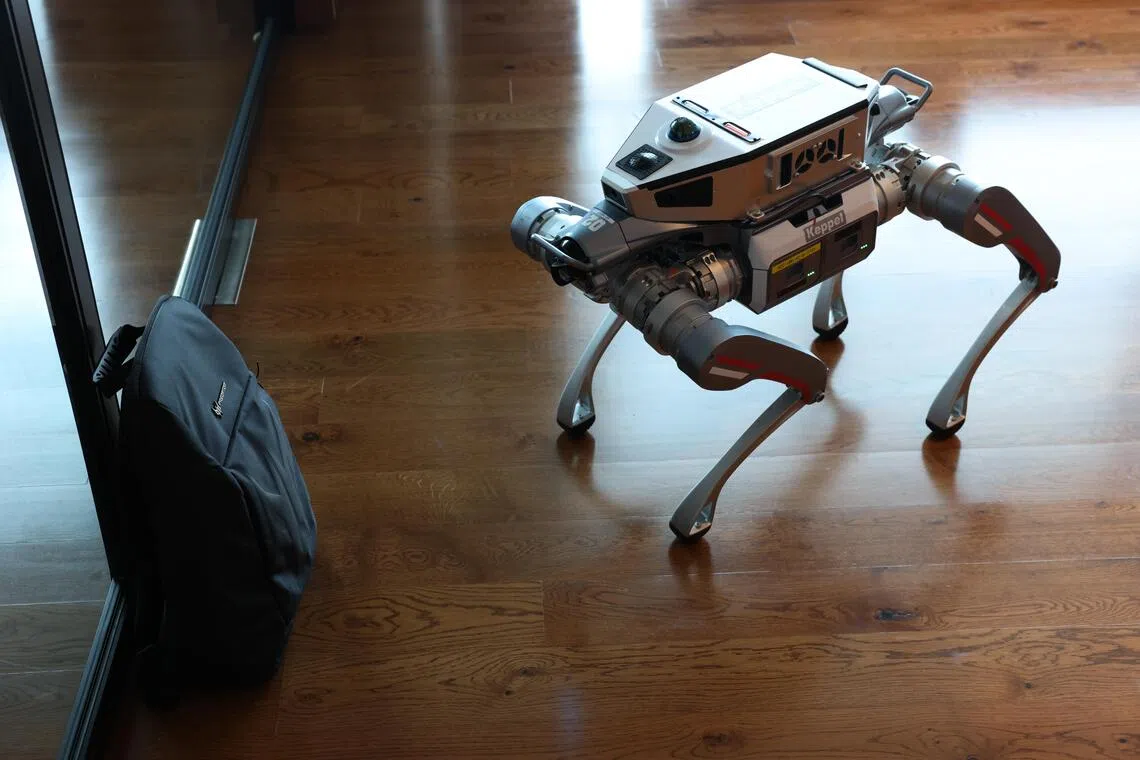
Ken the humanoid greets visitors by name, while a robot dog called Sentry sweeps the room and flags something odd, right on cue. The cameras love it.
Ken is being trained to flip high-voltage switches at the Senoko waste-to-energy plant. Sniff, another robot dog, is meant to crawl into incinerators and test the air for toxic gas.
Both trials are about six to eight weeks old. There is no rollout date, and neither robot has gone to the regulators yet.
But think of them as the opening act. Keppel’s true AI headliners have no legs, no faces and no photo call. They are software agents with names such as Tellus and Athena, and some of them already make or save real money.
On Oct 27, Keppel also got a gold star. Deputy Prime Minister Gan Kim Yong named it one of 24 “Champions of AI” during the Singapore Week of Innovation and Technology.
Two wheels and a belt
“We actually want to become an AI-native global asset manager and operator. That’s our goal,” said Manjot Singh Mann, who runs Keppel’s connectivity division and doubles as chief digital officer. He co-chairs Keppel’s AI executive committee with Louis Lim, CEO of real estate.
Keppel CEO Loh Chin Hua has since put a date on it. The group aims to be AI-native by 2040, Loh said in an interview with The Straits Times.
Why bother? Keppel already cashes in on the AI boom by building the data centres, power plants and subsea cables it runs on.
The answer is scale. Keppel is still a minnow next to Blackstone, which crossed US$1 trillion in assets in 2023. Hiring its way to that size would be slow and costly, and Mann admitted tech talent is “always a challenge” in Singapore. AI is how Keppel hopes to punch above its weight.
That pitch rests on Keppel’s double flywheel. Think of it as two wheels joined by a belt. One is asset management: raise money, invest, sell and recycle the capital. The other is operations: running the power plants, data centres and buildings inside those funds.
The way Lim sees it, AI is the belt. “AI brings them both together and gets the information from our operational side to inform how we make our investments. That we see as the superpower,” he said. He called it Keppel’s “new secret sauce”.
The stakes are higher than the robots suggest. Keppel expects more than 70 per cent of its earnings by 2030 to come from infrastructure that supports AI. Its funds under management (FUM) hit S$106 billion at end-July, and it wants S$200 billion by 2030.
Doubling the money without doubling the staff is the quiet promise behind all the AI talk.
But the boss is careful not to oversell it. At Keppel’s third-quarter update on Oct 29, with markets fretting over AI spending, Loh stressed that its data centres, power and cables serve the wider digital economy, “including but not limited to AI”.
Analysts are already dreaming bigger. After Keppel’s Next forum in September, JPMorgan’s Mervin Song and Terence Khi asked: “Can investors also dare to dream of a S$1 trillion FUM target by 2040?” DBS’ Ho Pei Hwa noted that Blackstone and Apollo took about a decade to grow from US$200 billion to US$1 trillion.
The agents that earn
Take Tellus, built for Keppel’s data centre arm. If Keppel is eyeing Vietnam, for example, Tellus pulls public data on power, water, fibre and where the hyperscalers like to build, then draws a heat map of the likeliest sites.
“It allows us not to have a huge team of people in that country going day in, day out, trying to visit different provinces,” said Mann.
Tellus helped Keppel settle on the Australian site where it has locked up land and power for a 720 megawatt data centre campus.
Keppel called this “power banking”. When power is the scarcest input, getting there first is a great advantage.
Tellus has since been lent out. An Australian bus firm in Keppel’s portfolio uses it to plan routes, and the real estate team is trying it on schools.
Then there is Athena, which reads sensor data from Keppel’s data centres to predict when parts will fail. It once beat a supplier to the call. “While they were saying, ‘No, this is not going to fail’, we told them it is going to fail, and we were right,” said Mann. Athena is now being rolled out across all of Keppel’s data centres.
Lim’s favourite example is duller, which makes it more convincing. “We used to take maybe two, three weeks at least to do a hold-sell analysis,” he said. “Some of our analysts now can do it in 45 minutes.”
Still in the workshop
Agent 9D, which uses nine agents to flag project bottlenecks early, is only partly deployed. The co-chairs said it was too early to put a number on its savings.
Vanguard, the contracts agent, drafts hyperscaler contracts from Keppel’s past deals. Low-risk calls can go to the machine. For important ones, said Mann, “we always still have the human with a name that is going to make that decision”. That rule is one of Keppel’s “10 commandments” for AI.
In the early days when generative AI arrived, staff piled in and pilots multiplied. Asked for Keppel’s worst AI mistake, Mann would not call it one. “It was a pivot,” he said. “It was becoming a pilot graveyard.”
Lim put it more vividly. “If you apply AI to a ball of spaghetti, what happens is that you get an even bigger, messier ball of spaghetti,” he said. The fix is to clean up the data and workflows first. “There are a lot of bees around now. What we’re trying is to create the hive.”
So Keppel added layers: a council of top management, the AI Exco under Lim and Mann, and AI pods run by the businesses rather than IT. Each pod must say upfront what it will deliver. Projects are then pivoted, killed or scaled. “Our job is to contain excitement,” said Mann.
How do two divisional chiefs decide what dies? “We just fight with each other,” Lim joked.
Keppel will not say how much it spends. “If we don’t put in this money, I think we will be shortchanging our own future,” said Mann.
Back to the robots
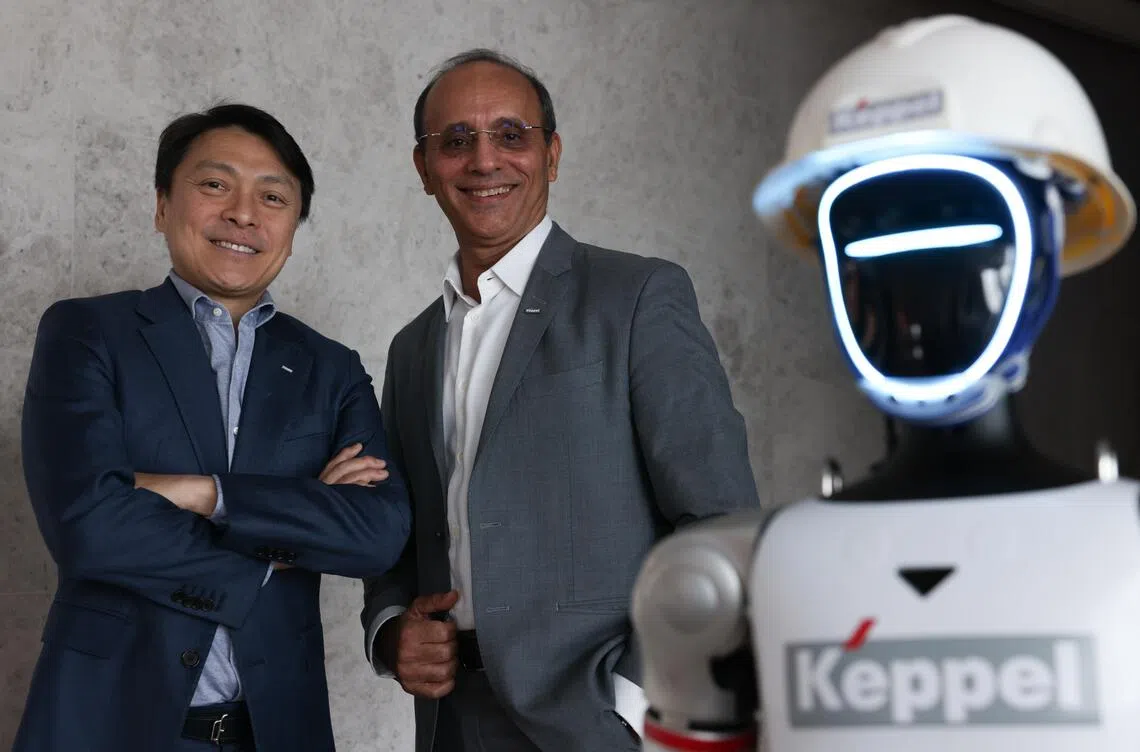
To be clear, the robots are hardly a gimmick.
The unit testing Ken, Keppel Technology Solutions, grew revenue past S$900 million in the first nine months, and more than doubled its earnings before interest, taxes, depreciation and amortisation.
The robots’ jobs were picked for safety. High-voltage switching takes two workers. One flips the switch, while the other holds him by a hook, ready to pull him clear if there is a shock.
“Why should it be done by humans in the first place?” asked Mann.
Sniff’s job is no kinder. Before an incinerator is refired, a worker in a mask climbs in to check the gas levels. Keppel’s Singapore waste-to-energy plants burn more than 3,000 tonnes of rubbish a day, so this is not a rare chore.
DBS’ Ho Pei Hwa called the furnace robot “a tangible example of how Keppel can leverage technology to enhance returns”, while noting it is still on trial.
Hardware remains the sticking point. Henry Chang, managing director of digital services and partnerships at Keppel, who ran the demo, said robotics has yet to have its “ChatGPT moment”.
The machines still break down and must be trained on reams of data. Ken itself runs on hardware from Unitree, the Chinese robot maker.
Then there is the regulatory hurdle. Mann said the robots must work flawlessly before Keppel even asks for approval. “We would never showcase it if we didn’t believe that this can be executed,” he said. “Question is scale, and question is time.”
Keppel calls it a “non-negotiable” that no one loses their job to AI, and its new champion status makes that pledge a public one.
The promise is not pure charity. Keppel’s agents learn from what its veterans know. “The best for our kind of AI modelling is to let the legacy knowledge and institutional knowledge remain in the organisation, because our models are built on that foundation,” said Mann. Let the old hands go, and the machines lose their teachers.
One day, Ken may flip that switch while the second worker stays home. Until then, the headliners at Keppel are the ones nobody photographed.