

Latest profit misses trigger flurry of downgrades for Singapore stocks
Telcos get worst revisions, trade war continues to weigh on electronics, property remains tricky, while banks are a prime pick for most brokerages
Singapore
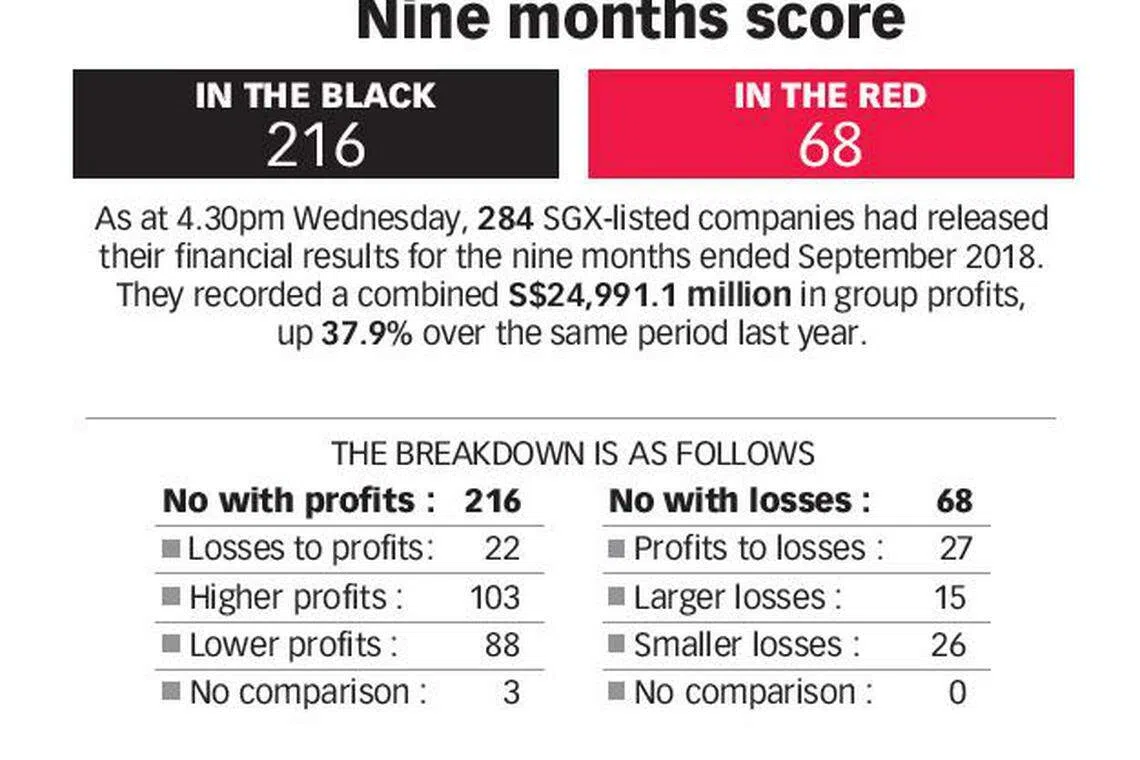
A RASH of analyst downgrades rounds up the latest September-quarter corporate earnings parade, in which more companies fell short of the street's growth forecasts and positive surprises grew rarer.
Banks were the only consistent performers, with the rest of the sectors posting disappointing or mixed results.
Only three Straits Times Index (STI) stocks - Yangzijiang Shipbuilding, CapitaLand Mall Trust and Wilmar - got their consensus 2019 earnings estimates raised this round, down from six companies during the June-quarter results season, according to Credit Suisse. The stocks that suffered the biggest cuts in consensus earnings were Venture Corp, Golden Agri-Resources, Singtel, Hutchison Port Holdings Trust and Sembcorp Industries, the bank said.
UOB Kay Hian head of research Andrew Chow told The Business Times: "Other than banks, most sectors were relatively disappointing or met expectations at best."
Of all the stocks covered by the house, 36 per cent posted results that were below expectations, Mr Chow said.CGS-CIMB's tally of earnings misses outnumbered earnings beats 17 to 12. Research head Lim Siew Khee said her house made fewer downgrades this round, having already assumed a "very conservative" stance over the last quarter.
Among companies covered by Phillip Securities, "hardly any stock meaningfully beat expectations", said head of research Paul Chew.
"The bulk of our recommendation changes post-results were downgrades," he noted, citing factors such as higher-than-expected costs to execute expansion plans, customer delays in launching new products, rising operating costs and more tepid sales.
On a sector-by-sector basis, telcos got their forward earnings numbers slashed the most this quarter, as analysts struggled to see how the profit declines of Singtel, StarHub and M1 could be reversed amid fierce competition from mobile virtual network operators and the impending entry of TPG Telecom into their home market.
The US-China trade war claimed its victims too.
Electronics manufacturer Hi-P International cut its interim dividend by half, opting to stay cautious after net profit fell 11.9 per cent year-on-year on the back of lower sales across its customer base.
Hi-P blamed the trade conflict for lower customer demand and expressed confidence in its prospects for the remainder of the year, though analysts were less enthusiastic about the low earnings visibility.
Maybank Kim Eng analyst Lai Gene Lih wrote: "We do not see indications that pricing will improve in 2019. Hi-P wants to diversify its product mix amid a market with weak volumes. This could reduce economies of scale as a wider mix requires more resources. Profitability in 2019 could also be weighed down by relocation costs, as some resources are shifted to Nantong and Thailand."
Valuetronics, which produces in China and derives 44.8 per cent of revenue from North America, also said its business momentum remains intact.
Mr Lai wrote: "Management has updated that around 20 per cent of revenues are impacted by tariffs (instead of) the 10 per cent guided previously, as more customers have come forward to update that they are impacted. Nevertheless, (management believes) customers are not front-loading sales ahead of the potential hike in tariffs to 25 per cent from 10 per cent come January."
But analysts trimmed their forecasts for Valuetronics anyway on the chance that trade tensions play out bigger than expected.
By far, the stock that got the biggest skunking was Venture Corp, which missed every forecast on the street. Shares of the electronics services provider dived 9.29 per cent in one day after third-quarter net profit fell 27.5 per cent year-on-year on a likely IQOS production cut.
IQOS is the smokeless tobacco device Venture makes for Philip Morris that helped lift its profit to record highs last year. Venture has repeatedly sought to downplay the significance of IQOS to its topline, but JP Morgan estimates that IQOS accounted for 25-30 per cent of Venture's revenue in 2017.
Meanwhile, most consumer stocks performed ho-hum. DBS consumer research analyst Alfie Yeo told BT: "Recent earnings have been pressured by higher operating costs, largely related to expansion initiatives amid unexciting revenue growth."
Strong results from casino operator Genting Singapore, agri-food group Japfa and multilevel marketing firm Best World International were exceptions rather than the rule.
Japfa, which sells milk, poultry and beef in Indonesia and runs poultry and swine farms in Vietnam, delivered "gangbuster" third-quarter results, said UOB Kay Hian's Mr Chow. Japfa is an "excellent proxy" to rising protein consumption from the growing middle class and Mr Chow is eyeing stronger earnings in 2019, on the back of a turnaround in the Vietnam swine business.
Separately, Best World defied gravity in spite of recent market turmoil, closing at S$2.11 on Friday, up 41.6 per cent since RHB initiated coverage on Oct 23. Best World reported a 145.3 per cent surge in third quarter net profit, after shifting its China business to a franchise model and recognising revenues under the new business model.
Though Best World has hinted at higher professional fees and other related expenses next quarter, RHB analyst Juliana Cai wrote: "Management said that for the nine months ended Sept 30, end-demand for Best World's products in China was still growing at 100 per cent year-on-year. We believe this signals a positive outlook for the next three to six months in China."
For consumer stocks under DBS's coverage, earnings for next year are expected to grow by 8-10 per cent, driven by a mix of low base effects, revenue and margin expansion, Mr Yeo said. He believes Singapore consumer stocks are "fairly priced", with valuations at a 13-year mean of 23 times forward price-to-earnings (PE).
Going into 2019, Mr Yeo still likes stocks with defensive earnings and strong cashflow/balance sheet themes: "We have a buy on Sheng Siong for its strong balance sheet, improving efficiencies and new store growth profile. We also like Koufu for its strong cashflow generation capability, defensive earnings, and net cash balance sheet, decent dividend yield and cheap valuation vis-à-vis its peers."
Analysts also favoured other undervalued consumer stocks like Thai Beverage, and "bombed out" stocks like Genting Singapore.
Healthcare on the other hand is largely out of favour. Mr Chow said: "Healthcare valuations are still not cheap enough on a PE basis...."
The outlook for property remains tricky too, said Phillip's Mr Chew: "Even when property sales were performing well, share prices were sluggish. The theme is who can clear inventory the fastest. Any runaway rise in residential prices may only invite more (government) intervention."
But CGS-CIMB's Ms Lim noted that punters could take advantage of range-bound trading opportunities in property counters.
She said: "We think the en bloc replacement demand could still sustain near-term secondary market sales. Property stocks are trading at a 49 per cent discount to RNAV (revalued net asset value), which is mid-way between a one to two standard deviation discount to mean, and at 0.63 times price to book value.
"As property stocks' performance are highly correlated to take-up rates, the slower absorption rate would mean that property stocks would likely continue to trade range bound."
Punters will also be watching for higher China residential handovers at CapitaLand, and more progressive billings for UOL, Ms Lim said.
The verdict, at the close of another so-so earnings season, will please index-huggers.
Banks were the prime pick for most houses, given that net interest margins should rise in tandem with rising interest rates while the economy trundles on. Though Ms Lim noted that banks are seeing lower quarter-on-quarter loan growth in China and Hong Kong, the sector is still relatively less exposed to trade war woes.
For the rest of the market, the outlook is pretty bland. Mr Chew said: "We have a subdued outlook for the fourth quarter. Global growth is decelerating and stocks under our coverage are not immune to this.
Mr Chow's strategy for 2019 is to load up on solid blue-chip and dividend plays: "As valuations have closed in towards the mean, we balance our portfolio with blue chips that could deliver earnings with some upside potential or quality laggards with either strong dividend yields or specific catalysts. This is key in the event of any negative surprises, both from company-specific or macro developments."






