

Lendlease hunkers down amid headwinds, seeks ‘selective’ growth opportunities
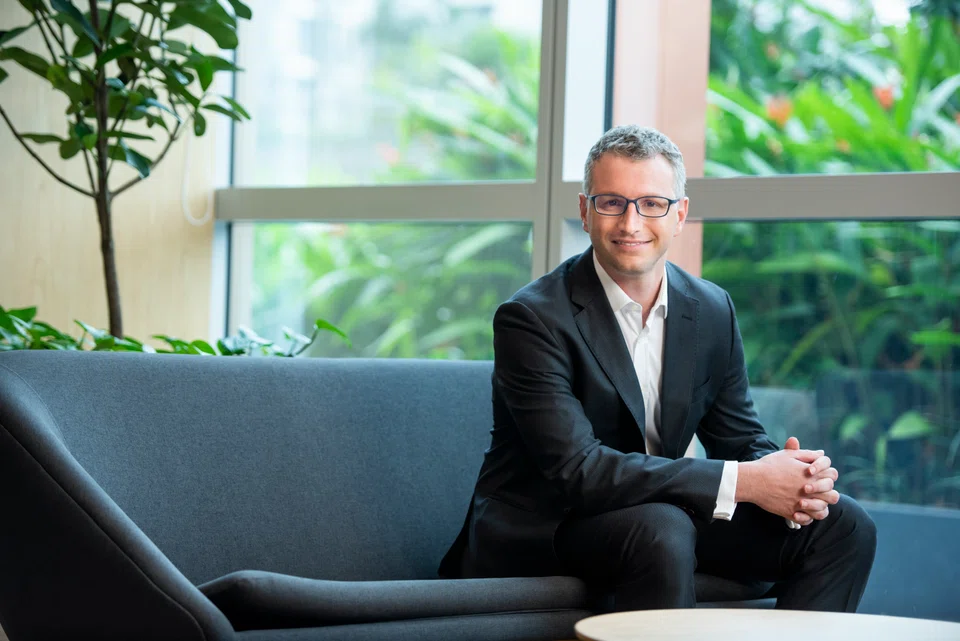
Justin Gabbani, Asia CEO of Lendlease Group, eyes opportunities to deploy partnered funds for data centres and life science builds

Elysia Tan
THE year 2023 was meant to be a special one for Lendlease Group, as the Australian Securities Exchange-listed construction and real estate company celebrates 50 years since it expanded its operations into Singapore. But the group has found little reason for cheer.
Lendlease reported a statutory loss after tax of A$232 million (S$201 million) for the full year ended June, deepening from a loss of A$99 million the year before.
This was mainly due to the recording of a A$295 million provision on a retrospective, industry-wide action by the United Kingdom government.
Core operating profit after tax stood at S$257 million for FY2023, down 7 per cent year on year.
Shares of Lendlease have slid 17.2 per cent in the year to date to close at A$6.49 on Friday (Oct 20)
Lendlease’s Asia chief executive officer (CEO) Justin Gabbani said the group intends to focus on its existing projects – rather than take on new ones – to maximise value in a post-Covid environment.
The group is also renewing its commitment to what it describes as an “investments-led strategy”. It targets for its investments segment’s funds under management to grow from A$48 billion in FY2023 to A$70 billion by FY2026.
Globally, the group has historically allocated 60 per cent of its total investment and development capital to development, while the remaining 40 per cent went to investments. But it is now looking to rebalance this to the inverse, with investments taking up 60 per cent, Gabbani said.
“In terms of the business in Asia, I’d say we’ve probably been an investment-led business already for some time,” he added.
Changing priorities
Gabbani pointed out that Lendlease has also increasingly shifted – in the last five to six years – from white-site developments to redevelopments.
He noted that three of Lendlease’s redevelopment projects in Singapore – Shaw Tower, Paya Lebar Green, and Singtel’s Comcentre headquarters – will all be green buildings. After all, this has become the general expectation for large multinationals, Gabbani said.
Also of increasing interest to Lendlease are data centres and life science-related builds, he said, noting that the group has invested capital to deploy into these subsectors in Asia-Pacific.
Last year, a data centre campus for Princeton Digital Group commenced construction in Japan, with the first phase of its development expected to complete in March 2024. It is the maiden project under a US$1 billion data centre partnership, which is 20 per cent funded by Lendlease and 80 per cent by a large institutional investor.
“We’re seeing a lot of demand in the Japanese market, particularly around Tokyo and Osaka, but also more recently in the Malaysian market, and we’re pursuing a number of opportunities in that market as well,” Gabbani said.
While Australia is also seen as “a hunting ground”, there has been relatively less demand, he added.
On the life sciences front, Gabbani said major pharmaceuticals and life sciences groups eye Singapore and China as the two main markets for biomedical lab facilities.
The Singapore story
Gabbani noted that Lendlease’s office properties in Singapore are “pretty much” at full occupancy and have posted “good amounts of reversion” in the past 18 months.
“In the markets in Asia, we’re not seeing necessarily this work-from-home phenomenon being a sort of long-term trend, with flexible working being more embraced in these markets,” said Gabbani.
The group is also sponsor of the Singapore-listed real estate investment trust (S-Reit) Lendlease Global Commercial Reit , which made its debut on the Singapore Exchange in 2019.
Under the Reit’s portfolio are two properties in Singapore – retail and office complex Jem in the Jurong Lake district, and prime retail mall 313@Somerset along Orchard Road – as well as Sky Complex in Milan, Italy, which comprises three Grade A office buildings.
In June this year, Lendlease Global Reit also acquired a 10 per cent stake in Parkway Parade Partnership (PPP) for S$90.5 million.
PPP holds an indirect 100 per cent interest in 291 strata lots in Parkway Parade – an integrated office and retail development in Marine Parade – which represent 77.09 per cent of the lots’ total share value.
“That’s not telegraphing that (the Reit is) suddenly going to buy the whole Parkway Parade tomorrow, but it’s a strategic stake,” said Gabbani, who is also chairman of the Reit’s manager.
The Reit will have the opportunity to increase its stake if investors in the partnership look to sell. This is unlikely in the short term, but might be something that “comes across” over the medium term, he added.
The focus has been consolidating and managing these properties, said Gabbani. “It’s about being very selective in the current environment.”
Citi Research in late August downgraded Lendlease Global Reit to “neutral” from “buy” and cut its target price by 21.8 per cent to S$0.61. This came amid rising concerns on the capital management front, as the Reit’s aggregate leverage ratio reached 40.6 per cent as at Jun 30, 2023.
Units of Lendlease Global Reit have tumbled 29.8 per cent year to date, closing at S$0.495 on Oct 20.
Gabbani acknowledged that most Reits are likely coming to the end of their hedging periods and are starting to see upticks in interest and borrowing costs, which impact their distributions per unit (DPUs)
For the FY2023 ended June, Lendlease Global Reit’s DPU dipped 3.2 per cent to S$0.047, despite both its gross revenue and net property income more than doubling to S$204.9 million and S$153.9 million, respectively.
“(But) I think we’re probably at the peak of the interest rate cycle,” Gabbani said. As an indicator, he referenced fixed home-loan rates, which have been “falling for the last three to four months”.
“When we were at the bottom of the cycle, everyone talked about lower for longer. Now everyone’s talking about higher for longer. So it’s probably going to be somewhere in the middle.”
TRENDING NOW

Singapore government slaps loan curbs on individual private-hire car buyers

If Europe goes to war, the fallout will be felt in East Asia
The grid is the transition: Why Asean’s next energy challenge is coordination

Indonesia stocks suffer worst plunge in nearly 30 years as MSCI proposes standalone status

