LHN taps trends in e-commerce and sharing economy
Its strategy of revamping unused, under-utilised spaces to suit emerging industry trends has proven valuable during the pandemic.

Singapore
LHN Group's strategy of revamping unused and under-utilised spaces to suit emerging industry trends has proven valuable, after the pandemic triggered a rush towards e-commerce and bumped up demand for its co-living spaces.
Five years ago, the company did a strategic review of its business and began shifting away from traditional self-storage - typically catering to those storing personal items - to target merchants operating online instead. It came as Singapore's government was increasingly pushing for e-commerce to take off.
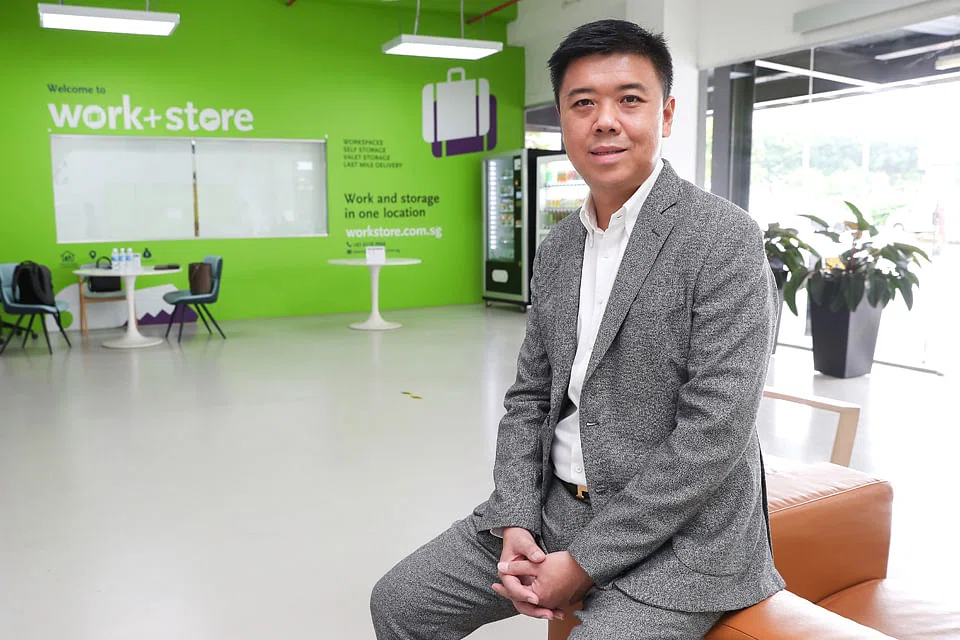
Today, the group operates nine properties in Singapore under its Work+Store brand. They house storage units as small as 50 square feet (sq ft), with flexible workspaces for business owners.
As Covid-19 pushed consumers to shop more online, the average occupancy rate rose from 84.1 per cent as at Dec 30, 2019, to 91.6 per cent as at Sept 30, 2020.
"During the circuit breaker last year, we realised that the whole of Singapore was quiet. But our customers who are e-businesses were busy fulfilling their orders for last-mile delivery," said Kelvin Lim, chairman and managing director of LHN.
The pandemic also aided its co-living segment, which is profitable.
LHN's largest co-living property at 31 Boon Lay Drive had healthy demand from non-construction foreign workers who had to move out of dormitories due to the high number of Covid-19 cases. Occupancy across the 437 units rose from 91 per cent as at Dec 31, 2019 to 95.6 per cent as at Sept 30, 2020.
Mr Lim said other co-living properties at the fringes of the Central Business District attracted interest from white-collar workers and expatriates who wanted to downsize from their studio apartments in the city.
LHN's 150-unit property on 150 Cantonment Road is managed by startup Hmlet, while its 62-unit co-living premises at 10 Raeburn Park is managed by International Service Apartments.
A 117-unit co-living property at Lutheran Road is managed directly by the group, and caters primarily to students.
LHN's bottom line has improved in recent years. Over the last four years, its net profit has increased by a compounded annual rate of 80.1 per cent to S$24.2 million in FY2020 ended September.
The group has three main business arms: the core business of leasing out industrial, residential and commercial properties (which LHN describes as space optimisation); facilities management; and logistics services.
Height of the outbreak
Revenue from the facilities management business almost doubled to S$39.6 million in FY20, thanks to a S$22.8 million increase in management services provided for workers' dormitories.
At the height of the Covid-19 outbreak among migrant workers last year, LHN secured contracts to convert spaces into workers' dormitories and to manage them. This also generated S$16.1 million in revenue from residential properties under the space optimisation arm.
These contracts, however, last only between six and 12 months. Income from managing dormitories is already beginning to taper off, said Mr Lim.
LHN will now focus on revamping spaces to cater to e-commerce, co-living and flexible workspaces.
Up to 70 per cent of the space in LHN's Work+Store facilities is taken up by e-commerce retailers, most with a turnover of below S$1 million.
A typical lease lasts six to 12 months, and the average renewal rate is 80 per cent. LHN is looking for tenants with longer lease terms.
"Our unit sizes are suitable for startups; and when our customers expand their business, we are also able to offer them a bigger unit under our traditional leasing space," said Mr Lim.
It certainly helps that LHN is clued into the latest e-commerce trends. Its largest Work+Store facility, located in Ang Mo Kio, has photography studios, a live-streaming area, meeting rooms and a customer lounge.
In February 2020, the group acquired the former Hyflux Building at Kallang Bahru through a joint venture with Oxley's deputy chief executive Eric Low. When the new facility commences operations in April, it will be supported by an automated retrieval system and a dedicated last-mile logistics team supplied by LHN.
New ventures
Though the group has expanded into new territory in recent years, Mr Lim said the bulk of its revenue in the industrial segment still comes from traditional leasing.
LHN was originally in the sawmill and timber trading business. In 1991, when production declined, then-chairman Lim Hean Nerng - Mr Lim's father - began leasing out excess warehouse space in the family-owned factory to tenants in the wood-working business. This was later expanded to include other tenants.
In the last five years, the group has shifted away from tenants in labour-intensive trades towards companies in trading and services.
"As you know, the government is trying to cut down reliance on foreign labour. So we skewed ourselves away from those tenants with a heavy reliance on that," Mr Lim said.
LHN boasts an asset-light model: About 80 per cent of its properties by area is master leased, and about 20 per cent is owned. This, the company said, gives it flexibility to exit projects that are a drag on the business.
Last year, for instance, it decided not to renew a large lease area in Tuas (10 to 40 Tuas South Street 1) that catered mainly to engineering and construction tenants.
Instead, the group will double down on new areas of growth. Last November, it established a joint venture with Mr Low's sister to acquire Amber Hotel property in Katong.
The intention is to fit the property out as a co-living cum hotel space, with personal rooms, communal spaces and amenities. It will be open for stays as short as one day, unlike co-living serviced apartments which have a minimum occupancy period of seven days.
Clear market need
In February, LHN will commence operations at a mixed-use development at 1557 Keppel Road. The three blocks spanning 96,299 sq ft will be used as offices and co-living units.
There is a clear market need for integrating co-working with co-living, Mr Lim said, and the group intends to develop more spaces to fit.
LHN had a gearing ratio of 21.6 per cent as at end-September. Though the group needs to lever up as it expands, Mr Lim said it will take a very cautious approach based on its cashflow position.
"(As a rule of thumb), for leasehold properties, non-gearing yield should be at least 12 per cent. And for freehold properties, at least 6-8 per cent," he said.
"The pandemic has brought about changes in the way we live, so we are watching very closely for what is going to blow up in the market. And when we see opportunity, we will be the first runner to create new concepts to suit businesses and individuals."
Shares of LHN closed last Friday at 19.2 Singapore cents, giving it a market cap of S$77.3 million. The stock trades at 3.2 times earnings and at 63.5 per cent of its book value.