LSEG’s diversified business model drives resilience

Raphael Lim
WHEN the London Stock Exchange Group (LSEG) announced its plans to buy data service provider Refinitiv in August 2019, the world was a very different place.
Yet, the Covid-19 pandemic, shifts in global monetary policy as well as geopolitical tensions in Europe have not held the group back from delivering on targets set when the acquisition was made.
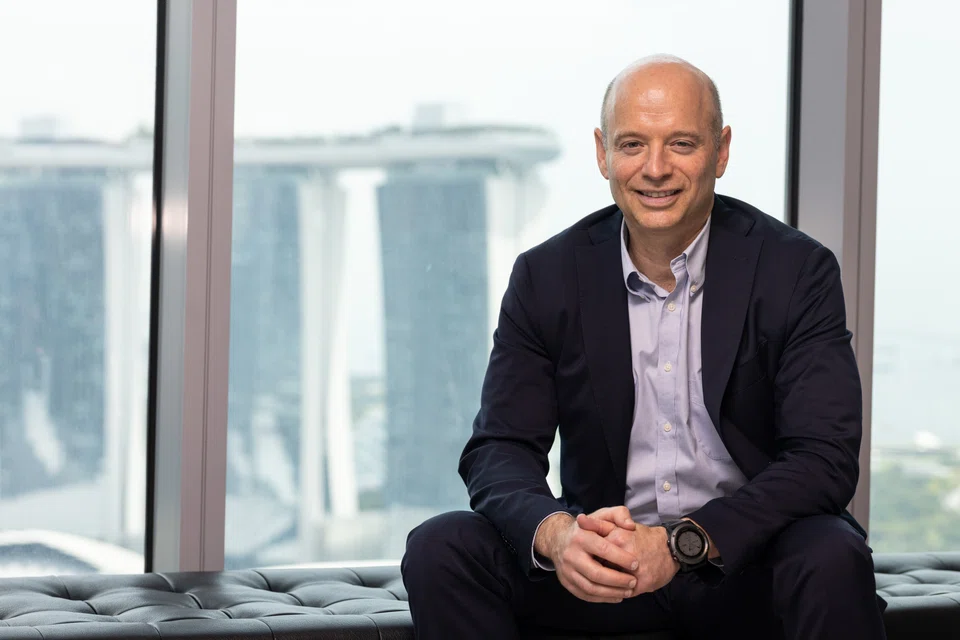
LSEG’s chief executive David Schwimmer believes this can be traced to the resilience of the company’s diversified business model.
“We are diversified by product, by currency, by region, by customer; so from that perspective, we’re very well positioned to navigate an environment like this,” said Schwimmer in an interview with The Business Times.
Periods of uncertainty and volatility also mean customers may need certain aspects of LSEG’s business and offerings even more, he added.
“The data and analytics that we offer, and the access to liquidity, and the access to risk management, become, if anything, more important for our customers,” he said.
Shares of the London-listed financial markets infrastructure and data provider have risen around 19 per cent year to date, on the back of higher total income and gross profits in the first nine months of 2022, closing at GBX 8,272 on Dec 2.
The company also announced a £750 million (S$1.2 billion) share buyback in August.
Analysts have been generally positive on the stock, with 15 buys, three holds and one sell rating, according to Bloomberg data as of Nov 30.
Transformational deal
Schwimmer – a former Goldman Sachs banker – took the helm at LSEG in 2018. The US$27 billion Refinitiv acquisition was announced around a year later. An all-share acquisition from a Blackstone consortium, it closed in 2021.
LSEG had to fight off some competition. Around the time when the proposed acquisition of Refinitiv was announced, Hong Kong Exchanges and Clearing (HKEX) also made an offer for LSEG and asked LSEG to step away from the Refinitiv deal. But LSEG’s board quickly turned that down.
The Refinitiv deal has significantly altered the company’s make-up. Prior to the acquisition, while LSEG had a presence in Asia and America, its focus was largely in Europe.
Schwimmer said: “We knew we wanted to make LSEG more global, have capabilities across more asset classes, and have leadership in data and analytics.”
The data and analytics business now accounts for around two-thirds of total income, from less than half before the acquisition.
“Access to data, the ability to manage and distribute data, is just as important an element of market infrastructure as is access to an exchange, or an over-the-counter trading platform, or a clearinghouse,” said Schwimmer.
LSEG’s approach has been focused on building capabilities across the trade life-cycle, data, analytics and information services, he added.
“That was all intentional: to create a very diverse business that benefits from incremental volatility in the markets, but is not overly dependent on transaction volumes.”
Around 70 per cent of the group’s revenue is recurring, from long-term subscriptions, and that number is “stable and growing”.
Rising uncertainties
When the Refinitiv acquisition was first announced in 2019, the group targeted to deliver a compounded annual revenue growth of 5-7 per cent over the first three years after completion.
The company is on track to hit that goal, but economic conditions are also growing more difficult.
Over 80 per cent of LSEG’s revenue in the first half of 2022 came from Europe, the United Kingdom and the United States – regions where there have been concerns over potential recessions.
Schwimmer, however, is “very confident” of hitting the mark.
He noted that around 15 per cent of revenue comes from Asia, which is a growing market.
Meanwhile, the banks, which are doing well in the rising interest rate environment, are a big customer segment for LSEG.
“It’s important to keep in perspective that for a lot of our customers, it has been very difficult for many, many years. And it’s now actually gotten a little bit easier because of the interest rate environment,” he said.
Even as rates rise, he also remains comfortable with the company’s leverage targets given its diversified revenue streams, high operating margin, and strong cash generation.
“When the transaction closed, our leverage was a little over 3.5 times net debt to Ebitda (earnings before interest, taxes, depreciation and amortisation). We have now brought it down to less than two times, which is within our target range of one to two times,” Schwimmer said.
“We’ve shown in the past that if we take it up meaningfully to do an acquisition, we can bring it down quickly.”
The rising interest rate environment and volatile market conditions have also meant that initial public offering activity worldwide has been subdued in 2022, and LSEG’s London Stock Exchange business has not been spared.
“There is a healthy pipeline of companies that would like to access the public markets, raise capital, but will sort of wait for calmer times,” Schwimmer said, but he noted that the London Stock Exchange is now less than 5 per cent of LSEG’s revenues.
Room for more deals?
Schwimmer said the company would continue to look for opportunities that make sense strategically and financially.
“We’re taking strategic capabilities and plugging those capabilities from the companies that we acquire into our global network … so we can take some fairly small acquisitions, and plug them into our global business and get a lot of additional opportunity from them,” he said
Over the past year, the group has also made four different acquisitions – three in data and analytics, and one in post-trade.
When asked if the company would consider growth by partnering or acquiring other exchanges, Schwimmer noted that recent history demonstrates such transactions are very hard to do.
“The economies of scale benefits from doing exchange transactions are real,” he said. “But the politics and some of the nationalistic challenges associated with exchanges make cross-border exchange activity pretty challenging and pretty unlikely.”
He added: “That is not our strategic direction, we have plenty of opportunities to grow the different parts of our business without that.”
No large-scale merger or acquisition is planned for now, as LSEG remains focused on the integration of Refinitiv.
“We said it would be a five-year integration; so, we’re two years or so into that now, making great progress,” Schwimmer said. “We’ve got our integration, we’ve got a number of different transformation programmes that we’re driving internally, and so we’re just focused on executing.”