

Luxury sales plunge in China as tax push hits rich shoppers
Sales at the 25 biggest luxury labels in China dropped more than 10% in July
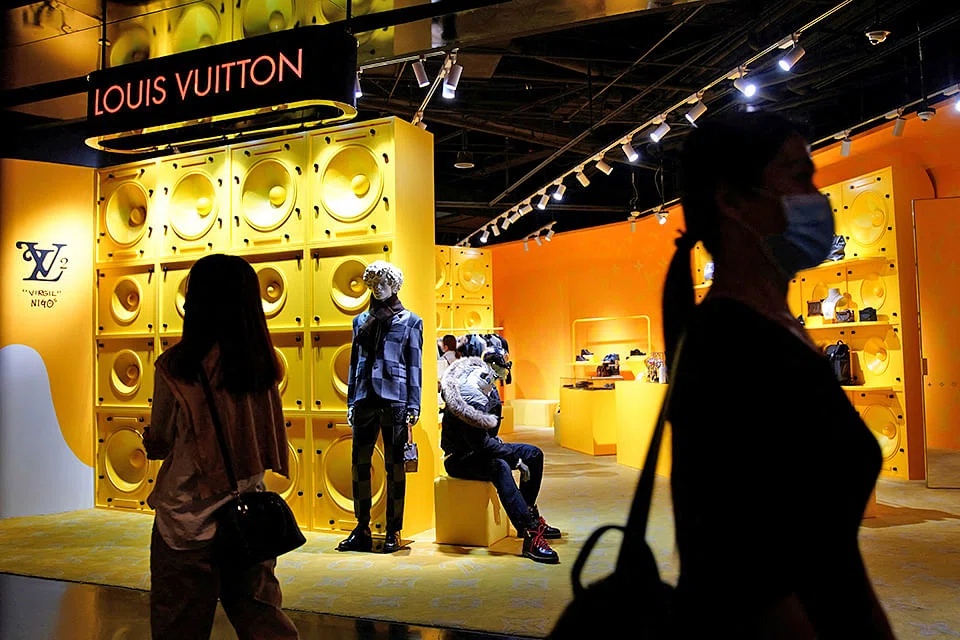
[BEIJING] Global luxury brands are facing a deepening sales slump in China, as the country’s campaign to tax offshore wealth sends ripples from stock markets to casino floors and dampens spending by the country’s richest consumers.
Sales at the 25 biggest luxury labels in China dropped more than 10 per cent in July, according to three research firms surveyed by Bloomberg that track industry data. That’s worse than the slowdown witnessed in June, and marks a sharp reversal from the brisk business seen earlier this year.
LVMH’s Louis Vuitton and Dior, as well as Kering’s Gucci, Bottega Veneta and Balenciaga all recorded double-digit sales drops, while Hermès swung from gains to declines, the people said. Growth for Chanel and Prada also decelerated significantly, the firms said.
For global luxury giants, the declines add uncertainty to the outlook in one of their most important markets. China was once the engine of decades of luxury growth, but competition for the wealthiest shoppers has intensified and middle-class consumers have cut back on their spending amid the country’s economic downturn.
The slump coincides with China’s sweeping efforts to stem capital outflows and reclaim tax revenues, including tighter controls on cross-border stock trading and demands for citizens to pay billions of dollars in levies on offshore assets and investment gains. The measures have dampened the spending appetite of wealthy Chinese, threatening to unravel a luxury recovery that began less than a year ago on the back of an AI-fuelled stock market boom.
“Operators are beginning to report more caution among their VIP clients against the waning wealth effect and a tighter tax environment for high-income consumers,” said Jacques Roizen, co-founder of Shanghai-based consultancy Foresight Performance Partners. “There’s legitimate concern among luxury executives when looking at July’s performance.”
LVMH, Kering, Hermès, Chanel and Prada didn’t immediately respond to requests for comment.
China’s new measures amount to the biggest shake-up of its cross-border financial system in a decade, further restricting channels long used by affluent households to preserve and diversify their wealth. The clampdown has contributed to erasing last year’s 28.3 per cent rally in the MSCI China Index, which is down 8.9 per cent this year – one of the worst performers among major global markets. Hong Kong’s Hang Seng Index has also lost steam after strong gains in 2025.
Shares of LVMH were down 1 per cent, while Kering and Hermès were both trading about 0.6 per cent lower in Paris on Thursday (Aug 20).

The market downturn has further eroded consumer confidence. With property values depressed, wealthy Chinese have increasingly shifted their money into stocks and other financial assets, making them more sensitive to market swings. In gambling hub Macau, casinos reported steeper-than-expected revenue declines in June and July, with high-rollers betting less and visiting less frequently.
“We observe some correlation between the capital market performance and luxury sales in the last two years,” said Robert Wu, CEO of Shanghai-based market data and research firm Baiguan. “In the past, such correlation was less obvious because a lot of wealth was stored in real estate.”
Stella Lin, a 37-year-old financial product salesperson in Shanghai, said the downturn has been enough to halt discretionary spending. The value of her stock portfolio – accounting for more than half of her invested capital – has plunged, and she hasn’t bought any luxury goods in recent months. Previously, she splurged during summer holidays, attending VIP events and buying designer handbags and clothes.
“I’m already in a money-losing mood,” said Lin, who used to spend at least US$15,000 a year on luxury products. “I haven’t felt like shopping in any fancy stores in the past two months. When to spend again? You need to ask when the stock market can improve.”
Caution from clients like Lin adds to a gloomy outlook for China’s consumer sector. Retail sales growth slowed to 0.6 per cent last month, while big-ticket items including jewellery and cars were among the worst hit, with sales plunging more than 10 per cent.
Billionaire Bernard Arnault’s LVMH is also dealing with the fallout of a trademark dispute with local beverage company Molly Tea. While Louis Vuitton won the trademark infringement case involving its signature four-petal floral motif, the episode sparked a social media backlash, with accusations of cultural appropriation going viral.
To be sure, luxury brands also faced extreme heat, heavy rainfall and a surge in outbound travels during the July summer holidays, which contributed to weaker foot traffic and sales.
August will be a crucial test of consumer confidence, with the Chinese Valentine’s Day – typically one of the country’s strongest luxury shopping occasions – falling this week, said Roizen of Foresight Performance Partners.
“If brands cannot produce positive growth even with that tailwind, I would regard that as a strong evidence of a genuine slowdown,” he said. BLOOMBERG
Decoding Asia newsletter: your guide to navigating Asia in a new global order. Sign up here to get Decoding Asia newsletter. Delivered to your inbox. Free.
Share with us your feedback on BT's products and services
TRENDING NOW

Government to bring forward raising of retirement age, give employers more financial support to create flexi-load jobs
If Europe goes to war, the fallout will be felt in East Asia

Indonesia stocks suffer worst plunge in nearly 30 years as MSCI proposes standalone status

Vietnam’s northern provinces, not Hanoi or Ho Chi Minh City, are powering near 10% GDP growth

