Making visual search a fashionable way to look for products
Online visual and image recognition search "better, faster and more efficient than using keywords", says ViSenze
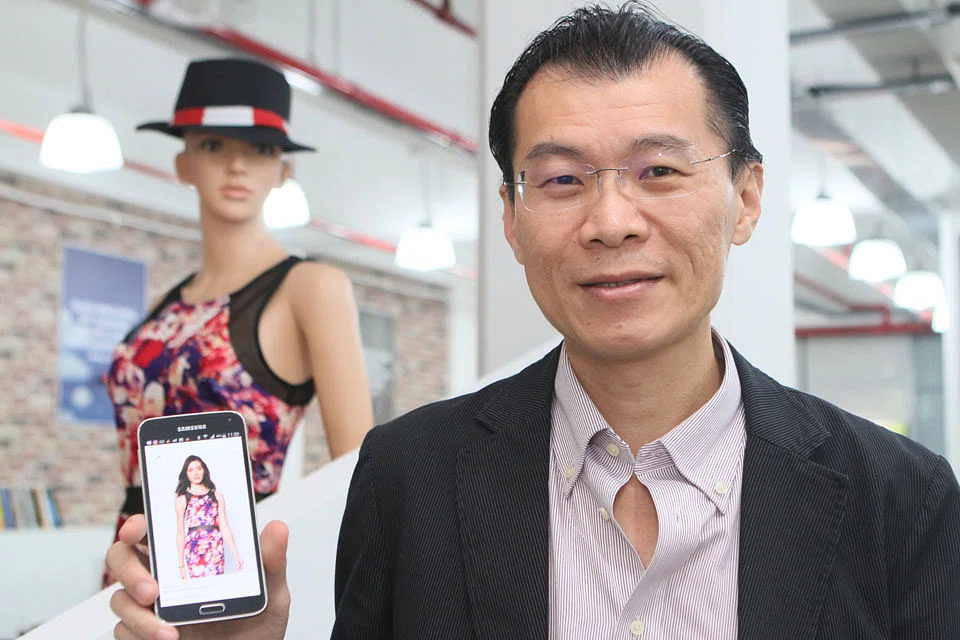
HER World, Cosmopolitan and Style may not be typical reading material for a middle-aged man, but they are for 47-year-old Oliver Tan. The chief executive officer and co-founder of ViSenze probably knows more about fashion than the average woman. Halter dresses, shift skirts, open tiptoes, wedges - Mr Tan knows them all.
And he has to, because he is running a company specialising in visual search and image recognition, a technology that ViSenze started out applying in fashion e-commerce. A three-year-old spin-off from the National University of Singapore, ViSenze's visual technology was "a solution looking for a problem", said Mr Tan.
The problem did not arise until the scientists, also co-founders, met up with Mr Tan and Roger Yuen, chairman and co-founder. Mr Yuen is also chief executive officer and founder of fashion social network Clozette. "We're the problem guys," said Mr Tan. And by that he means that they knew how to make use of the technology.
Referring to a sleeveless floral-print dress on a nearby mannequin, Mr Tan asks: "If you wanted to buy this dress online, how would you describe it?" As this reporter struggles to find the right words, he whips out his smartphone and takes a picture of the dress. In an instant, his screen is filled with images of similar-looking dresses.
Herein lies the problem. People are searching for fashion outfits and products but not "guessing it correctly", said Mr Tan. Keywords are either wrong or image tags too vague, such that keyword searches will likely end in hundreds of results that will take too long to browse. "No online shopper has that patience," he said.
Today's online shoppers want things immediately. "Show it to me right now, or show me something similar," said Mr Tan, adding that if online retailers fail to do that, shoppers will lose patience and not return. Thus, ViSenze set out wanting to bring the in-store shopping experience online, and help shoppers find products "better, faster and more efficiently than using keywords".
With its technology, shoppers can upload photos of products to find something similar within seconds, or they are given similar product suggestions as they browse. ViSenze first tested this on Clozette in early 2013 for about a year to get user feedback. During that time, Mr Tan found himself having to understand foreign fashion concepts. "We're scientists, not fashionistas," he said. But determined scientists they were.
So although it was "not natural" for men to be learning women's fashion, Mr Tan started reading fashion magazines and brochures. He also visited many fashion sites like FashionTV to get more information, and because "it is very strange for men to buy women's magazines".
Besides learning these concepts, the founders, being the first here to use visual search in e-commerce, faced scepticism from local firms who wanted to see a track record. They thus looked overseas for partners.
Rakuten Taiwan took a liking to the technology and became the company's first major client. Mr Tan said they were experimental, something Singapore companies generally lack. "The affinity to experiment with it, learn something out of it. If it doesn't work, it doesn't work. But at least you try it, experiment with it, if it works, you're the first in the market to claim innovation."
ViSenze went on to work with several big names in e-commerce, such as Zalora and India's e-commerce giant Flipkart. The company's revenue trebled last year, and is set to grow 10-fold this year. While its Application Programming Interfaces are publicly available on a subscription basis, ViSenze operates mainly business-to-business.
The company focuses on bringing its technology to industries where it "makes the most sense", areas such as fashion, lifestyle, home decor and accessories, where consumers base buying decisions on visuals. "Where we operate best is where keyword description has limited capability to describe it, and people are looking for it visually," said Mr Tan.
For example, ViSenze created a visual search app for interior furnishing company Goodrich Global that drastically cut product search and customer response times. It also introduced visual search for schematic drawings on patent platform PatSnap. There are thus varied applications like product packaging, artwork and possibly diseased skin conditions.
ViSenze's ability to adapt quickly and at scale to different verticals and use cases enables it to stay ahead of the competition, said Mr Tan. Its technological strength, which can process millions of images and respond to queries instantly, helps achieve this. Research and development thus remains a core of the company.
Developing next generation products allows ViSenze to build "defensible, competitive advantages" that are hard for others to follow, said Mr Tan. The company is moving into image recognition for both photos and videos, where machines can describe images. They capture product attributes such as the length of a dress or colour of a car, and generate them as tags.
Understanding what an image contains "illuminates visual content" for publishers, enabling them to monetise it by showing contextually-relevant advertisements, said Mr Tan. In e-commerce, search filters can be created from extracted product attributes to streamline results. Image recognition can also be used to look up information on things people come across. ViSenze is currently piloting this in areas such as library content, animals, landmarks and even wine labels.
Though there are many applications for its technology, the company wants to use it to add value or solve real-world problems. "I don't want our visual search or image recognition to be used as a toy, or as a gimmick," said Mr Tan. Thus even with technological strengths, ViSenze takes effort to understand clients' use cases, and the problems they need to solve.
And for every new area it ventures into, both machines and people are involved in learning. The team has to first understand what visual attributes are important to clients before teaching the machines to detect them. "Understanding all of these attributes allows us to hone and tune our algorithms to return sharper and better results that matches the buying behaviour of real-world users," said Mr Tan.
This need to internalise domain knowledge has brought him from understanding women's fashion to understanding watches, jewellery and even saris. While working with Flipkart, Mr Tan recalls speaking with Indian friends and dropping by Little India on weekends to learn how people buy saris. It is not always easy, but it is this deep knowledge that allows ViSenze to be ahead of the curve.