

Malaysia Smelting mining its own business
World's third-largest refined tin maker in bold experiment to convert lead smelting facility as it plans to increase its own smelter input.

Anita Gabriel
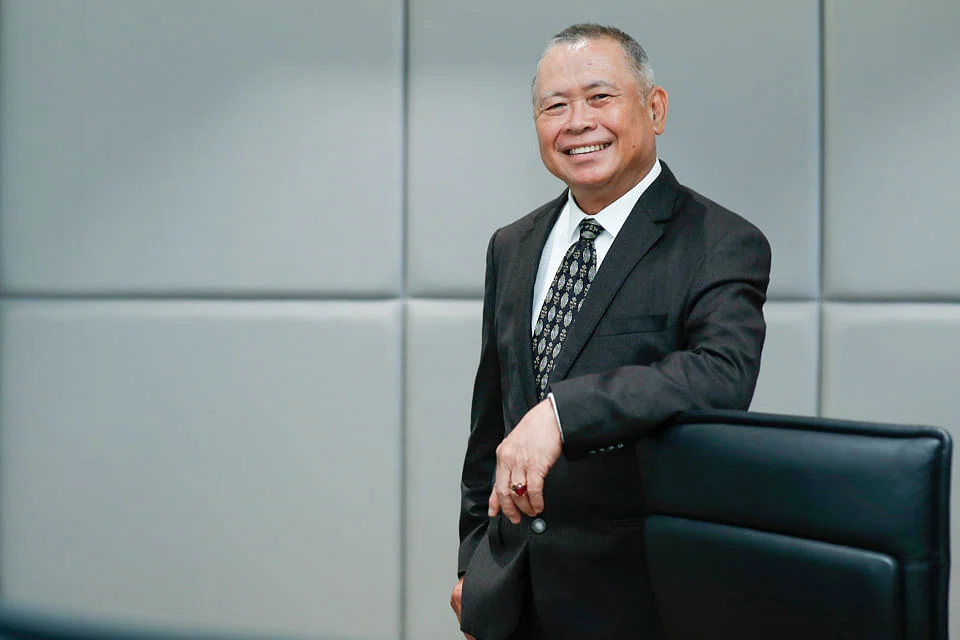
IN Pulau Indah, a once-sleepy fisherman island turned industrial estate in Malaysia's Klang district where the country's largest and busiest port resides, a bold experiment for the multi-generational tin business is shaping up - to convert a lead smelting facility into a tin smelter.
"We are the only joker in the world to do this. The world is watching us," says Patrick Yong, chief executive of the world's third-largest refined tin maker Malaysia Smelting Corp (MSC), as he laughs, not nervously, but with unmistakable audacity.
If the state-of-the-art plant in Port Klang - a big leap from MSC's sole existing "archaic" facility in Butterworth, Penang - lives up to its promise to cut not only cost, but dust emission and off-gases, and lift capacity by over 50 per cent, it will be a master stroke for Mr Yong, an electrical engineer by profession who was a consultant to MSC before he took over the helm of the tin titan in October 2016.
The new facility, which was acquired back in mid-2016 for RM50 million (S$17 million) and boasts a furnace with the world's one-of-a-kind technology, is set to be test fired by year-end but can only really start smelting in 2019's second half which is when it is expected to get the green light from Malaysia's environmental agency.
"It's a huge game changer . . . and engineering challenge which no one else dares to play," enthuses Mr Yong, 65, who succeeded MSC's long-serving former chief Chua Cheong Yong amid a leadership renewal of sorts at the firm which is 54.8 per cent owned by one of Singapore's oldest firms, The Straits Trading Company.
Listed in Malaysia back in 1994 and 17 years later also in Singapore, MSC is the world's largest custom tin smelter, having produced 27,172 tonnes of tin metal in 2017 at its Butterworth plant that has long been overdue for an upgrade. That was further necessitated by MSC being shooed away from the location by the environmental body for being a nuisance to residents there.
"It was a matter of time before we had to vacate. So, we took the chance to upgrade our equipment," Mr Yong admits.
Straddling the old and new
"The Butterworth plant is very archaic. Their furnaces are like giant pizza ovens. It's very inefficient to operate and maintain but it works, so we are still using them," he adds.
It's not as bad as it sounds. The old plant that converts ore into pure tin metal of various grades that are registered at the London Metal Exchange (LME) and Kuala Lumpur Tin Market (KLTM) is in fact one of the most low-cost smelting plants in the world.
Yet, its old age has been a bane with the smelting business losing money in 2017 owing to high costs; so, the plan to phase out production there and move to the new facility has a sense of urgency.
"We don't have to do things like the Flintstones used to do , as everything is (going to be) pretty fast," he remarks.
But it can't be rushed.
"Until we are very safe and feel things are within control, then only will we shut down Butterworth. We can't afford to shut one down and say we are ready and find that we are not. Till then, both plans will run in parallel," he says.
No doubt, the wait is worth the while. The new furnace not only packs a better punch for efficiency and requires a lot less physical footprint, it will also require half the manpower of 550 currently employed in Butterworth; the smelting process is cleaner (reduced carbon footprint) as the furnace is fuelled by natural gas and if Mr Yong has his way, there will also be room for solar and waste heat.
"Unfortunately, our 'green tin' will not earn any carbon credits in Malaysia but when that comes to play, it will be a positive. Until then, it's about goodwill benefits when we export to countries like Europe . . . these guys are tree huggers," he remarked.
Steely prices
The price of tin - the metal is used in almost everything from smartphones to cars and food packaging to solar cells - has been "steely" lately. Two years ago, the average tin price stood at US$17,900 a tonne and before that in 2015, at US$16,050/tonne. Last year, it climbed to US$20,036 and has been holding up a tad higher so far this year.
But the impact has been negligible on MSC's latest first quarter ended March 2018 as it's been offset by a stronger ringgit against the greenback with net profit falling 64 per cent to RM4.6 million as revenue fell 12 per cent to RM357 million.
That's not enough to take all the shine off 2017 which was a good year for both MSC and Mr Yong as it marked the firm's second straight year of profits - its first in a decade - thanks in large part to meticulous cost cutting and the exit from unviable investments abroad including Indonesia and Africa.
Even so, net profit for the full year more than halved, weighed down by losses in the smelting business and this somewhat offset the impact of higher tin price that buoyed the mining division.
He expects the tin price to go "northwards". By that, he predicts that the price could climb to US$25,000 next year which he describes as a "moderate, middle ground, Buddhist path" versus the super-bullish expectations that prices could scale US$30,000-US$40,000/tonne.
"It's very simple. This is one of the few nonferrous metals that are hardly recycled," he explains. Fanning further hope of the metal price clicking higher is the pace of new applications being developed in the semiconductor and battery markets. Fuelling more hope is tin's rising usage in energy-related technologies, chiefly lithium-ion batteries.
Mining its own
The bulk, or 95 per cent, of MSC's smelter input or tin ore comes from customers while the remaining comes from Rahman Hydraulic Tin - its own mine in Perak, a Malaysian state with a rich mining history and the country's oldest and largest tin mine.
MSC has another mine-in-the-offing in Pahang where mining activities, according to Mr Yong, is expected to take place soon and it is scouring more places with three other spots identified for possible exploration activities to guard itself against highly volatile tin prices.
His target is for MSC to provide some 30 per cent of its own smelter input. "It's much better to be an integrated tin player than just being a miner or a smelter. You don't need to cry quietly in the corner when tin prices fall but can decide which side of the hill to stand on when prices fluctuate," he says.
He adds: "The deposit in the peninsula is tremendous. Elsewhere, people are scavenging on tailings as demand for tin is so great. And here, we have tin on the ground waiting for us to mine."
That's not to say he's only got virgin mines on his mind. Mr Yong is also keen to see MSC extract more value by reworking its mine tailings - a far less costly exercise which could pay off handsomely given the robust demand for the tin tailings.
"Opening the mines will take five years. But we can do the tailings right now...all I need is to find space (for a concentration plant)," says Mr Yong.
With that, it is easy to see where the heart of this "tin man" is likely to be over the next five years.
TRENDING NOW
Philippine power giant First Gen rebuffs foreign offers, plans up to US$2.6 billion in expansion

Once staunchly pro-China, Malaysian Chinese businesses are now distancing themselves from Beijing

Nearly half of Singapore workers put in at least six unpaid hours a week: survey
Vietnam’s data-centre investment rush faces reality check on power and site constraints

