Malaysia's rubber glove boom spotlights longtime labour standards issues
Workers of some glove-makers speak of cramped, unclean living conditions, but the firms say working and living conditions are in line with government regulations

Singapore
WHILE Top Glove has repeatedly made headlines for allegations of forced labour and poor working conditions at its facilities, other Malaysian glove manufacturers are apparently no better.
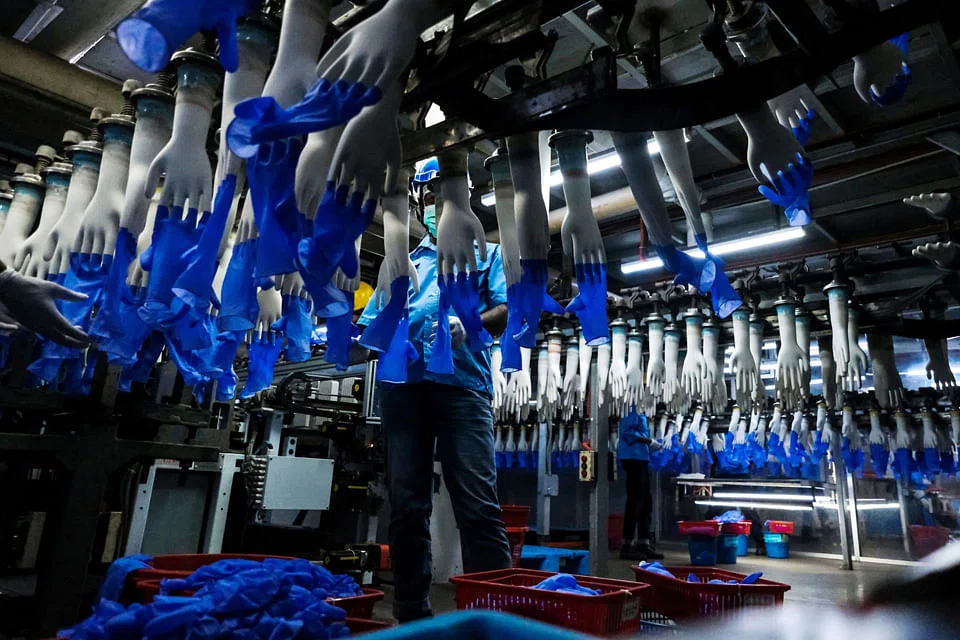
Employees of Hartalega and Kossan Rubber Industries, whom The Business Times recently contacted, offered accounts of gruelling 12-hour workdays (including overtime) and startling stories of vermin-infested communal living facilities.
One common theme was the cramped and uncomfortable living conditions, with as many as 40 people occupying a dormitory room. One worker complained that 20 people were made to share just two toilets and two showers. A former employee recalled that 30 people shared three toilets and three showers.
"It was hell for me, and that's why I left the company," he said.
Another worker from Bangladesh complained that he lived in a "small room" shared by 12 people. They had four toilets and two fans among them, he grumbled.
"It's not easy to ask the company to change something like having more fans because they may have rules. People are scared to talk about this, they fear that they could lose their jobs."
Yet, things might be about to change.
Companies like Top Glove, Hartalega and Kossan have been thrust into the limelight over the past year. With the onset of the Covid-19 pandemic, demand for personal protection equipment like rubber gloves has soared, fuelling a massive surge in profitability at these companies.
For its third fiscal quarter ended May, Top Glove - which is dual-listed on the Singapore and Malaysia markets - reported net profit of RM2.04 billion (S$660.9 million), almost six times the net profit of RM347.9 million in the corresponding quarter last year. Revenue for the quarter came in at RM4.16 billion from RM1.69 billion last year. This brought the company's earnings year-to-date to RM7.26 billion, up from RM575 million in the same period last year.
Hartalega and Kossan, which are both listed on Bursa Malaysia, also reported strong financial results.
Hartalega posted net profit of RM1.12 billion for Q4 FY21 ended March, up from RM114.4 million a year ago, due primarily to an increase in revenue to RM2.3 billion from RM778.2 million. This lifted the group's net profit for FY21 to RM2.89 billion, compared to profit of RM433.6 million in FY20.
Meanwhile Kossan reported net profit of RM1.04 billion for its first fiscal quarter ended March, up from RM64.8 million in the year-ago period. Revenue for the quarter rose to RM2.19 billion from RM611.5 million. The group said this quarter marked its " best-ever performance" on the back of an "unprecedented demand" for its glove products.
The higher market profile garnered by the rubber glove makers has come just as investors have become more concerned about the environmental, social and governance (ESG) aspects of the companies in their portfolios. And the expanded scale of their operations has made them larger targets for law enforcement agencies.
In July last year, the US Customs and Border Protection (CBP) issued a Withhold Release Order (WRO) against Top Glove on reasonable information that multiple forced labour indicators exist in the company's production process.
On March 29, disposable gloves manufactured in Malaysia by Top Glove arriving at all ports of entry in the US were seized under the CBP's direction.
Meanwhile, some institutional investors have expressed their disapproval in their own way. In January, BlackRock and Norges Bank Investment Management voted against the re-election of certain non-executive directors at Top Glove's annual general meeting (AGM).
BlackRock also warned that it would hold other incumbent directors who were not on ballot at the AGM accountable by voting against their re-election at future shareholder meetings.
In June, Top Glove was ousted from three ESG-related indices, namely the FTSE4Good Bursa Malaysia Index, Asean 5 and Emerging Markets Index. The company also announced that it had pushed back its listing in Hong Kong which was set to raise up to US$1 billion.
When asked if other Malaysian glove makers were under investigation, a CBP spokesperson said the organisation does not comment on whether specific entities are under investigation but it "continues to aggressively enforce federal law to prevent goods made by forced labour from entering the US".
The spokesperson added that the CBP is also investigating allegations of forced labour in a "variety of regions and industries".
In response to requests for comments from BT, both Hartalega and Kossan said they have taken the necessary steps to protect their employees, and that their working and living conditions are in line with government stipulated regulations.
A Hartalega spokesperson said the company takes the welfare of its workers "very seriously and would never compromise on this". The company also set out its efforts to improve the working and living conditions for its workers. For instance, the company said it has completed the installation of wall-mounted fans in more than 80 dormitories to date out of a total of 146.
"Our hostels meet the International Labour Organization's (ILO) Housing Standards, which stipulate sufficient space per person," said the spokesperson. "Hartalega has undertaken a clear and definitive strategy to ensure that we continue to enhance and improve on our social compliance journey, and our workers' accommodation is certainly part and parcel of this journey."
Kossan said it has policies and control measures pertaining to working conditions, and adheres to the Malaysian laws and regulations. The company added that it practises responsible recruitment with a "strict agency code of conduct" in place.
Detractors of the rubber glove sector are not convinced though.
Pauline Gothberg, national coordinator of the Swedish County Council Network on Sustainable Public Procurement, said the Malaysian glove industry has been on her office's radar for many years.
In a recent report by independent consultant Impactt Limited that was commissioned by Ms Gothberg's office, Hartalega, Top Glove and Kossan were audited and a number of issues were raised. These included wages, working hours and safety and hygiene in working areas.
Gloves manufactured in Malaysia arrive in Sweden through a network of suppliers and sub-suppliers. This makes it difficult for the country to use its influence as a customer to push for better labour standards in Malaysia.
"I think a big challenge is that our direct suppliers do not understand what is required of them," said Ms Gothberg.
If faults are detected along the way, government authorities in Sweden could sometimes impose sanctions on their direct suppliers. But these are unlikely to immediately improve conditions for workers in Malaysia.
"In a way, (the sanctions) cascade down through the supply chain, so this is not just a matter of sanctioning our Swedish suppliers because this would not help the workers in the factories," she added.
Nevertheless, the fact that companies like Top Glove have grown large enough to be noticed by global investors is a positive development. Ultimately, it will be forced to adopt better labour standards.
"Labour practices and ESG problems were never an issue many years ago as these companies faced no pressure from investors, buyers or the government to comply," said Andy Hall, a labour rights activist.
Indeed, even though Top Glove has come under regulatory and investor scrutiny recently, many smaller rubber glove manufacturers in Malaysia - like Supermax and YTY - are still "flying under the radar", he added.
Mr Hall said there is a discrepancy between what glove companies say and do, and a lack of sufficient "checks and balances" means that many companies in the industry are unlikely to have the relevant policies in place.
Beyond the glove manufacturers, Mr Hall warns of similar problems in industries such as palm oil and electronics. He is now calling for investors to do their necessary research before putting money into a company.
"In order to be effective, you need a trickle down approach," he said. "You have to harness the powers of investors and buyers, because they are the people responsible and they have to do better."