The rate cutting cycle: What does it mean for fixed income investors
Following the US Federal Reserve’s rate cut, M&G Investments highlights key considerations for bond investors, emphasising flexibility amid changing market conditions
Jassmin Vaanee Peter-Berntzen

Last September, the US Federal Reserve made a bold first move towards normalising monetary policy with a 50 basis point rate cut. After five years of significant challenges for fixed income investors who purchase bonds, this potentially marks a key turning point and signals that the global inflation surge may finally be easing.
For the Fed, this shift means the focus has moved further away from the 2 per cent inflation target and towards the labour markets and economic growth, where recent data has been weaker.
So, the question remains: will US economic growth stabilise at the current level of around 2-3 per cent, or does the normalisation of labour markets signal trouble ahead?
Says Mr Richard Woolnough, fund manager, M&G Investments: “While a soft landing is still very much possible, the combination of weaker economic growth and still-tight monetary policy – despite recent rate cuts – calls for a cautious investment approach.”
What does this mean for bond investors
With inflation nearing the Fed’s 2 per cent target, and the labour market stabilising, economic conditions are beginning to resemble pre-pandemic norms. In the US, job creation has slowed, and the ratio of job openings to unemployed workers has returned to levels seen between 2017 and 2019.
The changes in economic fundamentals have allowed the Fed to start easing its monetary policy. However, bond investors need to carefully evaluate how these macroeconomic shifts might affect their investment strategies.
According to Mr Woolnough, there are three key points to consider: inflation, high government debt levels and bonds.
Inflation – a persistent concern
After being low for most of the past decade, inflation surged in 2021, driven by post-Covid-19 reopenings and supply chain disruptions, and further worsened by the Russia-Ukraine crisis.
This is a stark reminder that inflation can quickly resurface when demand outpaces supply.
Says Mr Woolnough: “As the Fed begins cutting interest rates, inflation risks still persist. Central banks, having learnt from the inflationary pressures of the past few years, are likely to be more cautious going forward. They are likely to avoid keeping rates too low for too long or engage in large-scale quantitative easing.”
Bond investors, says Mr Woolnough, could benefit from keeping vigilant, as inflation may continue to be a challenge in the coming years. Interest rates could stay higher for longer. From an investment perspective, this would be an opportunity for bond investors, as higher rates would translate into higher levels of income over time. On the other hand, if inflation remains subdued, investors would therefore be able to benefit from superior risk adjusted returns in real terms, without having to take undue levels of credit risk.
In this economy, a flexible approach, such as the one adopted by M&G’s Optimal Income strategy, may be fitting. Designed to adapt to a wide range of market conditions, M&G’s Optimal Income strategy involves proactive adjustments to positions along the bond yield curve to stay responsive to changing market environments.
Navigating high government debt levels
In the pre-pandemic era of ultra-low interest rates, both public and private sectors were able to accumulate debt with minimal consequences. However, as interest rates have risen, the cost of servicing that debt has increased, placing pressure on governments and corporations alike.
In the US, for example, federal debt has increased from 104 per cent to 120 per cent of gross domestic product (GDP) over the last five years, and interest payments now account for a larger share of government revenues. This may limit fiscal flexibility and make it more difficult for governments to respond to economic challenges or invest in growth.
“For bond investors, understanding and assessing which governments and sectors can manage their debt burdens responsibly could be crucial for long-term success,” shares Mr Woolnough.
Bonds as a source of stability
Throughout recent market turbulence, bonds have continued to offer stability and consistency in otherwise volatile market conditions.
“Despite both bonds and equities delivering negative returns in 2022 due to aggressive rate hikes, high-quality government and corporate bonds have remained a reliable source of diversification,” says Mr Woolnough.
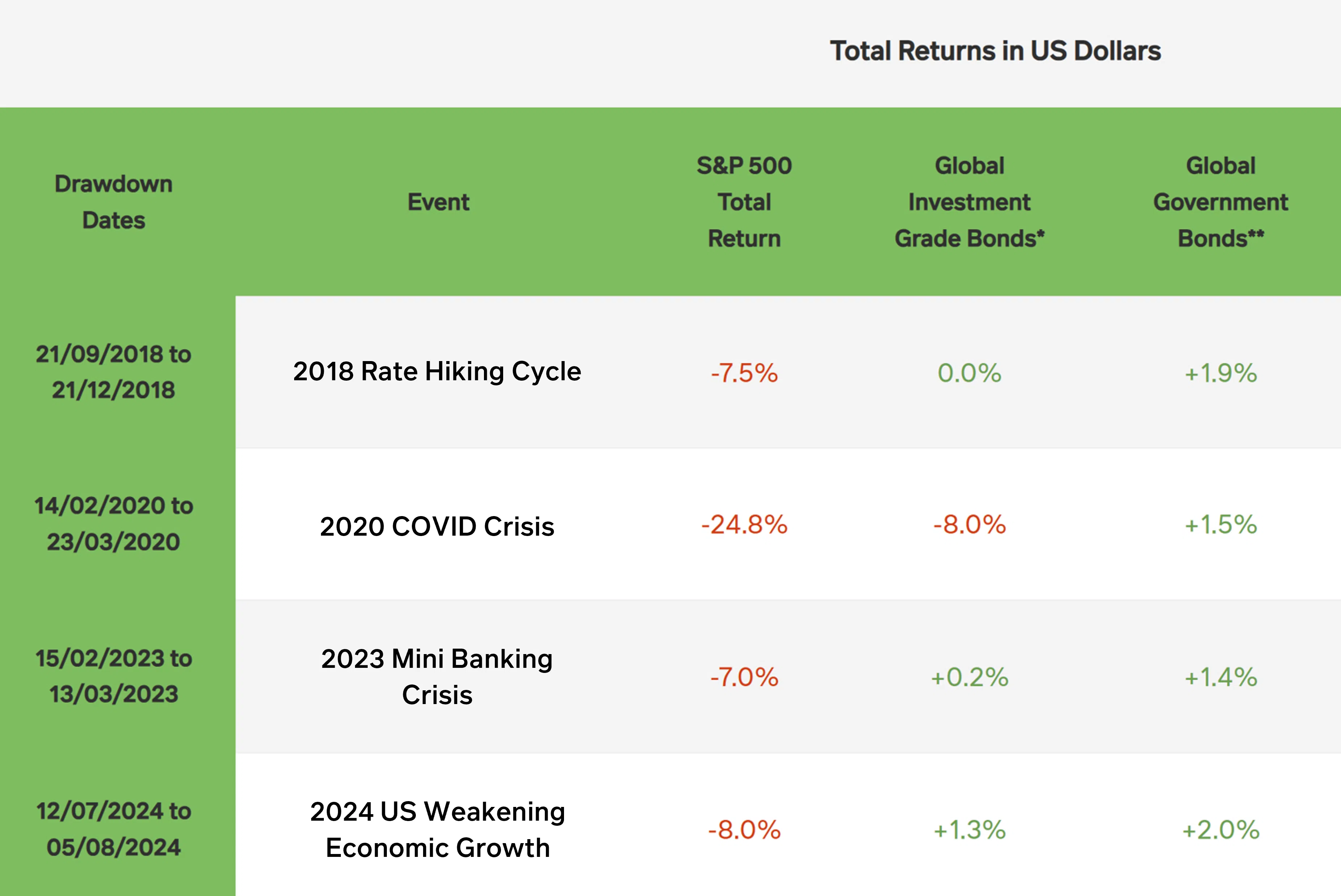
During major periods of market stress — such as the 2018 rate hikes, the market crash of 2020 driven by the Covid-19 pandemic, the mini banking crisis in March 2023, and the recent slowdown in US economic growth — high quality government and corporate bonds have remained relatively steady, often providing stability when equities struggled.
Says Mr Woolnough: “As investors enter this new phase, bonds will continue to play a crucial role in providing stability and diversification. Investors will need to assess the broader financial landscape and explore all investment possibilities to help ensure the preservation and growth of income.”
Seizing opportunities in a shifting market
The past five years have been challenging for bond investors, marked by inflation spikes, rising debt and market volatility. Now, with likely more interest rate cuts on the horizon, the market environment may be set to shift, presenting new opportunities and risks.
Says Mr Woolnough: “Flexibility and strategic thinking will be key to navigating the new landscape. The M&G Optimal Income strategy, launched in 2006, has demonstrated the importance of being flexible in response to changing market conditions.
By staying proactive, addressing inflation risks, and understanding debt sustainability, bond investors can seize future opportunities while protecting their portfolios from potential risks, says Mr Woolnough.
“With nearly two decades of experience, we believe that maintaining flexibility — across duration, credit, and global bond markets — has been key to our strategy’s consistent long-term performance. The future offers great potential for those who remain adaptable and strategic in navigating the evolving investment landscape,” he adds.
Find out more about the M&G Optimal Income strategy.
Disclaimers:
The value of investments will fluctuate, which will cause prices to fall as well as rise and you may not get back the original amount you invested. The views expressed in this document should not be taken as a recommendation, advice or forecast. Past performance is not a guide to future performance. We are unable to give financial advice. If you are unsure about the suitability of your investment, speak to your financial adviser.
The content of this page reflects M&G’s present opinions reflecting current market conditions. They are subject to change without notice and involve a number of assumptions which may not prove valid. All information included in this page has been written for informational and educational purposes only and does not constitute an offer or solicitation to invest into any security, strategy or investment product. Information given in this document has been obtained from, or based upon, sources believed by us to be reliable and accurate although M&G does not accept liability for the accuracy of the contents.

Decoding Asia newsletter: your guide to navigating Asia in a new global order. Sign up here to get Decoding Asia newsletter. Delivered to your inbox. Free.
Share with us your feedback on BT's products and services