

Manulife S'pore rides high on 2016 breakthrough year
S'pore market now group's 3rd largest, thanks to bank distribution channel.
WHAT a difference 2016 has made for Canadian insurer Manulife Singapore, whose fortunes were turned around from struggling for new business market share in a highly competitive sector to now being one of the front runners.
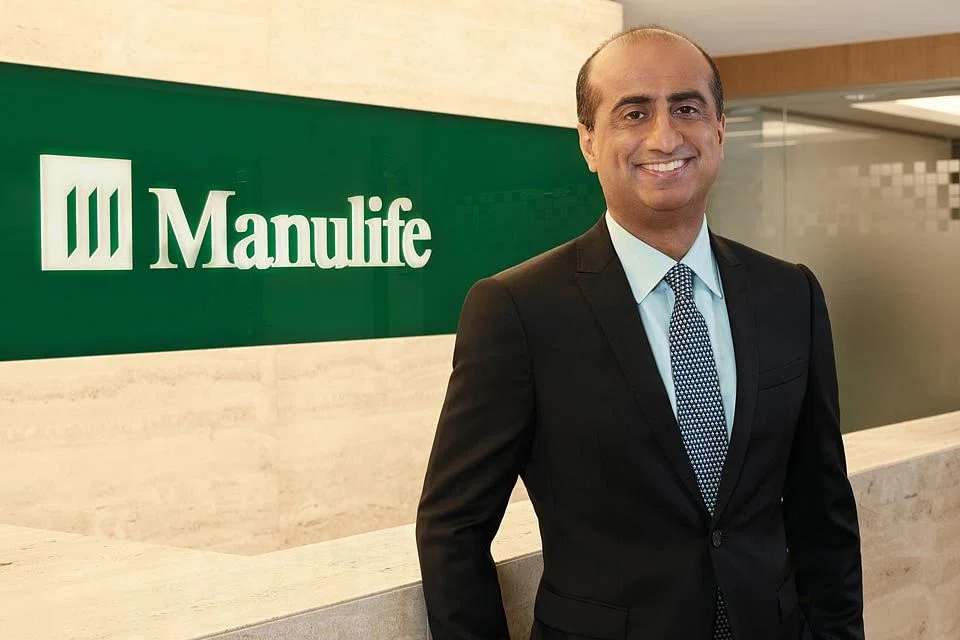
As chief executive Naveed Irshad puts it, the Manulife Singapore growth story in the past three years is a simple and straightforward one.
Under the Canadian's watch, the company has grown 10-fold and Singapore is now the group's third largest market in Asia, after Hong Kong and Japan. In 2016, Asia contributed a third of the group's core earnings and 81 per cent of new business value (NBV). Annualised premium equivalent (APE) - a measure of sales - in Singapore grew from US$71 million in 2014 to US$374 million in 2016 while NBV soared from zero to US$85 million in the same period. On a constant currency basis, core earnings rose from US$19 million to US$64 million.
A large part of this meteoric rise has to do with its bank distribution channel.
In early April 2015, Manulife Financial Asia said it snagged the coveted 15-year exclusive DBS bank distribution deal at an eye-popping initial payment of US$1.2 billion - what some in the industry believed was too high a price to pay.
The deal that started in January 2016 gave the insurer serious muscles that it needed to leap frog to the front of the new business market share race. Since then, Manulife Singapore has been giving its closest rival Great Eastern a run for its money in bancassurance.
But the insurer was not just making waves in this space.
In late April 2015, the insurer opened the doors to its financial advisory (FA) firm, Manulife Financial Advisers, where about 200 of the insurer's 800 agents were moved to the new set up.
The FA arm allows advisers to sell products manufactured by rival insurers and had struck initial fear in pockets of a community still big on the traditional business model of selling through tied agents.
"You've to recognise that you're not able to manufacture everything and sometimes even if you're able to manufacture, it may not be competitive and (have) high value so you should open it up from a customer perspective," Mr Irshad explains.
Thrown into the mix was the issue of poaching, which created unhappiness among some players who lost agents to Manulife Financial Advisers.
Internally, there was tension simmering following the movement of some Manulife agents to the FA arm. When asked, Mr Irshad says without answering directly: "Well, I think there're different models so the agents are really a core part of our business . . . Manulife Financial Advisers is a more open architecture. It's a little bit more on your own type of thing so I think there's a place for both depending on the type of person, depending on what they want to do."
Still working through the bumps and potholes, the insurer is now focused on maximising the bank partnership - something that is crucial if history is any indication. Bancassurance contributes more than half of Manulife Singapore's new sales. The remaining is divided between its 600 agents, its 650 advisers, the major local FA firms, international brokers and the direct sales channel.
Even with a strong bank distribution channel that has access to a large pool of customers, it is difficult for the insurer to cross-sell and up-sell products.
But Mr Irshad is counting on his strategy to work - to offer simple products without the bells and whistles that can be easily purchased through the different channels.
His team is working to leverage the data the bank already possesses to simplify the underwriting process. Data such as credit card as well as health and wellness spending patterns can help the insurer design products that are aligned with customers' needs.
They are also looking to get bank customers who are already transacting electronically to buy insurance products online.
"So earlier this year when we launched IncomeGuard, which was a completely online product, a direct product, simple, protects your income against death, critical illness and retrenchment. That's been a pretty good success and you'll see a lot more of those sorts of initiatives. We'll try different things, adjust on the fly, fine tune. I think the whole part of this is to run a whole bunch of experiments and figure out what really works and scale it up in a big way."
This "test and fail, fail fast and succeed" mentality in an era of disruption is what Mr Irshad sees as the key challenge for insurers who "have been more focused on building a big thing and making it work rather than trying to be nimble and quick".
"Even (for) us in the past, I think this would've been more of a challenge but . . .we've got an initiative to implement agile sort of methodologies across the group so, let's say our approval processes and things like that are being adjusted to fit into this new framework."
Currently, Manulife Singapore offers products in three areas - retirement, high net worth and traditional protection. It has launched 20 new products since January 2015, bringing the total number under its belt to 27.
Some critics say Manulife Singapore has conveniently copied rivals' products and improved the benefits - a clever tactic depending on who you ask.
But Mr Irshad dismisses this in his soft-spoken way: "There's more transparency in the marketplace. You have compareFIRST as an example, so all the features are available to be compared . . . I think gone are the days where everybody develops their products in silo and tries to hog them . . . Typically you do benchmark your competitors and you want to make sure that you have a clear story - that's normal product development in a transparent environment."
The outlook for the insurer seems promising but a closer look at its shorter term investment rate of return averages for participating (par) funds says otherwise.
"One of the reasons for the lower returns in recent years was that we were quite Singapore focused in our investments. As you know, the Singapore stock markets underperformed so we've since quite diversified out and also added some attractive investments in some private equity, private debt into our par funds, so that should also diversify the mix and provide good long term returns," Mr Irshad says.
Always up for a challenge, the actuary by training believes the entry of robo advisers and blockchain technology will keep his people on their toes and there are plans to use these tools to complement the roles of agents and advisers.
Even though the industry faces a whole host of threats from fintech, insurtech, low interest rates, greater regulation and compliance costs, Mr Irshad is optimistic. "I feel we're well-positioned to pivot no matter what happens because we're really everywhere . . . We don't have to worry about protecting legacy stuff."






