MLT posts 7% fall in Q4 DPU; eyes up to S$300 million in asset sales
China assets earmarked for sale are to be offloaded into a planned renminbi fund


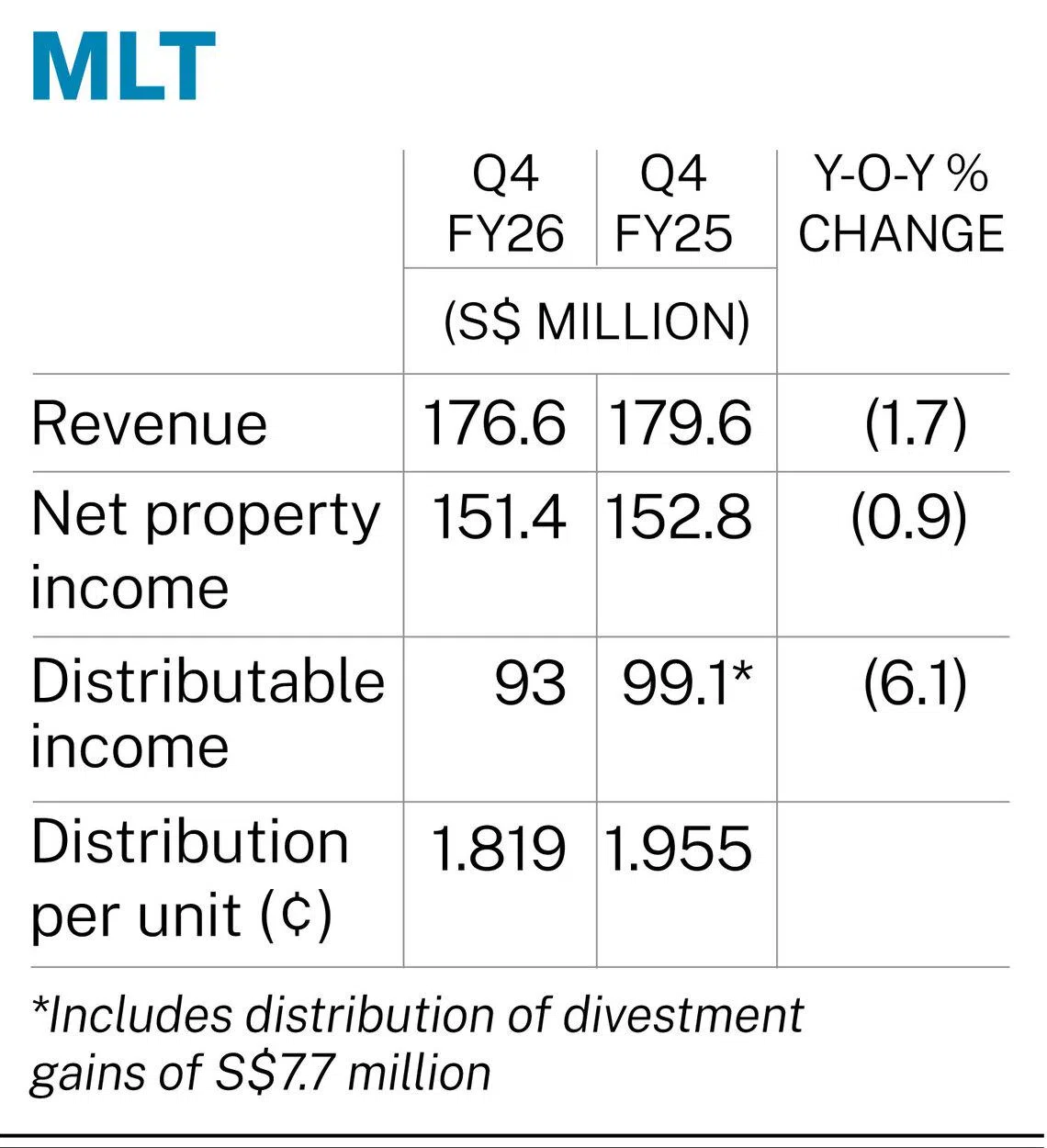
[SINGAPORE] The manager of Mapletree Logistics Trust (MLT) on Thursday (Apr 30) posted a distribution per unit (DPU) of S$0.01819 for the fourth quarter ended March, down 7 per cent from S$0.01955 in the year-ago period.
This brings total DPU for FY2026 to S$0.07262, down 9.8 per cent year on year. Distribution for Q4 will be paid on Jun 23.
Excluding divestment gains, Q4 DPU would have risen 0.9 per cent from S$0.01803 in the year-ago period, and FY2026 DPU would have dipped 3.4 per cent from S$0.07519 previously.
Distributable income fell 6.1 per cent to S$93 million for Q4, from S$99.1 million in the same period the year before. It would have been up 1.8 per cent, excluding divestment gains.
Revenue was down 1.7 per cent on year at S$176.6 million and net property income (NPI) fell 0.9 per cent to S$151.4 million in Q4.
The declines were primarily due to an absence of contributions from divested properties and weaker regional currencies.
In FY2026, MLT divested six properties at an average premium to valuation of about 20 per cent. The properties sold include 1 Genting Lane, 8 Tuas View Square and Mapletree Logistics Centre-Yeoju in South Korea.
Excluding the impact of divestments and currency volatility, MLT would have registered growth in revenue and NPI of S$3.6 million and S$4.1 million in Q4, respectively.
This would have come amid higher contributions from the existing portfolio and contribution from the revamped Mapletree Joo Koon Logistics Hub, said the manager.
MLT previously identified about S$1 billion worth of older-specification properties for divestment, with roughly half of these assets located in China and Hong Kong.
Of this, about S$270 million worth of assets have been divested to date, said Jean Kam, chief executive officer of the manager, at the earnings briefing on Thursday (Apr 30). (*See amendment note)
Further divestments
For the upcoming financial year, MLT is targeting S$200 million to S$300 million in divestments from its pipeline, she added, noting that this would include assets to be offloaded into a private renminbi fund currently under development.
Progress on the fund has been delayed due to a change in the limited partner, noted Kam. The replacement partner is undergoing due diligence, with MLT indicating that binding agreements could be signed by the second quarter of FY2027.
On acquisitions, Kam is still bullish on supply chain diversification markets, such as India, Vietnam and Malaysia, despite forex volatility.
She said that MLT will mitigate currency risks where possible through natural hedging, including taking on onshore borrowings in local markets.
These markets continue to offer structural growth, underpinned by stronger gross domestic product prospects relative to the rest of Asia, Kam pointed out.
While currencies such as the Indian rupee have been volatile over the past 12 months amid global headwinds, she added that a medium to long-term view suggests a more moderate depreciation trend of around 3.5 per cent.
For the full-year, revenue was down 2.6 per cent at S$708.3 million in FY2026, from S$727 million the year before.
NPI fell 2.4 per cent to S$610.2 million in FY2026, from S$625.3 million.
Distributable income for FY2026 was S$370.1 million, down 8.9 per cent from the previous year’s S$406.4 million.
As at end-March, MLT portfolio’s weighted average lease expiry by net lettable area was 2.5 years.
It recorded average positive rental reversion of about 3.3 per cent, including China. China’s rental reversion was -2 per cent in Q4, improving from -2.2 per cent in the previous quarter.
Pointing to earlier signs of stabilisation in China, Kam expects negative rental reversions to continue narrowing, taking another three to four quarters to turn neutral.
By region, West and Central China appear to have bottomed out, with lower-tier cities like Kunming, “seeing stabilisation and higher rent being signed”.
In the south, while new supply is expected to come onstream, MLT has limited exposure and assets there continue to enjoy high occupancy, said Kam.
She added that lease expiries in the North are limited in the coming year, while more are due in the East. Still, she expects the eastern region to “recover faster due to stronger consumption”.
“In light of the ongoing Middle East conflict and broader supply chain uncertainties, we remain vigilant and focused on execution,” said Kam. “Our immediate priorities are to preserve portfolio stability through tenant retention, prudent cost management and active lease management, while continuing our portfolio rejuvenation strategy to unlock value and position MLT for sustainable long-term growth.”
Units of MLT ended Thursday 0.8 per cent or S$0.01 lower at S$1.22, before the release of the results.
*Amendment note: The article has been updated to reflect that S$270 million worth of assets have been divested to date, and that MLT is targeting S$200 million to S$300 million in divestments from its pipeline for the upcoming financial year.