Marco Polo Marine bets on renewables for future growth
The company’s revenue mix will rely on oil and gas for now

THE pivot to the renewable energy sector for Macro Polo Marine (MPM) was something that CEO Sean Lee has been pondering for a while.
In the quest to turn around the business as oil and gas demand for vessels cooled in 2019, Lee and Darren Teo, managing partner at Apricot Capital (a major shareholder of MPM) had a conversation on pivoting to the renewable energy sector. A think tank was set up and ideas were bounced about for a year, but nothing concrete arose.
It took a vessel charter from a Taiwanese company to pique Lee’s interest in 2020. It was during Covid-19, and Lee made multiple trips to Taiwan, enduring long quarantines to talk to vessel charterers there.
“I realised that our vessels were working for the wind farms there, at that moment I thought it was an opportunity, we could repurpose our vessels to work for a different industry,” said Lee.
Further research to understand the market revealed a gap in the commissioning service operation vessel (CSOV) and the service operation vessel (SOV) space. SOVs offered little by way of margins, but CSOVs were looking attractive.
CSOV is a vessel that would house both its crew and technicians as well as provide a platform for equipment to work on offshore wind farms.
When MPM decided to build its own back in 2020, there were only 23 active CSOVs in the market, all based in Europe. While another 15 were under construction, MPM wanted to plug the gap in Asia. “This is a neglected market, and European players found operating in Asia a challenge. That’s where we found an advantage in being an Asian player,” explained Lee.
There were plans to initially repurpose an anchor handling tug vessel to build MPM’s first CSOV. However, further research showed that it was not suitable, leading the company to design and build their own after getting inputs from the various partners in the ecosystem.
Considering the different demands that various customers wanted, Lee noticed that comfort was a common topic. “So I thought let’s do an Asian version of that,” he said.
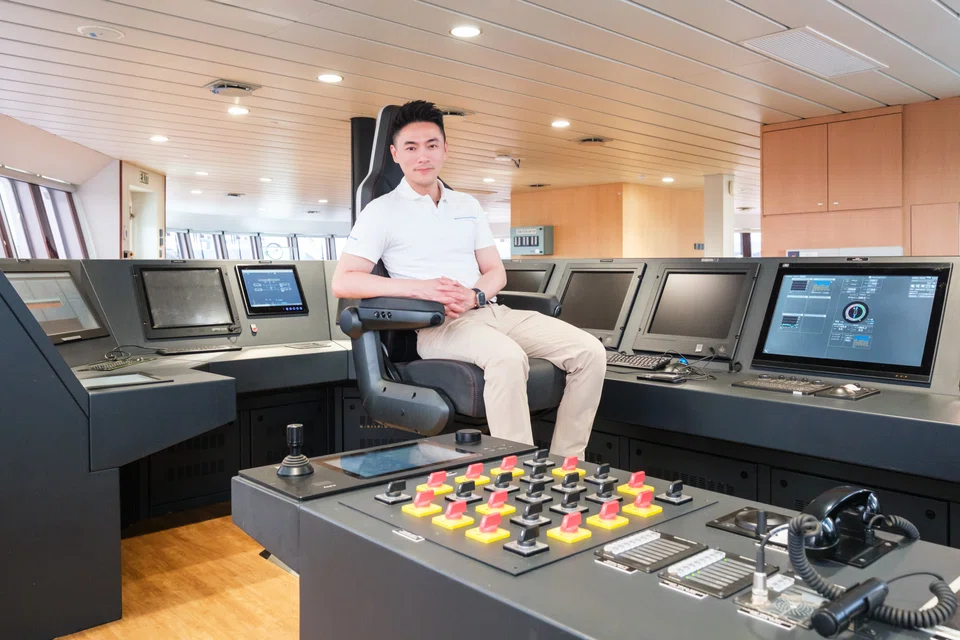
Commercial vessels typically have a spartan interior. But MPM’s new CSOV – the MP Wind Archer – is outfitted with soft lighting and design features that would not be out of place in an interior designer’s showcase.
Other creature comforts such as a cinema, a karaoke room and a lounge with a massage chair are available for the crew and technicians on the boat. Coupled with air conditioning with 100 per cent redundancy to deal with Taiwan’s summer, the Wind Archer is markedly different from other CSOVs.
The vessel can accommodate up to 110 personnel, and these touches are meant to aid in retaining personnel working in the harsh offshore environment.
“It’s a balancing game at the end of the day; we are trying to differentiate ourselves from the rest of the players,” pointed out Lee.
There is also another added benefit of going into CSOVs, as the oil and gas sector has started utilising CSOVs as well for offshore operations.
The Wind Archer has charters for the next three years.
Coupled with the expected completion of the Drydock 4 and the acquisition of three crew transfer vessels, MPM expects these assets to contribute to financial performance from the second half of 2025.
The most recent first-quarter 2025 update showed revenue falling 11 per cent to S$25.8 million from S$29.1 million in Q1 2024. MPM did not report net profit in its Q1 update.
Both its business units – ship chartering and shipyard – saw declines in Q1 2025 revenue contributions.
Ship-chartering revenue for the quarter fell 13 per cent due to lower third–party chartering income from Taiwan. This was offset by higher charter rates of utilised vessels and a marginal improvement of average fleet utilisation rate from 70 per cent to 71 per cent.
Shipyard revenue for Q1 2025 dipped 9 per cent, driven by a decline in ship-building activities. This was offset by an increase in ship-repair projects which drove up yard utilisation rates to 83 per cent from 79 per cent.
Looking ahead, MPM’s revenue mix will still rely more on oil and gas rather than renewables in the short term, as the company lacks enough vessels to support the new segment.
But Lee believes that the revenue mix will be more balanced between the two sectors in the future.
“The fact that we are doing more capex in the wind industry, a larger percentage will go to pure wind farms rather than oil and gas,” he added.