

More than 162 million Marco Polo Marine shares change hands on plan for reverse takeover of Fuji Offset
The heavy trading also follows the group’s announcement of a 9% increase in H1 earnings to S$11.6 million
 Add BT as a preferred source

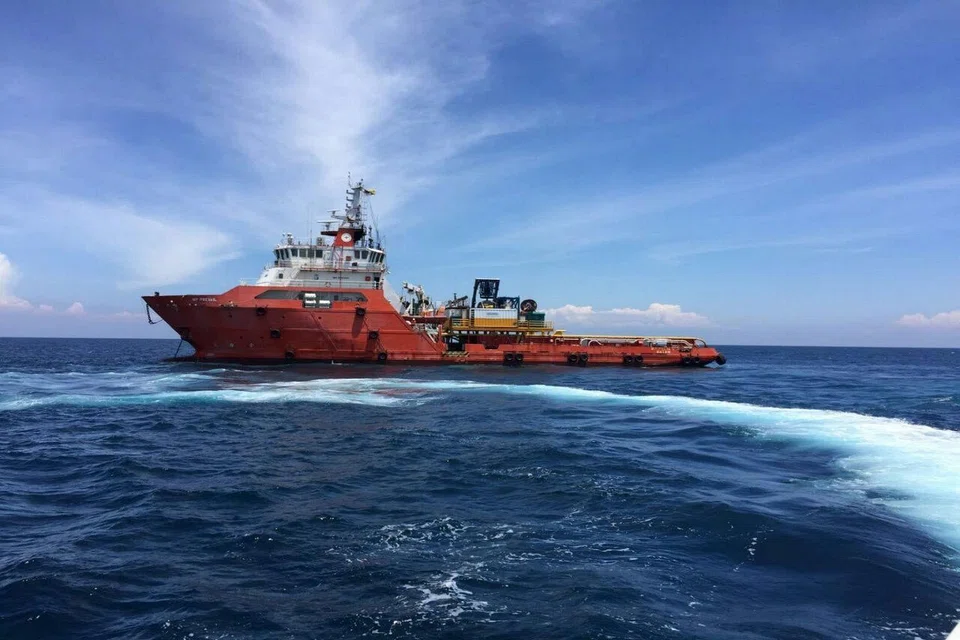
[SINGAPORE] Marine logistics company Marco Polo Marine saw heavy trading on Friday (May 15) after it announced a higher net profit for its first half and proposed a reverse takeover of Fuji Offset.
More than 110 million shares of the integrated marine logistics firm changed hands before the midday trading break, placing it among the morning’s most actively traded stocks.
The counter closed 3.9 per cent or S$0.007 higher at S$0.187, with 162.5 million shares traded.
Earlier on Friday, Marco Polo Marine posted a 9 per cent rise in net profit to S$11.6 million for the six months ended Mar 31, compared with S$10.6 million for the year-ago period.
Revenue jumped 40 per cent year on year to S$74 million, from S$52.7 million. The top-line growth was driven by robust performances in both its ship chartering and shipyard segments.
Shipyard reverse takeover
Separately, the company announced a proposed reverse takeover with the injection of Marco Polo Shipyard and MP Marine into Catalist-listed Fuji Offset Plates Manufacturing , in return for new Fuji shares. The two units own the group’s shipyard business.
Members of the Teo family behind instant coffee giant Super Group are listed as substantial shareholders in both Marco Polo Marine and Fuji Offset, according to their 2025 annual reports.
The family’s private investment holding firm, Apricot Capital, holds a 12.1 per cent stake in Marco Polo Marine as at May 8. A 21.8 per cent stake is owned by the Lee family, comprising Marco Polo Marine CEO and founder Sean Lee, his sister and his father.
Fuji’s annual report for the year 2025, meanwhile, lists members of the family with at least 39 per cent of the company’s shares. As at Mar 20, a combined 39.11 per cent stake is owned by Super founder David Teo and his brother Steven Teo, who have respective stakes of 23.12 and 15.99 per cent.


Several other individuals with the surname Teo are among Fuji’s 20 largest shareholders as at March.
The proposed transaction has a maximum consideration of S$139 million. This comprises a base consideration of S$120 million and a deferred consideration of up to S$19 million, to be paid via the issuance of new Fuji Offset shares at S$0.701 each.
The deferred consideration is structured as an earn-out, which depends on the target companies achieving specific adjusted net profit after tax targets for the financial years ending 2026 and 2027.
Once the proposed transaction is completed, Marco Polo Marine is expected to hold a controlling interest of around 74.1 per cent in Fuji Offset’s enlarged capital. This stake may rise to up to 76.8 per cent if the maximum number of deferred consideration shares is issued.
Fuji Offset will change its name to MPSE to reflect its new core business, subject to shareholder approval.
Marco Polo Marine said that the deal is part of its strategy to maximise shareholder value, as the transaction could “(crystallise) the intrinsic value of the shipyard assets at a substantial premium to their book value”.
It added; “By creating a separately listed entity for the shipyard business, the transaction establishes a transparent platform for future growth.”
The group noted that currently, a substantial portion of the shipyard’s revenue from intragroup projects is eliminated upon consolidation. This includes its fleet renewal and expansion into offshore wind support.
However, “post-transaction, all revenue will be fully reportable, providing investors with clear visibility into the shipyard’s earnings capacity and its strategic role in the offshore wind sector”.
The spinoff will also establish an independent capital-raising platform for the shipyard business, the group added. This would enable it to fund future growth and expansion based on its own market capitalisation, and without diluting the holdings of Marco Polo Marine’s shareholders.
The transaction is subject to conditions including the execution of a definitive sale-and-purchase agreement, satisfactory due diligence, as well as approvals from the Singapore Exchange and the shareholders of both Marco Polo Marine and Fuji Offset.
Improved earnings
Breaking down its results for the six months ended Mar 31, Marco Polo Marine said that chartering revenue rose 38 per cent to S$44.3 million from S$32 million in the prior year.
This was supported by the expansion of its offshore support vessel fleet, higher average charter income, and an increase in average utilisation rates to 71 per cent from 68 per cent.
Shipyard revenue increased 43 per cent to S$29.7 million in H1 FY2026, from S$20.7 million in the previous corresponding period.
The segment benefited from an increase in ship repair projects with higher contract values, offsetting a reduction in the number of third-party shipbuilding projects.
Earnings before interest, taxes, depreciation and amortisation surged 87 per cent to S$28.8 million.
Excluding foreign-exchange effects and one-off items, adjusted net profit stood 44 per cent higher at S$13.8 million.
Net asset value was S$0.075 a share as at end-March. The group maintained a net cash position of S$46.9 million.
The company provided an optimistic outlook for FY2026, noting that the offshore oil-and-gas industry continues to project a favourable outlook due to supply constraints caused by prolonged underinvestment.
Additionally, the offshore wind sector is experiencing growth driven by energy transition investments.
Previous deals and developments
In November, Marco Polo Marine announced it had secured a NT$4.7 billion (S$198 million) contract to design and construct an oceanographic research vessel for Taiwan’s National Academy of Marine Research.
The group will also expand its fleet this year with the addition of two new anchor handling tug supply vessels, valued at a combined US$34 million.
Marco Polo Marine also highlighted plans to submit a listing application for its Taiwan subsidiary, PKR Offshore, by the third quarter of 2026. The proceeds will go towards developing its wind vessel fleet.
Decoding Asia newsletter: your guide to navigating Asia in a new global order. Sign up here to get Decoding Asia newsletter. Delivered to your inbox. Free.
Copyright SPH Media. All rights reserved.
TRENDING NOW

Singapore private housing is ‘decoupling’ from HDB market as buyer pools diverge: NUS survey

Simba’s 5G spectrum hurdle may accelerate Singapore’s telco market reset

Yen hits 40-year low in historic slide that’s rattled Japan

Malaysian tycoon Vincent Tan’s sell-downs point to pruning rather than an exit plan

