

Marco Polo Marine shares plans to unlock value as boutique fund manager becomes substantial shareholder
CEO Sean Lee says company is riding growth momentum and hiving off shipyard business to Fuji Offset in RTO to fund expansion

[SINGAPORE] For years, Marco Polo Marine has been flying under investors’ radar – operating a respectable but staid marine logistics business.
But its move to carve out and inject its shipyard business into Fuji Offset Plates Manufacturing , a multi-decade listco on the Singapore Exchange, has piqued the interest of the market.
A record 160 million shares were traded in a single day after it announced the deal and strong earnings.
On Wednesday (Jun 3), the company said boutique fund manager AGT Partners is now a substantial shareholder.
In a stock exchange filing, Marco Polo said the fund’s Ginko-AGT Global Growth Fund had bought 700,100 shares for S$117,980.85, raising its stake to 195,944,800 shares, or 5.006 per cent. The latest purchase translates to an average price of about S$0.1685. The stock closed at S$0.163 on Wednesday.
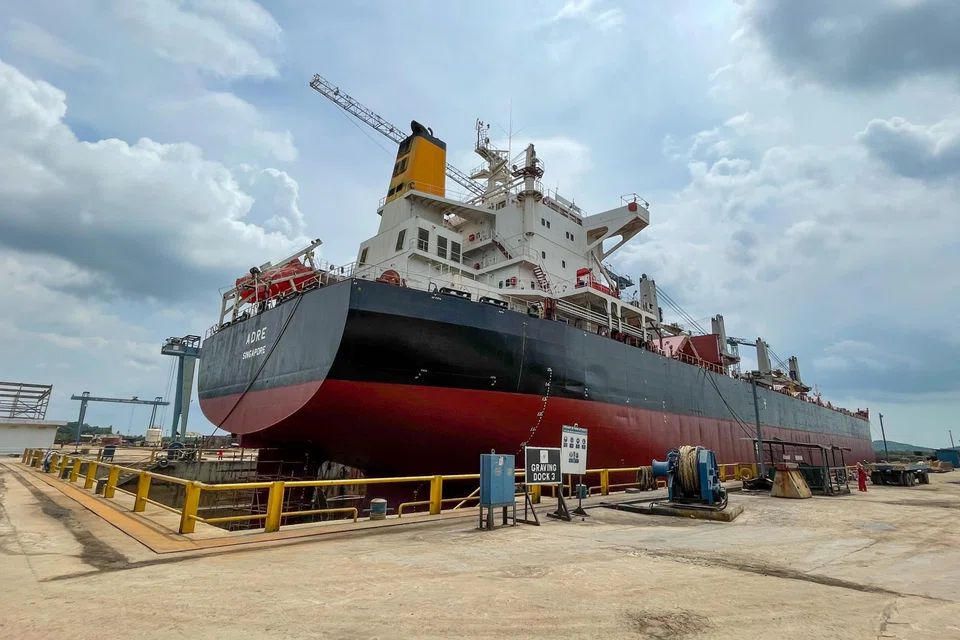
A month ago, the marine logistics firm proposed a S$139 million reverse takeover of Catalist-listed Fuji, which will issue new shares as consideration for two Marco Polo units – Marco Polo Shipyard and MP Marine – that operates the group’s ship repairs, maintenance and construction business.
The Business Times talks to Marco Polo chief executive officer Sean Lee about the plan and the company’s longer-term strategy.
Lee said the company’s shipbuilding division has been enjoying renewed momentum, as it comes off a lower base, following a lull in shipbuilding activity for several years.
Consequently, bigger projects were secured last year and “a lot more” inquiries are coming in, Lee said.


This and other recent developments signalled that Marco Polo is at an “inflection point”.
The positive operating environment has boosted both the group’s top and bottom lines. For its latest financial year ended September 2025, the company’s net profit soared 169 per cent to S$58.5 million, up from S$21.7 million in FY2024 and S$22.6 million in FY2023.
“We’ve been thinking about how to grow the company… so we’ll be needing a lot more working capital (and will) need to raise funds.”
Spinning off the shipyard business from the ship chartering business allows it to raise funds in a more efficient and targeted manner, Lee explained.
A separate listing for its shipbuilding also makes sense amid tighter credit from banks. Lenders are more cautious and liquidity is “not as free” anymore, Lee said in a separate podcast interview with BT.
Fuji Offset, whose business operations comprise manufacturing and selling products for the printing industry, was a suitable vehicle for a reverse takeover due to its clean balance sheet, and the fact that it shares some common stakeholders with Marco Polo, said Lee.
Members of the Teo family behind instant coffee giant Super Group have significant stakes in both firms, according to the 2025 annual reports.
The plan is for Fuji Offset’s existing business to be sold off eventually, Lee said. Subject to shareholder approval, the firm will be renamed MPSE to reflect its new core business.
Tapping green energy pivot
With the energy transition here to stay, Marco Polo has enjoyed rising demand for new types of vessels such as wind vessels.
But Lee notes that a complete replacement of oil and gas with renewables is “not going to happen any time soon” – especially as the Middle-East conflict has thrust energy security issues into the spotlight. Therefore, orders from the fossil fuel sector, particularly for the renewal of old fleets, continue to flow in.
Marco Polo does not build merchant vessels as it cannot compete with players such as Yangzijiang Shipbuilding, which are capable of building such vessels at scale.
Rather, it has a strong niche in specialised, offshore vessels, including those that support oil and gas sectors, such as anchor handling and platform supply vessels, alongside those that support wind sectors such as service operation and commissioning service operation vessels.
Lee noted that Marco Polo is one of the main companies in the world that builds these specialised types of offshore vessels.
Other players may not be interested in constructing such vessels as they cannot be built at a large scale, said Lee, as orders for these typically come in small batches, for one or two units.
AI and data centres
In its latest earnings report, Marco Polo said its shipbuilding segment has been boosted by a S$198 million contract win to build a 4,000-tonne oceanographic research vessel for Taiwan’s National Academy of Marine Research.
Having established Taiwan as a “first base” for the offshore wind sector segment of its ship chartering business, Marco Polo is eyeing growth in other markets.
Lee noted that Taiwan was one of the earliest markets in Asia, outside of China, that started working on offshore wind farm projects during the Covid period.
Back then, Marco Polo first began repurposing its offshore oil and gas vessels to serve Taiwan’s offshore wind sector demand, after identifying its growth potential.
Now, the company is aiming to expand its offshore wind business in Japan, Korea, the Philippines, Vietnam and Australia, with demand for wind farm construction rising in these markets as countries look to strengthen their energy security amid the Middle East conflict.
Having already built a presence in Taiwan and Korea, Marco Polo is in the process of entering the Japan market.
While growth in Japan is “slightly slower”, Lee believes that “it will come” in time, given the country’s ambitions to build up its wind power capabilities.
Despite the expansion plans, Taiwan will remain one of its main markets for the offshore wind sector business, said Lee.
This comes as demand for wind farm construction from the island has increased steadily over the years and is poised for further growth, especially as Taiwan – a tech manufacturing hub that houses some of the world’s largest chipmakers – looks to satisfy its rising power needs which are set to increase, due to energy-intensive sectors like AI and data centres.
The company managed to establish a foothold in the Taiwan market by meeting localisation requirements – by partnering local companies, having vessels bear the Taiwanese flag and ensuring that crews met local employee quotas.
Noting that the localisation process can be “challenging”, Lee highlighted the difficulty of staffing vessels to meet local worker quotas, due to the limited pool of manpower trained for work within offshore crews – which is distinct from the work of shipping crews.
To address this, the company had to train local workers from scratch to serve on offshore vessels, he said.
With similar localisation requirements elsewhere such as Korea and Japan, the plan is to have some crew members from these countries trained in Taiwan, before sending them back to train other staff, said Lee.
Decoding Asia newsletter: your guide to navigating Asia in a new global order. Sign up here to get Decoding Asia newsletter. Delivered to your inbox. Free.
Copyright SPH Media. All rights reserved.
TRENDING NOW

DBS, OCBC, UOB rout lops billions off STI as inflation, rate concerns spook investors

Grab CEO’s wife Chloe Tong on life with Anthony Tan and finding her purpose

OCBC sheds S$8 billion in value as shares close nearly 6% down; analysts cautious on banks

Deal between tycoon friends sparks scrutiny of Philippine power sector

