Marco Polo Marine's focus on renewables is paying off even as oil prices recover


Singapore
MARCO Polo Marine suffered a near-death experience when oil prices tanked in 2015 and 2016. But after a debt restructuring in 2017, the vessel charterer and shipyard operator has reduced its reliance on the oil and gas industry.
"We saw that the oil and gas sector was not going to come back any time soon but the dry docks are still there so we had to fully utilise it," said Marco Polo Marine's chief executive Sean Lee during a recent interview with The Business Times.
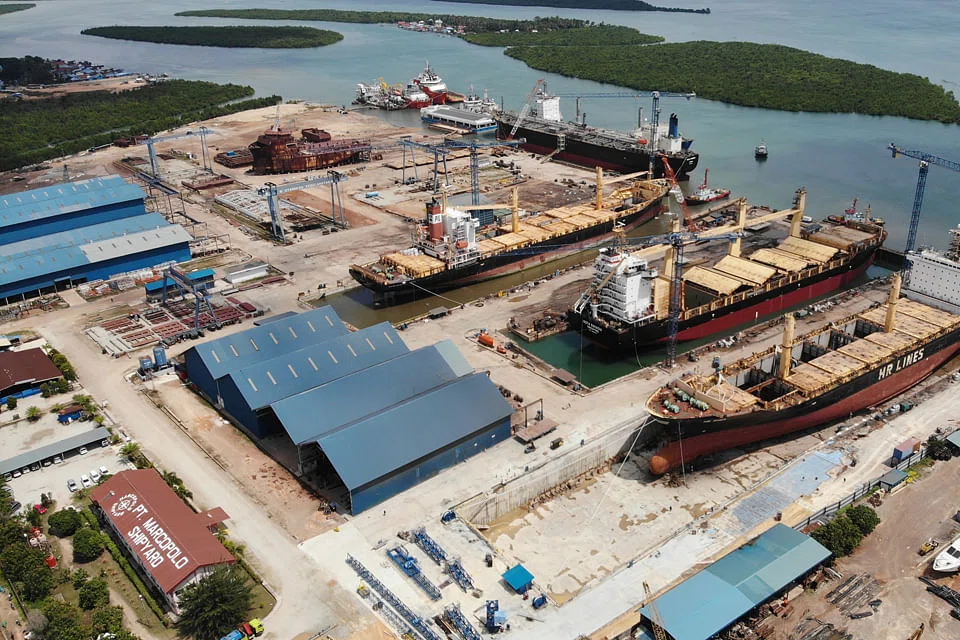
The company began offering its repairs and maintenance services to owners and operators of merchant vessels - such as container ships and tankers. Today, it counts PIL and Samudera Shipping among its customers.
To accommodate these relatively large merchant vessels, Marco Polo Marine had to extend the length of one of its graving docks from 190 m to 220 m in 2019. Another extension was also completed on one of its dry docks in February this year, which increased the group's ship repair capacity by 20 per cent.
"Container shipping demand suddenly boomed during the Covid-19 pandemic so we were lucky there of course," Lee said, adding that utilisation of the docks has hovered between 70 to 80 per cent.
For its financial year to Sep 30, 2021, the company reported a 49 per cent rise in revenue to S$46.1 million. Revenue from its ship building and repair services segment alone grew 51.1 per cent to S$26 million.
The company's bottom line swung from a loss of S$9.2 million in FY2020 to a profit of S$14.8 million in FY2021. Excluding non-recurring items, the company's earnings for FY2021 came in at S$3 million versus a loss of S$8.9 million for FY2020.
The company also had S$19.8 million in cash and cash equivalents at the end of FY2021, up from S$13.6 million in FY2020.
Tapping wind farms
Beyond ship repairs and maintenance, Marco Polo Marine is also expanding in the relatively new field of offshore wind farms.
Lee said he began exploring this sector in 2018, shortly after the company restructured its loans.
He attended a conference in Taiwan to learn about its plans to set up offshore wind farms, and came away optimistic about the role the company could play but under the impression that the project would take some time to execute.
During the Covid-19 pandemic, however, Lee started receiving enquiries for vessels that could help to transport parts and crew to construct these wind farms. It was then that he realised the Taiwanese government had brought forward its plans to expand the territory's wind farm capacity.
In August last year, the Taiwanese Ministry of Economic Affairs announced that it would auction sites that could yield 9 gigawatts (GW) of offshore wind power capacity between 2026 and 2031 as well as an additional 6 GW of capacity from 2032 to 2035.
Marco Polo Marine's existing vessels for oil exploration turned out to be a good fit for offshore wind farm construction. For instance, the company's anchor handling tug supply vessels that were normally used to tow oil rigs could now be used to carry crew and wind turbine equipment out to sea.
"We had to reinvent ourselves . . . essentially looking at the assets we had on hand and asking ourselves how we could repurpose them," Lee said.
Turning to drones
Marco Polo Marine has already dedicated about 20 per cent of its vessels to serving offshore wind farms, and Lee expects this proportion to rise in the coming years.
He is also looking beyond the construction of these wind farms and planning for their eventual operation and maintenance.
Marco Polo Marine announced in March this year that it will be co-developing 2 new specialised offshore wind service, operation and maintenance vessels with ship design company Seatech Solutions International.
These vessels will have 3D motion-compensated cranes and gangways to allow crew to quickly access the wind turbines at these wind farms. Lee said these custom-designed ships will also have hybrid battery-based energy storage systems that could be 15 to 20 per cent more fuel efficient.
Marco Polo Marine is also exploring the use of drones that can potentially carry payloads of over
100 kg over 100 km. It signed a memorandum of understanding with delivery drone maker F-drones on this initiative in March.
Lee said the use of drones could yield significant efficiency gains because ships would not have to sail back to base to collect spare parts that technicians need if these parts could be flown to them from nearby vessels, or even from an onshore base.
Oil price recovery
A decade ago, Marco Polo Marine was one of the many thriving offshore and marine players in the local market. As crude oil prices plunged in 2015, however, oil companies slashed their offshore exploration and production budgets and demand for offshore supply vessels (OSVs) evaporated.
Marco Polo Marine's revenue halved in FY2016 and the company fell into the red. In December 2016, the company's auditors cited the company's net current liabilities position and loss incurred before tax as conditions that might cast doubt on its ability to continue as a going concern.
While the company's financial condition has stabilised since its debt restructuring in 2017, its shares have lost more than 90 per cent of their value over the past 10 years.
Ironically, even as the company now charts a new direction, a strong recovery in oil prices is once again stoking demand for OSVs.
Lee said that OSV charter rates have improved in recent months, and that the sector still contributes the bulk of the company's revenue.
"Over the past few years, there's no real tonnage actually coming to the market because there's nobody building the vessels."
He added: "After the crisis, everybody thought that they were not going to build any more vessels. So, whatever you see now is what you get."
But there is no turning back now. Lee is adamant that Marco Polo Marine is better off committing its capital to expanding in the renewables space, which he expects to see strong growth for years to come.
"We are positioning ourselves towards more green initiatives, towards more renewables - so that's the direction overall. If you ask me where we are at the moment with the oil and gas sector coming back up, it's not going to change our focus," Lee said.
In a report on Mar 25, RHB analyst Jarick Seet noted that Marco Polo Marine's earlier acquisition of Taiwan-based PKR Offshore will also help deepen the company's exposure to the renewables sector by contributing another 2 OSVs to service the Taiwanese wind farm sector.
"In addition, with the Covid-19 situation in Taiwan improving, this will likely speed up the progress of its winning renewable energy projects," he said.
Combined with stronger chartering revenue, Seet is forecasting continued improvement in profitability at Marco Polo Marine over the next couple of years.
The RHB analyst sees the company clocking revenue of S$55 million in FY2022, and S$64 million in FY2023.
The company is expected to chalk up recurring earnings of S$4 million and S$7 million for those 2 years.
Seet has a 'buy' recommendation on the stock, with a target price of S$0.04.
Shares in Marco Polo Marine closed flat at S$0.29 on Mar 28. Its market capitalisation stands at S$99.1 million, or about 14 times RHB's FY2023 earnings forecast.