Markets price in fewer rate cuts as Fed holds on tariff uncertainty, persistent inflation

Industry watchers expect that lack of clarity over Trump’s policies will continue to weigh on US central bank’s movements

Summarise
Tan Nai Lun
Published Fri, Jan 31, 2025 · 03:56 PM
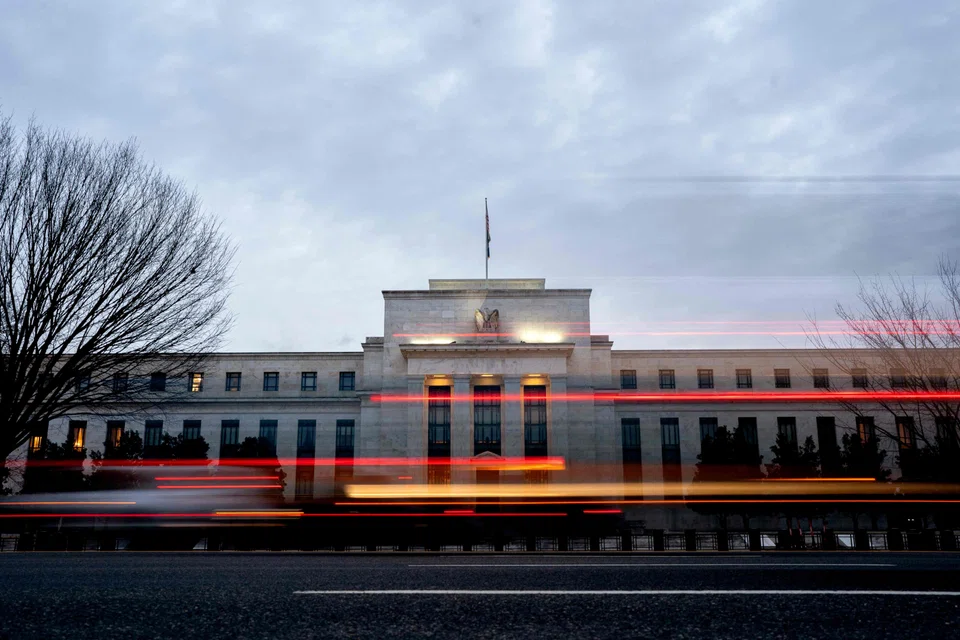
    • In the first Federal Open Market Committee meeting of the year, the Fed kept rates steady, and repeated that it was “in no hurry” to adjust its policy stance.
    • In the first Federal Open Market Committee meeting of the year, the Fed kept rates steady, and repeated that it was “in no hurry” to adjust its policy stance. PHOTO: AFP

    GLOBAL markets are pricing in fewer rate cuts for the year as the US Federal Reserve unsurprisingly kept rates on hold on Wednesday (Jan 29).

    In the first Federal Open Market Committee meeting of the year, the Fed kept rates steady, and repeated that it was “in no hurry” to adjust its policy stance.

    “We’ve long said persistent inflation pressures would prevent the Fed from cutting far or fast – and that this would not be a typical rate-cut cycle, but a fine-tuning of the policy stance. That is what is now materialising,” said Jean Boivin, head of the BlackRock Investment Institute.

    Markets have been adjusting to high-for-longer in recent months, and are now pricing just two Fed rate cuts this year, with the next one not until June, he added.

    Keeping an eye on changes

    While the move was unsurprising, market observers expect that uncertainty arising from US President Donald Trump’s policies will continue to weigh on the Fed’s movements.

    “The Fed’s decision to hold rates was expected, but the real story here is the renewed tension between the White House and the central bank,” said Nigel Green, chief executive of financial advisory deVere Group.

    The administration will push for a more accommodative monetary policy, as well as tariffs and mass deportation, which could drive inflation higher and create broader economic disruption, added Green.

    BlackRock’s Boivin also noted that Fed chair Jerome Powell did not explicitly mention the risks he believes could push inflation higher.

    “We think the Fed is trying to avoid making any forward-looking statements given the political changes in Washington,” he said.

    As a result, DBS senior rates strategist Eugene Leow expects the Fed to be in a reactive mode in the foreseeable future.

    “In the absence of material changes, policy settings may well be already close to neutral relative to what the data is showing,” he pointed out. “Meanwhile, Trump’s policies are a huge source of uncertainty, and Powell has stated that there is no way to model the impact until these changes get articulated.”

    Green of deVere thinks investors should reassess their portfolios with a focus on hedging against potential economic turbulence. “Instead of betting on immediate policy shifts, investors should recognise that markets thrive on stability, not unpredictability,” he said.

    David Norris, head of US credit and portfolio manager at TwentyFour Asset Management, explained that as credit spreads are at historical lows across many asset classes globally, carry will continue to be a main driver of returns.

    “This is a positive for fixed income given that high starting yields historically show a strong correlation to annualised returns over a medium- or longer-term investment horizon,” he said.

    Looking at Asia

    In Asia, the non-activity should allow central banks in the region to pay greater attention to their own domestic conditions in setting monetary policy, said Navin Saigal, head of fundamental fixed income for the Asia-Pacific at BlackRock.

    He noted that there is “much to like” about Asian bonds.

    “The diverse, generous income available in the region is highly complementary to global fixed-income portfolios; Asian bonds have had a low beta to US Treasuries; and Asian currencies have stabilised against the dollar,” Saigal pointed out.

    Meanwhile, the pause will likely benefit larger Singapore and Philippine banks due to their solid deposit franchises and funding, said Rena Kwok, senior credit analyst at Bloomberg Intelligence. She expects slower rate cuts to pose only modest asset-quality risks for Asean banks.

    Nevertheless, market activity in Asia will likely remain soft amid the festive season, observed Barnabas Gan, RHB’s acting group chief economist and head of market research.

    Markets in China and Vietnam remain closed until next week, while the market docket in Asean also “appears selectively eventful at best”, with Indonesia’s fourth-quarter gross domestic product data expected on Feb 5 and Malaysia’s December industrial production and foreign reserves figures on Feb 7, he added.