

MAS trials single QR code to rule them all
Under SGQR+ test, a merchant that signs up with a single financial institution will be able to accept all payment schemes


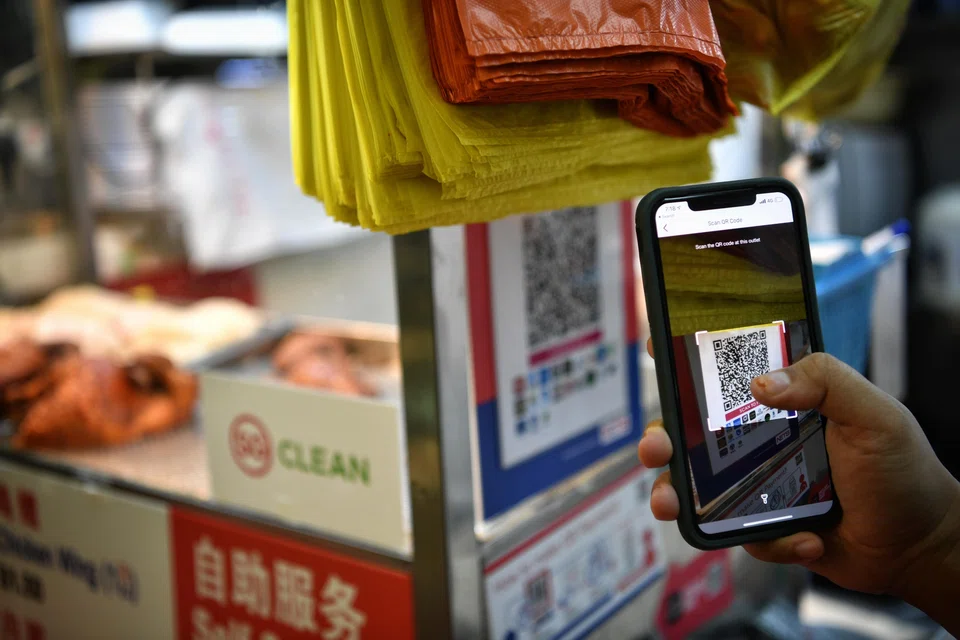
THE Monetary Authority of Singapore (MAS) will be trialling a new solution that is expected to improve the interoperability of the current Singapore Quick Response Code Scheme (SGQR), it said on Tuesday (Oct 31).
Through a proof of concept (POC) – conducted from Nov 1 to Nov 30 – MAS will explore whether it is feasible for merchants in Singapore to accept QR payments from a variety of payment schemes through a single financial institution.
SGQR, introduced in 2018, combines multiple payment QR codes into a single SGQR label. It has been widely adopted by merchants, but MAS noted that there’s scope to enhance the payments scheme.
Currently, merchants that wish to accept a range of payment schemes need to maintain commercial relationships with different financial institutions.
Meanwhile, consumers and tourists can only use their preferred payment applications if the merchant maintains a specific commercial relationship with the corresponding financial institution.
The new SGQR+ scheme is expected to increase the number of payment methods that merchants can accept.
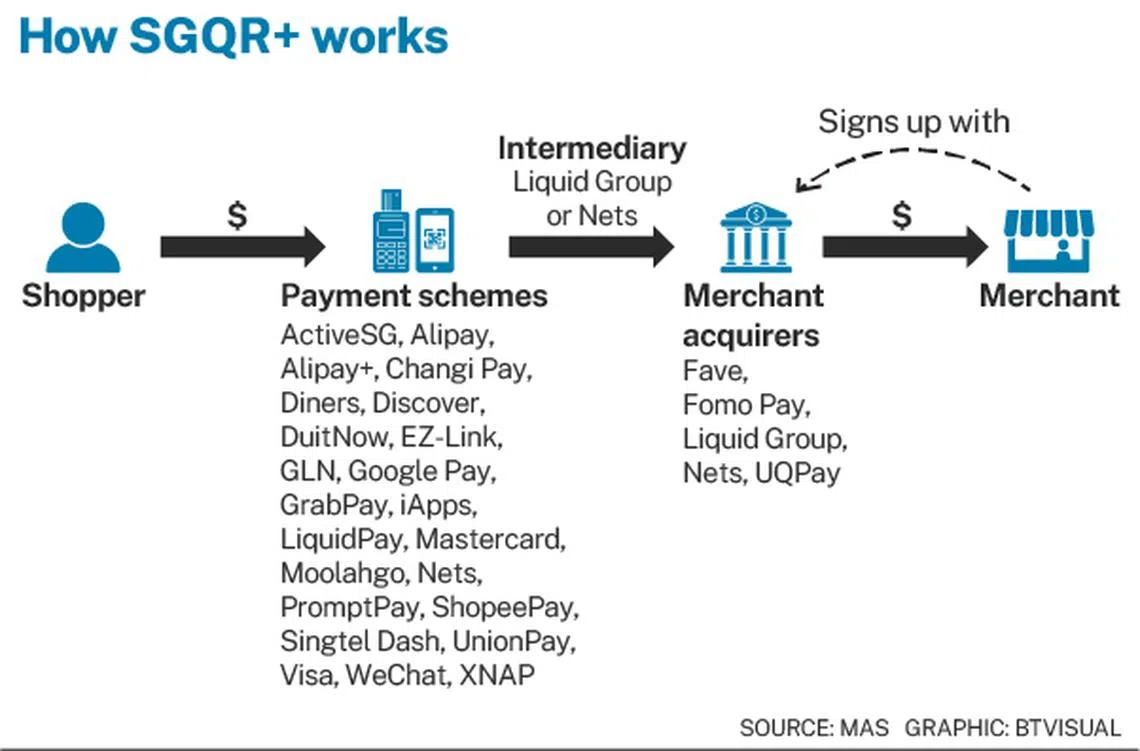
This would mean that merchants will only need to sign up with a single merchant acquirer to receive payments from a diverse range of local and cross-border payment schemes. Merchant acquirers are companies that help businesses process payments for a fee.
Merchants will also no longer need to maintain commercial relationships with several merchant acquirers to accept different payment schemes.
Mervyn Lee, corporate services manager at Arnolds Fried Chicken, said that under the current SGQR system, he would be hesitant to adopt more payment methods due to the additional work needed to reconcile different merchant acquirer accounts.
As employees occasionally record cash payments as Nets payments or vice versa, this creates confusion when the company’s books are reconciled.
If the company adopted more merchant acquirers, this could exacerbate the problem.
With SGQR+, he will be able to accept more payments from different payment schemes while receiving a single Nets statement – reducing the complexity of accepting more payment methods.
“(SGQR+) is definitely more efficient in the sense that I have less to deal with,” he said. “It’s more convenient, it saves me time.”
E-wallet provider Moolahgo chief executive John Hakim expects the SGQR+ scheme to widen the adoption of his e-wallet.
He said that previously, the company would have had to go through the difficult process of reaching out to different merchants or merchant acquirers to get its e-wallet accepted.
“With SGQR+, I would say that it’s actually very good progress in the right direction for the industry because it now opens up quite a number of app operators out there in Singapore (to be accepted),” Hakim said.
During the POC, SGQR+ will be rolled out with 23 payment schemes – including GrabPay, Nets, ShopeePay and UnionPay – across more than 1,000 merchant acceptance points, at the venue of the Singapore FinTech Festival and in the Changi district.
Consumers can also use their preferred payment applications at more merchants, while tourists can transact with their native payment applications. Malaysia’s DuitNow, Thailand’s PromptPay as well as China’s WeChat Pay and Alipay are some of the foreign payment schemes that will be accepted as part of SGQR+.
In addition, payment apps, such as fintech company Liquid Group’s XNAP, will also allow customers to make QR code payments with their credit cards.
This will be conducted through two separate schemes, featuring technology solutions by Liquid Group and Nets respectively.
Nets will allow consumers to scan and pay at Nets’ participating merchants, which include local and foreign payment schemes.
While Nets’ solution is already available to those under the Hawker Go Digital programme, the POC will test the commercial feasibility of deploying the solution across other segments, with merchants paying for the service, MAS said.
At the same time, Liquid Group will operate a switch that processes payments between the merchant acquirer serving the merchant, and the payment issuer serving the consumer through their schemes.
For instance, a customer using ShopeePay will be able to make payment to a merchant that engages the services of Fomo Pay, a merchant acquirer, over Liquid Group’s switch.
As the merchant-acquiring landscape is levelled with similar access to all payment apps, merchant acquirers see themselves finding niches among different types of merchants.
Liquid Group chief executive Jeremy Tan said that consumers instinctively choose to use certain payment methods when they make different payments.
For instance, people may use more credit cards for bigger-ticket items such as travel and lifestyle consumption, while they may use PayNow for smaller transactions.
“The key difference between the two tracks is, basically, people need to see which is the relevant user that they’re catering to,” he said.
Nets chief executive Lawrence Chan said that the network’s strength is in handling everyday needs, such as daily meals and transportation.
“Like in any payment option, we will serve one segment more than another segment, but generally across segments we do serve more everyday needs,” Chan noted.
TRENDING NOW

Philippine power giant First Gen rebuffs foreign offers, plans up to US$2.6 billion in expansion

Cliff Tan has 7 million followers and a 4-month waitlist. Why won’t he expand his business?

Could stablecoins be the future of money?

From finance aspirant to Asean CEO: TUV SUD’s Jonas Strahberger on finding people who believe in you

