MAS chief flags AI investment boom as key risk to global financial stability
MAS, ABS set up task force to boost cyber, technology resilience against AI-driven threats

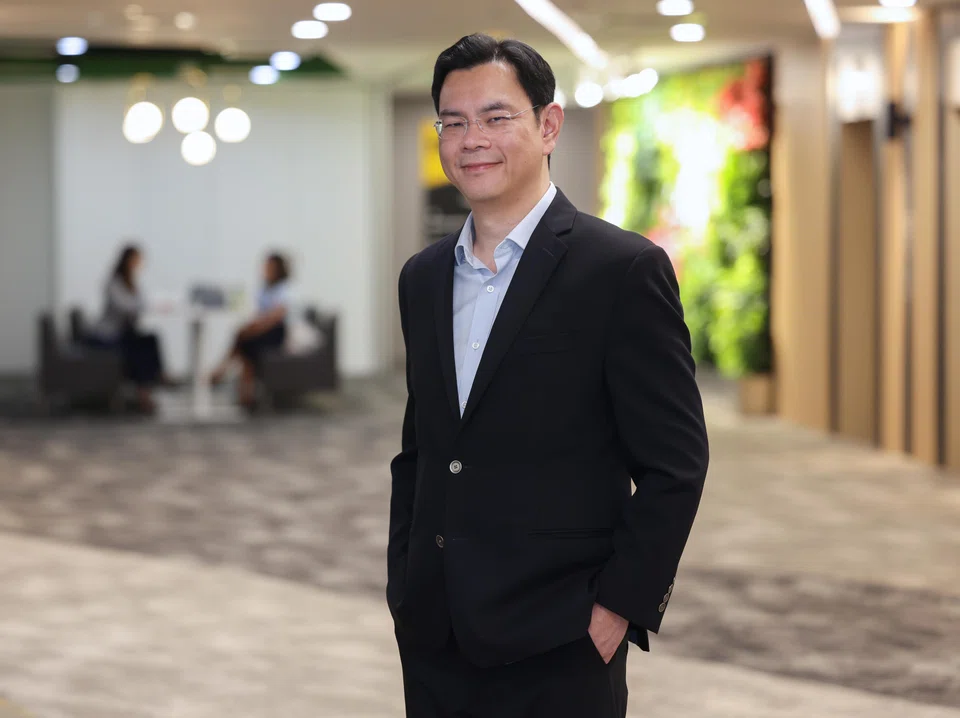
[SINGAPORE] The sustainability of the artificial intelligence investment boom has become a key area of risk for global growth and financial stability, said Chia Der Jiun, managing director of the Monetary Authority of Singapore (MAS).
This comes as global growth, investment and financial market performance have become highly dependent on projections of large and increasing investment in data centres and semiconductor chips, especially in the US and in semiconductor-exporting Asian economies, Chia said at the release of MAS’ annual report on Tuesday (Jul 28).
“While near-term investments are supported by committed orders and strong hyperscaler cash flows, there is greater uncertainty around the sustainability of these investments in the medium term,” he said.
Chia pointed out that markets will increasingly be looking to commercial revenue growth to justify the financing risks.
“Revenue growth will in turn depend on early signs of AI productivity gains at the firm level broadening across the economy and a deepening of transformative applications,” he added.
Chia noted two potential outcomes of the AI investment boom.
If the AI investment boom persists due to accelerating revenue growth and broadening productivity gains, it will have an impact on income, demand and inflation. This would affect how central banks assess their interest rates.
Meanwhile, a cut in AI investments could rapidly weaken global growth through a fall in business investments and semiconductor demand and a rise in negative wealth effects.
This could also cause a swift tightening of global financial conditions, as it poses risks to financial stability due to the exposure of equity, credit and loan markets to unsustainable business models.
SEE ALSO


“Given the high growth that we’ve experienced, it can be quite a sharp turn, and that can be quite damaging to growth and damaging to financial markets,” he noted, adding that the high stakes underscore the importance for markets and the corporate sector to find a sustainable path.
Tackling risks from frontier AI models
While MAS is closely watching the macroeconomic implications of AI, it is also stepping up efforts to address the technology’s growing risks to the financial system.
On Tuesday, MAS and the Association of Banks in Singapore (ABS) announced the AI-Driven Cyber and Technology Risk Taskforce, to strengthen collective cyber and technology resilience in response to the emerging risks posed by frontier AI models.
The task force consists of members from MAS, ABS, DBS, OCBC, UOB, the Singapore Exchange, Nets and Banking Computer Services.
This comes as advances in frontier AI and quantum computing are creating more risks in the fight against scams and cyberthreats, Chia said.
With AI, phishing can be made more personalised and persuasive at scale, using deep-fake impersonation, the customisation of scam messages and other deception tactics.
Meanwhile, frontier AI technology can rapidly identify and exploit vulnerabilities as well as automate attacks at scale.
“AI and cyber developments are changing rapidly and there is a need to continually assess the threats posed and strengthen resilience measures,” Chia said.
He expects quantum computing to pose significant risks in the medium term to the security of data and communications used by financial institutions.
MAS will thus issue a set of supervisory expectations later this year with clear expectations, milestones and timelines for financial institutions to build resilience as they migrate towards quantum computing.
At the same time, the banks must harness AI and strengthen their controls.
MAS is testing whether AI models trained on data across banks as well as the public and private sectors can improve the overall detection of scam transactions.
It expects the findings to be ready next year, and to help determine the case for setting up an industry-level utility to pool data and employ AI.
Since July, MAS has also required key financial institutions to use advanced AI models, to identify potential attack paths that could enable cybercriminals to disrupt critical services or gain access to sensitive customer data.
Lessons learnt from these exercises will be shared with the broader industry.
MAS will soon issue supervisory expectations for key financial institutions to develop and submit comprehensive assessments and action plans to strengthen their defence against AI-enabled cyberthreats.
Going forward, Chia expects the AI investment boom to continue to boost economic growth in the near term.
“Beyond that, it’s something we’re all watching, and there’s lots of people in the markets that are also fine-tuning their assessments of sustainability,” he noted.
“It is potentially highly transformative and can have good outcomes, but I think we have to guard against outcomes that will be destabilising.”
Decoding Asia newsletter: your guide to navigating Asia in a new global order. Sign up here to get Decoding Asia newsletter. Delivered to your inbox. Free.
Copyright SPH Media. All rights reserved.