MAS, banks seek to calm investors amid potential credit crunch, heightened recession risk



Yong Jun Yuan ,
Uma Devi &
Michelle Zhu
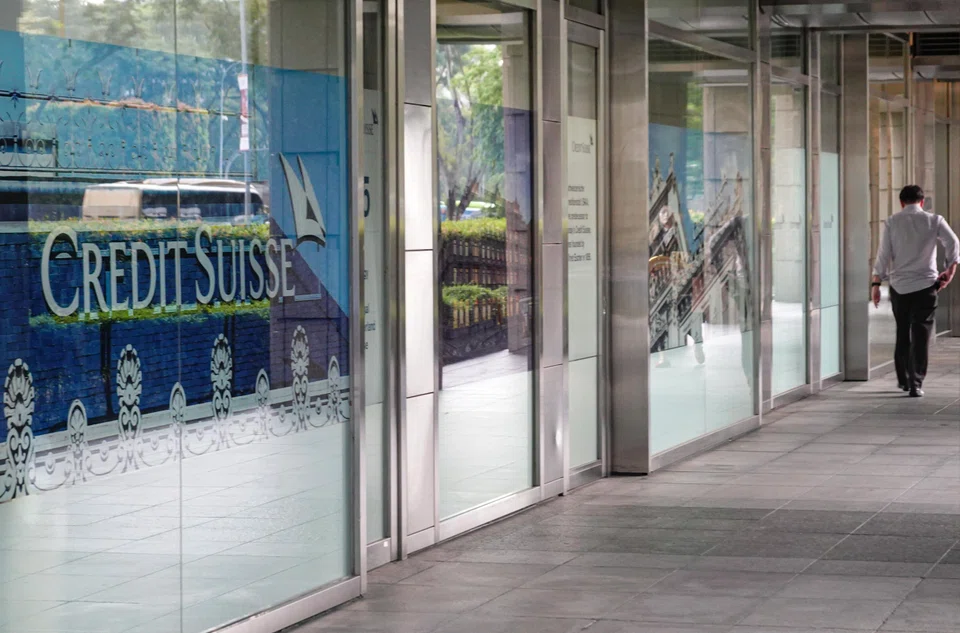
CREDIT Suisse Group will “continue operating in Singapore with no interruptions or restrictions” following its announced takeover by UBS, the Monetary Authority of Singapore (MAS) said. Meanwhile, a spokesperson from the Swiss bank said it does not expect any disruptions to client services.
The kneejerk reaction to the news that UBS will take over Credit Suisse was negative when Asian markets opened on Monday (Mar 20), though. And market observers expect to see risk-on sentiment pile on in the week ahead.
“MAS will continue to closely monitor the domestic financial system and international developments, and stands ready to provide liquidity through its suite of facilities to ensure that Singapore’s financial system remains stable and financial markets continue to function in an orderly manner,” said the central bank in a statement on Monday.
It said it does not expect UBS’ acquisition of Credit Suisse to have an impact on the stability of Singapore’s banking system.
Customers of Credit Suisse will continue to have full access to their accounts, while the bank’s contracts with counterparties remain in force.
MAS will remain in close contact with the Swiss Financial Market Supervisory Authority (Finma), Credit Suisse and UBS to facilitate an orderly transition, including addressing any impact on employment.
In response to media queries, Credit Suisse said it does not expect any disruptions to client services and that the bank is “fully focused” on ensuring a smooth transition and seamless experience for its clients and customers.
The bank added that its Asia Investment Conference, to be held in Hong Kong from Mar 21 to Mar 23, will go ahead as planned.
DBS analyst Yeo Kee Yan said news of the Credit Suisse takeover is unlikely to lift investor sentiment, as the move also saw the complete write-off of the bank’s Additional-Tier 1 (AT1) bonds.
“This led to a sell-off in the AT1 bonds of some Asian banks, pulling down bank stocks as a result,” he said.
Bank stocks under the microscope
As scrutiny of the banks intensifies, Singapore’s banks are looking sound.
Phillip Securities research analyst Glenn Thum noted that Singapore banks’ capital and leverage ratios are comparable to those of Credit Suisse, but that they are much more profitable.
With a focus on net interest income growth, Thum said, the trio had returns on equity (ROE) of around 12.5 per cent. In comparison, a large part of Credit Suisse’s revenue comes from commissions and fee income generated by its investment banking operations. Credit Suisse had an ROE of negative 16 per cent.
Maybank analyst Thilan Wickramasinghe said that although near-term sentiment could be impacted, better disclosures from banks could still lend support to prices.
“The Singapore banks are well-capitalised with strong liquidity metrics. They are also unaffected by the balance sheet uncertainty driven crisis of confidence that the US and European banks are undergoing,” he said.
Investors will nevertheless be “running a fine-tooth comb” through the capital structures of any bank stocks they hold, said a fund manager who declined to be named as he is not authorised to comment. He expects investors will “take a measured approach and stay on the side of caution”.
Tightening financial conditions
John Briggs, NatWest global head of economics and markets strategy, was even less sanguine. He sees the possibility of a credit crunch in the medium term, even if near-term stress in markets abates.
“I am confident that credit availability and lending standards will be an increasing headwind to the economy,” he said. “This is not a small thing; credit is the grease to the economic machine.”
While the large banks might be fine, Briggs flagged risks from smaller lenders. He noted that these would also be the banks supporting small homeowners and businesses. Some companies could even pause near-term hiring as banks tighten lending, he added.
Rajat Bhattacharya, Standard Chartered senior investment strategist, was similarly cautious. He believes financial conditions may have tightened enough to cause a recession sooner than markets are pricing in. Inflation and job market performance have historically been lagging indicators, he added.
He recommended equity investors rebalance from developed market equities to more attractively valued Asia ex-Japan, particularly China, as Asian growth remains resilient, in contrast with looming recessions in the United States and Europe. The technology sector would be a proxy for those seeking to benefit from a potential pullback in interest rates, Bhattacharya added.
Oil under pressure, gold a safe haven
The threat of recession is likely to pile pressure on the price of oil while boosting the price of gold.
“A recession in the US now appears unavoidable with or without rate hikes, and this will dampen global commodity demand even as China continues to recover from lockdowns,” said Clifford Bennett, chief economist at ACY Securities.
Meanwhile, market watchers are revising up their gold forecasts.
“If market skepticism over the scope of financial sector fragility persists, the precious metal could soon be knocking on the door of the US$2,000 level,” said Tim Waterer, chief market analyst at Kohle Capital Markets.
Fitch Solutions raised its gold price forecast to US$1,950 per ounce from US$1,850 previously, while noting that mounting global financial instability could drive gold prices towards its all-time high of US$2,075 per ounce in the coming weeks.
The analysts warned, however, that “significant price volatility” can be expected in light of “high global financial turbulence”.
Capital market activities to slow
Robson Lee, a partner at law firm Kennedys, said the recent developments will undoubtedly have a “negative impact on fundraising capital market activities”.
He also said this current climate does not lend itself to companies looking to launch an initial public offering, as costs of funds are higher and there is great market uncertainty.
“Valuations are likely to be at the lower end of the price spectrum as the global market has yet to properly price the double whammy of burgeoning interests rates and the fallout from the banking industry crisis,” Lee added.
Banking jobs safe for now
Human resource professionals said the banking industry could see a freeze in hiring, but they do not expect mass layoffs.
Lenders here have “fundamental differences” from the US, said Randstad Singapore’s general manager of banking and financial services Lim Chai Leng. “Singapore thrives on a stable finance ecosystem that is supported by a diverse funding base in the region to weather potential global stressors.”
Chief executive of human resource consultancy Career Agility International, Adrian Choo, noted that the banks had already been streamlining their manpower over the past 18 to 24 months. “I think they’re already quite lean, and I’m not seeing many layoffs,” he said, adding that the uncertain economic climate had also led to a slowdown in hiring.
Choo noted that banks may take a wait-and-see attitude as they observe the impact of recent developments, which could lead to a momentary freeze in hiring, but he does not see layoffs on the scale of those seen in 2008, when the world faced a financial sector-triggered crisis.
Indeed, Chris Iggo, chair of the AXA Investment Managers (IM) Investment Institute and chief investment officer of AXA IM Core, said the current situation differs significantly from the 2008 financial crisis.
Challenges today are about interest rate risk and the cost of servicing debt, he said, whereas in 2008, they were about credit risk and weaknesses on bank balance sheets related to credit impairments.
“Interest rates can be cut more quickly than credit issues can be resolved, so we do not see the current situation being anything like 2008,” Iggo said, adding that he expects interest rates to peak at above 5 per cent.