

Remain excellent and adaptable to thrive as global gateway city: panellists
 Add BT as a preferred source
DeeperDive is a beta AI feature. Refer to full articles for the facts.
IN ITS quest to maintain its status as an exceptional global gateway city, Singapore will need to continue striving for excellence and stay adaptable as it navigates competing priorities facing its residents.
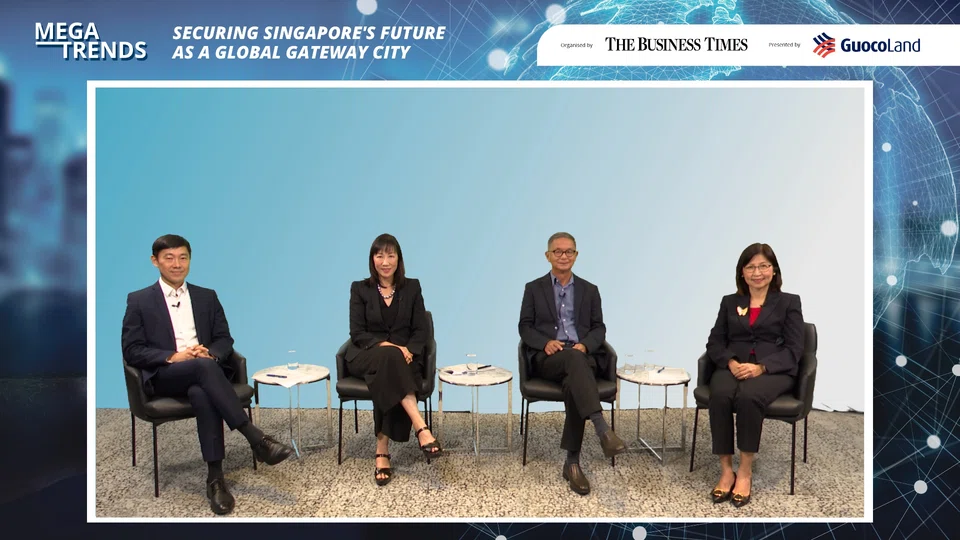
These views were expressed by Cheng Hsing Yao, GuocoLand’s chief executive; Deborah Ho, BlackRock Singapore country head and regional head of South-east Asia; and Khoo Teng Chye, chairman of Urban Land Institute Asia Pacific at a webinar titled “Securing Singapore’s Future as a Global Gateway City”.
The virtual event, held on Tuesday (Aug 23), is the second in a series of webinars on megatrends organised by The Business Times with property developer GuocoLand as the presenting sponsor. The panel discussion was hosted at Guoco Tower and moderated by Edmund Tie Holdings board member Ong Choon Fah.
BlackRock’s Ho noted that Singapore’s numerous awards in global and talent competitiveness did not happen by accident and were, instead, the work of generations prior that had set out to accomplish these goals.
“We all know how we’ve worked hard to ensure strong rule of law, political stability, low taxes and very importantly, the development of a strong financial system,” she said, adding that Singapore has kept up through challenging times with prudent reserves management.
Similarly, Cheng noted that there was something to be said for Singapore’s tendency in the past to chase superlatives in its pursuit of excellence, even if it was initially criticised for this.
Navigate Asia in
a new global order
Get the insights delivered to your inbox.
Since then, this has become one of the qualities that has defined Singapore as a city, with “all the engines firing at one go” in this pursuit of excellence, he said.
“It means that we always stay discontented, and we always want to outdo ourselves,” he added.
Cheng noted that there has been a tendency for some quarters in society to suggest that as Singapore has been successful, it can afford to ease up on the push for economic growth. This, he said, could not be further from the truth.


“Talent only goes to places where there are opportunities, where there are jobs, where they can find career progression…(these) come from economic development, from a vibrant economy, so it is still very important.
“You can have the most beautiful city, but if there are no opportunities, top talent will not hang around, so I think that that is something that we must never lose sight of,” he said.
Khoo cited the nation’s propensity for showing flexibility and resilience as something that has shone through, especially during the Covid-19 pandemic.
He brought up the example of shipping ice cream from Western Australia to Japan and how it has been well-recognised that the fastest way to do so would be through Singapore’s ports, instead of sailing directly between the 2 places.
Numerous factors, from PSA’s efficiency to the technology it employs to keep the ice cream cool, have set it apart from its competitors in the region.
“With all the supply chain bottlenecks going on everywhere in the world (during the pandemic), PSA was able to create value by being a catch-up port,” Khoo said.
Still, in the face of increasing balkanisation and protectionism, Ho said that Singapore will need to continue showing that its doors remain open to foreign trade and investment.
“The world is a changing place, but to be able to have a place where the bedrock, whether it’s infrastructure, the legal system or the quality of talent are going to be excellent, I think it’s something that businesses really need,” she said.
Citing the examples of Changi Terminal 5 and Tuas Mega Port, she said that she remains confident in Singapore’s ability to execute long-term plans.
While Singapore remains open to global talent, Ho added that the nation should also have faith in its own ability to compete.
“Let’s not forget that our talent is global standard, and the more that we are able to be welcoming and open to people from other parts of the world bringing different things to the table, the better off we’ll be,” she said.
Khoo, who is also a practice professor with the College of Design and Engineering at the National University of Singapore, further emphasised the importance for younger generations to understand how to take a systematic approach towards solving the complex problems that Singapore will face in areas such as climate change and an ageing population.
For instance, a plot of land could be used to build housing, attract industry for development or conserved as a green space.
While different stakeholders could compromise on some of these issues, he hoped that we would be able to innovate and come up with new ideas to minimise the need for trade-offs.
“Hopefully, as we solve some of these very difficult problems, we also become a hub for knowledge for other cities wanting to find out how Singapore did it,” Khoo said.
He added that the government has experimented with assisted living public housing in Bukit Batok, where the elderly can take up a 15-year lease and services like basic health checks and emergency monitoring.
In March, the government announced that the pilot would be expanded to new flats in Queenstown’s health district.
Another way that Singaporeans could adapt and innovate could be in the development of more mixed-use developments, said Cheng.
He noted that Singaporeans have generally aspired for bigger homes as a means of improving their quality of life. However, he also believes that quick and easy access to amenities like MRT stations and groceries could play a role in improving quality of life.
“I think there are ways that perhaps, the planning, development and design community can actually work on more ideas to make living better as a way to meet aspirations, as opposed to (just being) a space mathematical equation,” he said.
As for the development of new spaces, Cheng said that GuocoLand adopts a holistic way of looking at value and tries to uplift the neighbourhoods where it builds.
“Often it comes down to the public realm, how can we introduce more public spaces and form connections and connectivity to the neighbours. Other times, it is also to have a more respectful kind of urban design,” he said.
For example, he said that Guoco Midtown’s ground level is designed to respect the shophouses in its vicinity so that even as the development is built, it has a kind of relationship to the scale of the neighbourhood. Such measures help to create value for both the surrounding properties and the development itself.
“If we take a longer-term perspective of (not just) building a brand, but also the longer term value of our property, these things that may not seem to have commercial value are actually tremendously valuable in the long run,” he said.
Watch the full webinar here.

Decoding Asia newsletter: your guide to navigating Asia in a new global order. Sign up here to get Decoding Asia newsletter. Delivered to your inbox. Free.
Copyright SPH Media. All rights reserved.
TRENDING NOW

Shelving S$5 billion office redevelopment plan proved ‘wise’ as geopolitical risks mount: OCBC chairman

OCBC is said to emerge as lead bidder for HSBC Indonesia assets
Middle East-linked energy supply shocks put Asean Power Grid back in focus

Eurokars Group introduces rental car franchises Enterprise Rent-A-Car, National Car Rental, and Alamo to Singapore

