Mencast looks to free up space, raise cash
CEO Glenndle Sim laying the blocks for transformation of maintenance, repair and overhaul-focused business; using 'digital twin technology', it stands to release land used to store inventory, divest existing properties and generate cash to pare down loans.
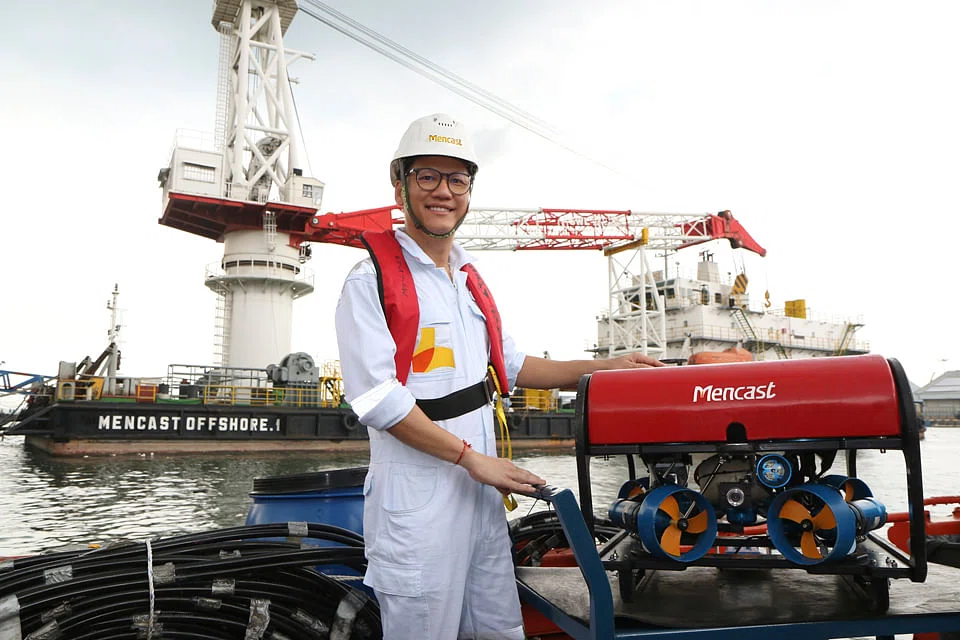
EVEN when facing adversity, Mencast executive chairman and CEO Glenndle Sim does not lose sight of his aspiration - he believes that the small-cap business he inherited from his father has the potential to evolve.
Like many offshore and marine (O&M) players that have tapped debt financing for expansion during better days, Mencast has to go through painful debt restructuring in order to ride through the tail-end of a protracted sectoral downturn.
However, unlike some of his peers who are still caught up in the daily struggles of making ends meet, Mr Sim has gone one step further to look at building sustainable value-add in Mencast's business.
There are good reasons for doing so. Even with oil prices breaking through US$80 a barrel, oil companies have not shown any sign of letting up on cost-cutting.
That is bad news for bottom-feeders such as Mencast - they can no longer count on fat margins getting passed on from oil companies to contractors that count as key clients for these SMEs' businesses.
To break out of this gridlock, Mr Sim argues for Mencast and its peers to emulate three key strengths of Mittelstand companies - small and medium enterprises (SMEs) that account for two-thirds of Germany's exports. These are: long-term customer focus, collaborative work style and continual innovation.
He believes that with these key strengths, SMEs here stand to beat the odds and emerge stronger.
The Mencast CEO has already been laying the blocks for the transformation of the maintenance, repair and overhaul-focused (MRO-focused) business and his labours are bearing fruit on several fronts.
In the second half of this year, Mencast and its partner, HTC Asia, expect to roll out their first MRO projects to be performed using a digital twin technology that Mencast has helped incubate since February 2017.
A digital twin is a virtual model of a product - in the context of the O&M industry, this could be a ship, rig or other floating structures.
The pairing of the virtual model with the physical ship allows for data analysis on ship components that in turn can be used for corrective actions to help extend the ship's life.
Mencast and HTC Asia hold an exclusive licence to distribute this technology, which can be used to pre-empt the need for spare parts and components before vessel arrivals.
With the digital twin technology, Mencast stands to free up land used to store inventories. Mr Sim is thus looking to divest existing properties. This will raise cash to pare down bank loans, which now stand at just under S$200 million.
Separately, Mencast has seen its customers returning to place more orders even with contracting activity slowing drastically in this downturn.
In March, Mencast disclosed contracts worth about S$5.6 million including the manufacturing and supply of shipsets.
BT understands that one unidentified customer behind the order of these shipsets is Penguin International, another small-cap listed firm on the Singapore Exchange. Penguin is said to be building over 20 aluminium vessels of various sizes in its Singapore and Batam shipyards.
Without commenting directly on the recent order, Mr Sim describes the working relationship between Mencast and Penguin has transcended that of a supplier and a customer.
He cites Mencast's involvement in the development of Penguin's new Flex-42X crew boat as one example. The 42-metre vessel, seating 80 passengers in business class comfort, can hit a speed of 30 knots, a record in its class.
To deliver this level of performance, Penguin and Mencast have worked to develop the propulsion solution. The end result, he adds, is "a solution that is much better than what each of us could deliver individually".
Mencast has benefited from this block of trust its CEO has earned over the years from the firm's clients. Penguin's managing director James Tham says: "Glenndle has a good sense of his business from the ground up. He is hands-on and switched-on."
Mr Tham adds that Penguin is mindful of being "part of a local eco-system made up of other homegrown companies that have achieved success in their own ways".
"In good times and bad, we give to and take from this ecosystem . . . Our relationships are built on professionalism, mutual respect and shared values as fellow SMEs."