

Markets cheer Singtel’s special dividend; company posts 23% higher H1 profit


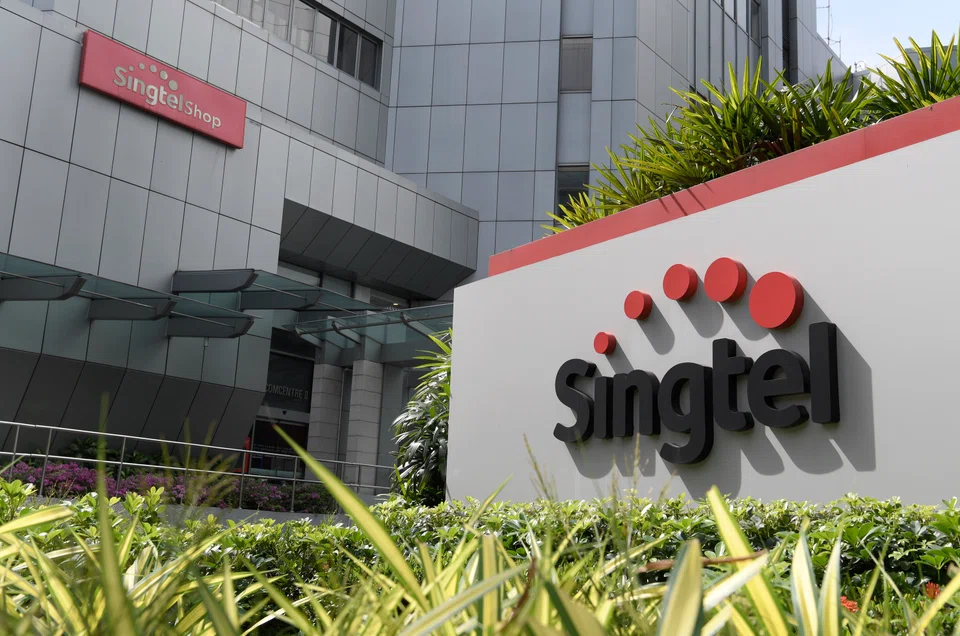
TELECOMMUNICATIONS giant Singtel reported net profit of S$1.17 billion for the first half ended Sep 30, up 23 per cent from H1 FY2022.
This comes after booking a S$1 billion net exceptional gain from the group’s partial divestment of its stake in Airtel, a turnaround from the net exceptional loss the previous year.
The group on Thursday (Nov 10) declared an interim dividend of S$0.046 a share; a special dividend of S$0.05 a share for FY2023, to be paid in two tranches of S$0.025 each, will also be given with the interim and final ordinary dividends.
Both the interim ordinary dividend and the first tranche of the special dividend will be paid on Dec 9.
Markets cheered the move to declare a special dividend, with Singtel shares rising as much as 3.9 per cent, or S$0.10 to S$2.65 in early morning trade.
Yuen Kuan Moon, group chief executive of Singtel, said that the dividend payouts bear testament to Singtel’s proven asset-recycling model.
“We are sharing the benefits by returning excess cash to our shareholders after setting aside capital for our growth initiatives,” he noted. “With the S$2.5 billion we raised from partially divesting our direct stake in Airtel, we’ve recycled some S$6 billion in the past 18 months since setting out to proactively monetise our assets to achieve better capital efficiency. We’ve also reduced our net debt by nearly a third from a year ago to buttress our balance sheet in these uncertain times.”
Group operating revenue fell 5 per cent year on year to S$7.26 billion from S$7.65 billion a year ago, due to adverse currency effects and the absence of revenue from national broadband network (NBN) migration and Amobee.
For the same reasons, earnings before interest, taxes, depreciation and amortisation (Ebitda) fell 3 per cent on year to S$1.88 billion. Earnings before interest and tax notwithstanding associates’ contributions rose 1 per cent to S$579 million.
In Australia, a combination of interest rate hikes, softer consumer and business sentiment, as well as a weaker Australian dollar resulted in a non-cash impairment charge of S$1 billion on Optus’ goodwill.
Singtel group chief financial officer Arthur Lang said that the rising interest rate environment was the main reason for the impairment charge on Optus’ goodwill.
“When we take an impairment, we want to do it (in a way that) reflects, I would say, conservatively, the current macroeconomics,” he explained.
A provision of A$142 million (S$127.7 million) has been made and recorded as an exceptional expense following the September 2022 cyberattack on Optus. Singtel said the provision is for a programme of customer actions, including an external independent review, third-party credit monitoring services and the replacement of identification documents, where needed.
As the company has not been levied any formal fine or penalty, Lang noted, the provision does not cover any potential fines.
In addition, Optus chief financial officer Michael Venter said that it is still too soon to say when churn rates, which rose in the aftermath of the attack, will fall to pre-attack levels.
“Also, it’s partly the actions that we took – we pivoted the whole organisation to support customers hit by the cyberattack, and we switched off all the advertising and switched all the sales channels to assist customers in those early periods.
“Some of those have now come back on again, and so we are starting to see the churn rates improve,” he said.
Regional associates’ pre-tax profit contributions rose 15 per cent to S$1.16 billion from S$1 billion the year before, which the group credited to Airtel’s “standout performance in India”, as it grew its average revenue per user through higher usage and tariff hikes.
Lang added that Airtel could record stronger growth in the enterprise and fixed broadband space than in the mobile space, and that the company remains confident in the Indian market.
However, Yuen said that Singtel will continue to track how macroeconomic headwinds affect the Indian market. Airtel’s contributions could also come up against challenges in Africa as a result of foreign exchange exposure to some African countries.
While other associates booked higher revenues during the period, their profit contributions were affected by the depreciation of regional currencies. Singtel said that its associates’ pre-tax contributions would have grown by 18 per cent had these currencies remained stable from the same period last year.
Singtel believes that it is well-positioned to weather macroeconomic headwinds down the road, and said it remains focused on executing its strategic reset.
Yuen said that the company has observed a tight correlation between the company’s share price and its return on invested capital (ROIC). To address the company’s share valuation gap, he said that it will target high single-digit percentage returns in the short to medium term, and double-digit percentage returns beyond that. This is up from an ROIC of just over 5 per cent last year.
The counter closed up 3.1 per cent, or S$0.08, at S$2.63 on Thursday.
TRENDING NOW

Once staunchly pro-China, Malaysian Chinese businesses are now distancing themselves from Beijing

Stocks to watch: HPL, Aims Apac Reit, Zico, Advanced Systems Automation, ComfortDelGro

‘How many will survive?’: Bubble fears arise as China’s humanoid robotics face reality check

Smaller board lots can’t fix a market run by three banks

