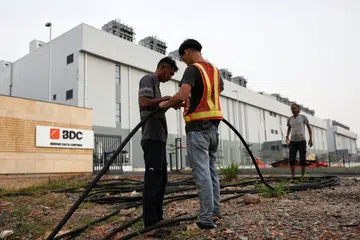
Memiontec eyes doubling market cap by 2026 with sights set on regional expansion


WATER treatment company Memiontec had a rough start as a listed company, launching its initial public offering (IPO) on the Singapore Exchange in February 2020 – just as the Covid-19 pandemic was unravelling.
In a recent interview with The Business Times, Memiontec’s chief executive Tay Kiat Seng recalled how the company had to cut its public float and settle for a lower price-to-earnings ratio because of poor market conditions and cautious investor sentiment. The group had also been hoping for a public float of 20 to 25 per cent, but was forced to trim this to 17 to 20 per cent.
Tay said the company “bit the bullet” and forged ahead with the listing anyway. But its problems did not end there, as the company’s order book and demand for its offerings were hit.
Although Memiontec was classified as an “essential” service in Singapore and operations were largely uninterrupted during the pandemic, Tay said the company’s order book would have been stronger if not for the pandemic. Margins and earnings would have been better too, he added, as the pandemic brought about a slew of problems, including higher costs and labour shortages.
More than two years after the company’s listing, with the pandemic’s effects gradually unwinding, Tay is hoping to catch a second wind.
The stock has gained 44.6 per cent this year, with most of the gains coming immediately following a 3-for-1 stock split in May. The company also managed to land a S$56.6 million contract from the Public Utilities Board for the installation of membrane bioreactor equipment in the second phase of the Changi Water Reclamation Plant. Announced in March, this is its largest contract to date.
Tay said he has specific plans to grow Memiontec. “We have a clear, concise business strategy that was developed together with global consulting firm McKinsey,” he said, adding that Memiontec is also exploring various fundraising opportunities using bonds, convertibles or share placements for its projects.
With this strategy in place, Tay is targeting a market capitalisation of S$500 million for Memiontec by 2026 – roughly double the company’s current value of S$231.3 million, based on its close on Friday (Nov 18) at S$0.35 per share.
Diversified player
Memiontec has close to 30 years of experience in water and wastewater management services in Singapore, Indonesia and China. The company began with TSEPC (total solutions with engineering, procurement and construction) projects, but Tay said the income from these projects was often “lumpy” in nature – meaning the group would only earn revenue on a per-project basis.
In search of recurring revenue streams, the group diversified into other areas.
To TSEPC, Memiontec has added three other segments: the operation, maintenance and service (OMS) of water treatment plants; the sale, distribution and trading of water treatment systems; and what it calls “sales of water”, which comprises build-operate-own-transfer and transfer-operate-own-transfer projects in Indonesia.
For transfer-operate-own-transfer projects, existing water treatment plants – along with ownership and operational rights – are transferred to Memiontec for up to 20 years. The asset is then transferred back to the owner, usually a government.
For build-operate-own-transfer projects, Memiontec is in charge of the construction of new water treatment plants. The ownership and operational rights are left to Memiontec for up to 25 years before being transferred to a new asset owner.
For the first half of 2022 ended June, Memiontec reported earnings of S$1.1 million – more than double the S$0.5 million in the corresponding year-ago period. This increase came despite a 39.8 per cent decline in revenue to S$16.2 million, and was attributed to higher margins from its TSEPC projects in Indonesia.
As at end-June, the group’s order book stood at S$121 million. The majority of these projects are expected to be substantially completed within the next two years.
Tay said demand for Memiontec’s services is expected to grow as countries such as Singapore and Indonesia continue to invest in water security and access to clean water.
Revised growth pillars, strategy
Memiontec’s revised strategy will see the group making strategic investments for recurring income in the sales of water segment, Tay said.
The company also has its eye on new markets, among them Vietnam. Tay reckons Vietnam will be a “big market” for the group, and said the company will look at merger and acquisition opportunities there.
“(Memiontec) is looking at Vietnam to acquire some build-operate-own-transfer projects, or to start work with some agents to do some of these projects,” he said.
Memiontec will also scale up project sizes and increase its footprints in Singapore and Indonesia, even as it looks to cut its overhead costs in Singapore. The company will also strengthen its sales distribution network in China, and identify and work with distributors in the region.
Tay believes Memiontec’s advantage over its competitors lies in the company’s presence along the entire value chain. While other companies can usually only provide solutions for water or wastewater, Tay added, Memiontec can do both.
In Vietnam, for instance, Tay noted that many companies in the water treatment industry do not have the relevant technology to convert seawater into drinking water. Such gaps in markets present opportunities for Memiontec, he said.
Although the economic environment is currently laced with uncertainty on the back of higher interest rates and rising inflation, Tay said he is confident that the demand for water treatment solutions will be strong in the near to mid term. The company will, however, remain “prudent” and not overspend on activities like hiring, he added.