Mooreast gets second wind from renewable energy business
It aims to have its renewable energy division account for over 80% of revenue by 2030, up from 10% currently

Sharon See
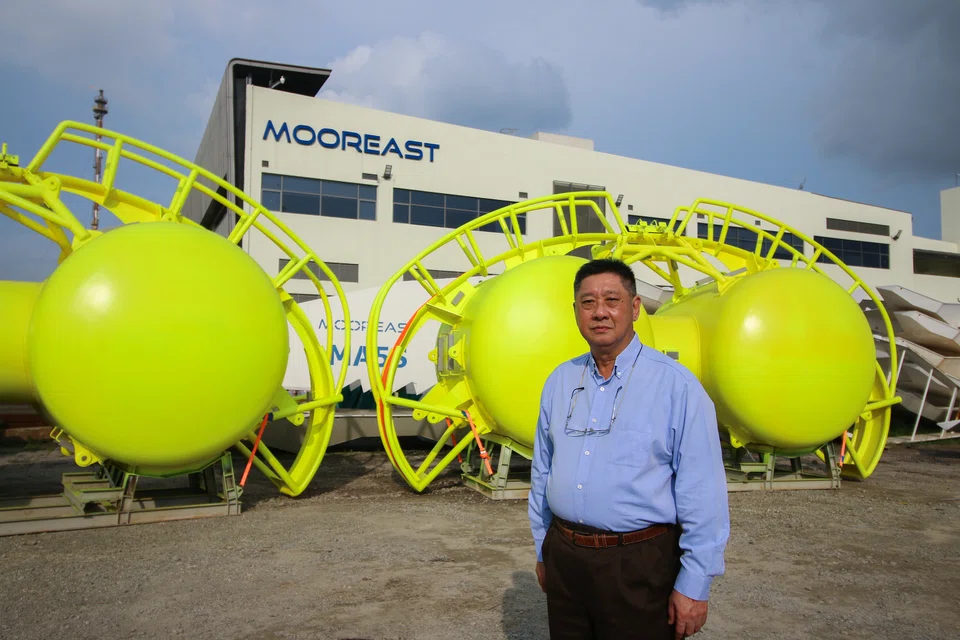
FOR the last three decades, Mooreast Holdings largely served oil and gas companies, helping to anchor rigs and perform other deep-sea operations.
But as the climate crisis deepens and demand for renewable energy soars, the mooring solutions company has found a surprisingly natural fit on the opposite end.
Instead of supporting oil rigs, it is anchoring floating wind farms instead, using similar technology.
Not only does this allow the company to capture a new and fast-growing clientele, it also lets it quickly scale up its offering due to the very nature of wind-farm operations.
While Mooreast’s regular anchors weigh 15 to 20 tonnes each, it is now looking to develop anchors that are 40 to 50 tonnes.
“Everything is supersized,” said Jaymes Sim, Mooreast’s commercial head. “The concept of designing is the same – the methodologies, the work that’s required is the same. But the challenges are slightly different because you have an extremely heavy and big turbine at the top that is constantly having wind blowing at it and trying to catch as much wind as possible, and you need that stability at the bottom.”
A turbine, he added, weighs about 1,000 tonnes. Consider, too, the fact that wind farms consist of multiple turbines and floaters per farm compared to an oil rig.
Depending on the type of floater used, the motion data or environment, three to six anchors may be needed to anchor a floater.
To build a 1 GW wind farm, up to 67 units of 15 MW wind turbines are needed, and these would be mounted on the same number of floaters. Such a set-up translates to the use of at least 200 anchors.
In comparison, an oil rig requiring “complicated mooring solutions” may use about 12 to 15 anchors.
Winds of change
It’s why the company expects its renewable energy division to account for 80 per cent to 90 per cent of its revenue by the end of this decade, up from slightly over 10 per cent currently, based on its financial results for the six months ended Dec 31, 2022. The bulk of Mooreast’s revenue comes from its mooring and shipyard business.
Sim Koon Lam, founder and chief executive of Mooreast, considers the pivot to renewables a “migration” of the business.
The experience, skills and know-how that the company has built up from its oil and gas business over the last three decades is being transferred to the renewable energy sector.
“We basically transformed ourselves into that, so it’s not a loss of knowledge,” said Sim, who is also Jaymes’ uncle. “What we do in oil and gas, and what we’re doing with renewables technology-wise, there are not (many) changes. But the mindset has to change.”
Jaymes Sim added that the perception held by people within and outside the industry is different.
“For example, you might say that we are working our way towards renewable energy, but actually the developers are telling us, ‘please come over, we don’t have enough supply’,” he said.
Japan has been a key market for Mooreast since 2013, with the country eager to source for clean energy solutions after a severe earthquake led to a nuclear disaster in Fukushima in 2011. One of the company’s recent projects involves delivering 15 mid-water arch buoys for Japan’s first commercial floating wind farm in Nagasaki, built by a consortium led by Toda Corporation.
Mooreast’s other important markets in Asia include South Korea and Taiwan.
More recently, Europe and the United Kingdom have emerged as a lucrative market – demand for renewables there has spiked since the Russia-Ukraine war last year sparked an energy crisis.
In February, Mooreast inked a collaboration agreement with ETZ, a non-profit company tasked with accelerating energy transition across north-east Scotland. The two companies will explore establishing a manufacturing facility in Aberdeen for the production of subsea foundations, as well as the consolidation and assembly of mooring components for floating wind farms.
These investments come at a time of sluggish growth in Europe, but Sim Koon Lam is unfazed as he eyes more opportunities in France, Germany and the Netherlands.
“They will definitely be more cautious on investments, but (focusing on) renewables is a whole-of-EU decision. They are pushing forward because they already face a challenge – either they have to pay a higher cost for gas or oil, or they have to look for another alternative,” he said, adding that he believes the European Union’s (EU) renewable push could in fact help its economy recover more quickly.
Thriving against the tide
Sim Koon Lam is no stranger to taking seemingly counterintuitive actions in the face of macroeconomic challenges over the years. One example is the July 2021 acquisition of the company’s current site, which spans three hectares, at 51 Shipyard Road in Tuas.
“It was basically the market downturn” when the company took over the site, he said, adding that he found the opportunity to take up a facility “reasonable”, “but a lot of people are saying I bought cheap”.
He added that “another crazy move” was to list the company in 2021, even as naysayers questioned why he made these decisions while the market was down.
“First of all, I think when the market is down, you can pick up a lot of cheap and good things,” he said.
He also saw the slowdown as an opportune time to “get ourselves prepared, get ourselves ready” to capture new opportunities when they came. This line of thinking, he said, was sparked by oil price plunges in 2013 and 2014.
Still, these moves may have caused the company to sink in the red for a while, Sim Koon Lam said. Mooreast incurred a net loss of S$2.26 million in FY2021. Excluding one-off expenses for its initial public offering (IPO), its net loss was S$1 million.
For FY2022, Mooreast turned a net profit of S$1.44 million, a result Sim Koon Lam attributed to having “worked hard”.
But even as the company pulls out all the stops to ride the winds of change, there are limitations and challenges beyond its control, he said.
“Yes, everybody wants to move forward and move faster, whether it’s in Asia or in Europe, but there are a lot of things that are still not ready,” he said. For example, supply chain challenges have not been completely resolved, and skills “lost” during the Covid-19 pandemic have worsened the manpower crunch.
There were more people laid off in the downturn, and the pandemic also led some to re-evaluate their priorities – for instance, preferring to work for the gig economy than in the shipyard, he reckoned.
With the increasing attention on renewable energy, though, both Sim Koon Lam and Jaymes Sim are hopeful this could draw more young people to the industry – especially those who want to do more to save the environment and reduce the impact of global warming.
“Unlike in oil and gas, where you’re just working for maybe your pay... I think globally, (in) the renewable energy sector, especially in Europe, (people) see it as a duty, that this is” giving back to society, said Sim Koon Lam.
For the rest of the year, he considers the outlook to be “challenging”, given that supply chain bottlenecks have not eased even with the fading of the pandemic, due to the gloomy economy as well as other uncertainties.
That said, with the Asian and Australian markets picking up, Sim Koon Lam said the company is also concerned that its Singapore facility, where all its products are manufactured, may not have sufficient capacity.
“At the moment, we are sourcing and looking at alternative solutions outside of Singapore,” he said.
Meanwhile, the company is also on the lookout for suitable targets to acquire, given it had allocated S$1 million from its IPO proceeds to mergers and acquisitions. However, Sim Koon Lam said the budget is potentially higher than that.
He said: “We haven’t stopped, we’re still looking… something that is in line with the direction we want to go, like renewables.”