

More drone applications in South Asia, greater demand for retirement living in Australia to drive Thakral’s growth
The biggest contributor to the company’s earnings comes from its associate GemLife, a resort living developer targeting retirees

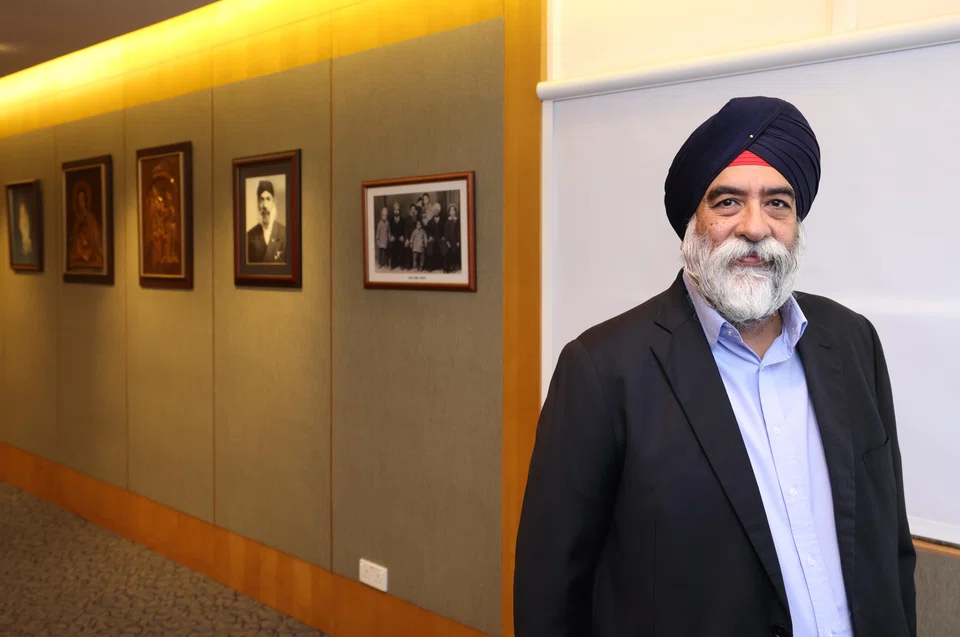
[SINGAPORE] Drone manufacturer DJI has been running tests in the Himalayan mountain range in Nepal, with unmanned aerial vehicles that could remove debris – which increases the risk of an avalanche – left behind by climbers on Mount Everest.
The growing number of drone applications has helped boost the earnings of Thakral Corporation , a diversified company that distributes electronics and lifestyle products including those of DJI, as well as invests in property.
And its chief executive officer, Inderbethal Singh Thakral, is confident that its distribution of DJI drones in South Asia will continue to drive growth.
“Drones are (covering) such a vast area. For us, every new application means more revenue in the future – so we are very excited about this whole space,” Bethal, as he is popularly known, told The Business Times in an interview.
Besides environmental monitoring, drone applications are increasing in other sectors as well, including surveillance for mining and energy companies, as well as last-mile delivery for pharmaceutical firms.
“DJI is very good at product development, and it’s very good at getting its products up and taking the full market share once they launch,” Bethal added.
Thakral’s revenue from the sale of drones in South Asia jumped 39 per cent in FY2024 to S$151.9 million, from S$109.1 million in the previous financial year, its earnings release on Feb 27 indicated.
This was the biggest jump in revenue among the company’s business segments in the period. Overall, the group reported S$288.8 million in full-year revenue, a 36 per cent year-on-year rise from S$212.3 million.
Real estate investments
However, the biggest contributor to Thakral’s net profit came from its investments in its associate GemLife, a resort living developer targeting retirees in Australia.
Thakral’s share of profits from its associates came in at S$22.5 million for FY2024, down 35.2 per cent from the S$34.8 million in FY2023. But this was mainly because it reduced its stake in GemLife to 31.7 per cent as part of a restructuring exercise.
The company’s full-year net profit more than trebled to S$28.8 million from S$8.2 million over the same period.
Therefore, Bethal has also identified this segment as a major growth driver for Thakral in the coming years.
“A lot of smart capital is being used, and that’s why our returns are very strong.”
Inderbethal Singh Thakral, CEO of Thakral Corporation
This goes with the philosophy the company has held since it was founded in 1905 – which is to make money from trade and park the profits in property, the CEO said.
He also noted that in Australia, listed competitors in the resort living space have a price-to-earnings ratio of about 22, whereas Thakral’s is at around 3. “That’s a far cry, right?” he added.
This is despite Thakral’s share price rising more than 30 per cent over the last year. The counter finished at S$0.81 last Friday (Mar 7).
GemLife has started development on 12 resorts, with some 1,800 units already occupied as at December 2024. There are 6,500 homes in the pipeline that Bethal hopes to sell by 2033.
What separates this investment from conventional real estate developments is the lower amount of capital required. While GemLife constructs the necessary foundation, the actual house is built only after it is purchased by a buyer.
“That also reduces our risk profile, while (letting us) grow with a smaller balance sheet. So a lot of smart capital is being used, and that’s why our returns are very strong,” said Bethal.
“This business model is very unique. You make your normal developer’s profit when you construct the product”, and then gain recurring income from weekly management fees, he added.
GemLife had to pause its sales as demand was outstripping supply, but it recently restarted them.
Thakral first invested in the developer nine years ago, while it was exploring ways to stabilise its earnings and create value.
“GemLife is definitely a value creation right now,” Bethal said.
Lifestyle and other investments
As for Thakral’s fragrance distribution business in China, Hong Kong and Macau, Bethal said there was plenty of room to grow, since the company currently occupies a small and niche share of a very large market.
While sales slowed down in the last few years due to the Covid-19 pandemic, they are picking up again in China with more funds entering the market.
“It’s nothing close to saturation – we haven’t even tested the waters. That’s why we are quite confident in our business model, that we’re in the right place,” said Bethal.
Thakral also launched a new investment arm during the pandemic to explore investing in frontier technologies. It has injected capital in two climate tech startups as well as a tokenisation venture, among others.
However, the company has decided to ringfence these investments for now, as its other business segments are hungry for capital, Bethal said. He added that Thakral has also adopted a wait-and-see approach.
“If we have an exit, then we can go and recycle the capital there. But more or less, for now, (we’ll just park the funds where) they are.”
TRENDING NOW

Once staunchly pro-China, Malaysian Chinese businesses are now distancing themselves from Beijing

Stocks to watch: HPL, Aims Apac Reit, Zico, Advanced Systems Automation, ComfortDelGro
‘How many will survive?’: Bubble fears arise as China’s humanoid robotics face reality check

Smaller board lots can’t fix a market run by three banks

