

Pandemic-linked collapses, distressed asset sales to rise: observers
This is especially as an adjustment to living with Covid-19 in Singapore leads to a withdrawal of support measures

Singapore
THE Covid-19 pandemic has been tough on local businesses and industries, but market watchers say there could be worse to come in terms of insolvency or troubled companies looking to sell off their assets - especially as an adjustment to an endemic state leads to a withdrawal of support measures.
Industries such as retail, food and beverage (F&B) and construction have suffered the worst amid "vacillating rules" related to social activities, dining-in, and caps on foreign workers, said Robson Lee, a Singapore-based partner of US law firm Gibson Dunn.
"I would envisage an increase in insolvency from these industries and a corresponding increase in distressed assets therefrom available for sale," he said.
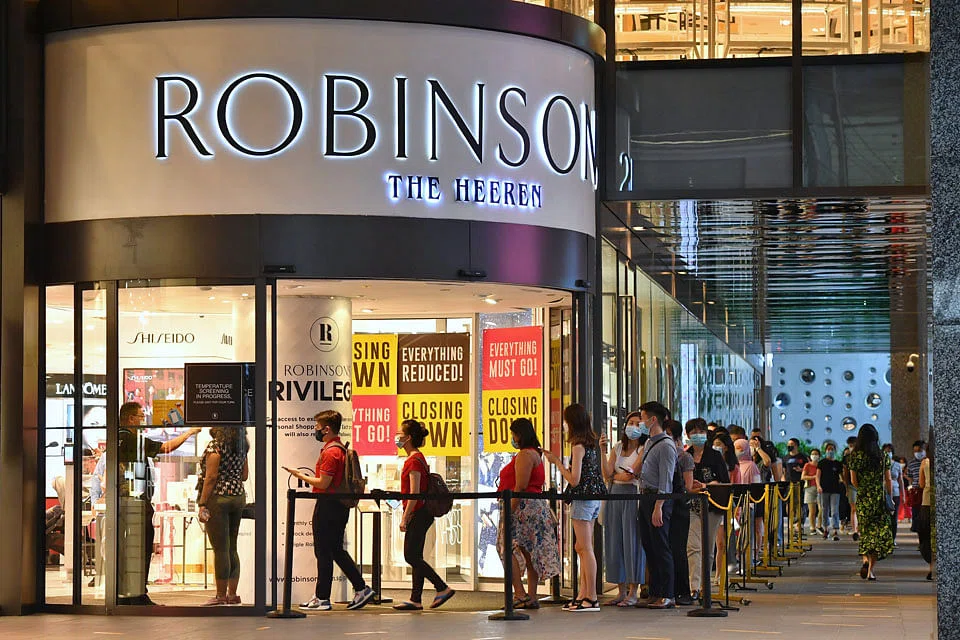
Many companies have already bitten the dust as they struggled to remain profitable and viable through the pandemic. In October 2020, department store operator Robinsons Singapore threw in the towel after 162 years of operations here. The brand has been revived as an online department store. Home-grown cafe chain Bakerzin went into liquidation in October as well.
Some listed companies have diversified into different industries and trades that are more pandemic friendly.
Offshore services company KTL Global moved into fruit and seafood and is mulling an entrance into the lab-grown diamond business, while property developer Aspen Group entered the glove manufacturing space amid a pandemic-fuelled spike in demand. Metal stamping company Metal Component Engineering has announced it wants to make investments into telemedicine and healthcare.
Raymond Chia, head of credit research for Asia at Schroders, said the level of corporate defaults thus far is "quite contained" in Singapore owing to the overall financial health of companies.
"As a guide, you would recall that back in 2016 and 2018, there was a slew of corporate defaults in Singapore across the logistics and oil & gas (sectors) especially, and to an extent infrastructure companies," said Chia, noting the default of water treatment company Hyflux back in 2018 was part of this trend.
"The outstanding debt in the corporate space has materially declined since then, and we are not seeing the same type of companies back then, assessing the markets today."
But the worst may be yet to come, as the generous government relief measures that were doled out in 2020 and 2021 to businesses taper off as Singapore tries to adjust to living with Covid-19.
"We have already seen the first wave of assets when an economic crisis exposes suspected illegal practices... but those affected by (Covid-19) are still to come," said Stefanie Yuen Thio, joint managing partner of TSMP Law Corp.
In her view, "over-leveraged businesses and sectors" that have been hit the hardest by the pandemic will be affected. The "lucky ones" could be restructured by way of solvent mergers and takeovers on the back of a narrative of strategic corporate action, she added.
On the buyers' side, things are looking rosy. A combination of cheap money, funds from special purpose acquisition companies (SPACs) with only a few unicorn targets to go after, and capital lurking around have shored up Singapore's investment scene.
This could mean the market for distressed assets could rise significantly in the near term, as buyers capitalise on low prices.
Said Thio: "Honestly I haven't seen a lot of distressed sales; but there should probably be a "yet" at the end of that statement.
"The deals we are seeing currently are for new businesses, emerging technologies and innovative businesses, strategic acquisitions like in the medical and educational spheres. They're not companies in trouble. That wave may come soon."
With distressed assets likely to rise, who is likely to pick up these assets? Gibson and Dunn's Lee said the "cash is king" mantra is likely to be applicable.
"Companies which have strong reserves are well-positioned to buy on the cheap," said Lee.
Such acquisitions could be in the form of buying distressed assets of competitors who are mired in debt to strengthen the buyer's market position, or buyers taking the opportunity to establish vertical business integration by acquiring control of its suppliers or distributors.
Family offices and investment companies could also take the opportunity to acquire control in iconic businesses with strong fundamentals that just need a "blood transfusion" to recover their balance, he added.
TSMP's Thio said private equity funds "flush with cash" or companies with strong balance sheets - especially those that have successfully restructured themselves - could be "well-placed to go shopping".
"The problem is that money was so freely available when governments opened national wallets to support businesses during the initial phases of the pandemic. So borrowing was cheap," she said. "While debt is certainly in the picture, due to cheap borrowings, I'm seeing some securities swapping deals too."
Thio also stressed that foreign money has found its way to Singapore shores because of the way the country has handled the Covid-19 pandemic, and because US-China tensions have sent investors looking for a more neutral business environment.
Global merger and acquisition (M&A) activity has been hitting historic highs as the world recovers from the brunt of the coronavirus on the back of low interest rates and "soaring stock prices", said Elaine Chow, director for tax at Mazars Singapore at a webinar The M&A Tax in Asia-Pacific on Oct 14.
With the flurry of deals, the importance of due diligence for buyers, sellers and the overall market has risen significantly. Chow said that before committing to a purchase, buyers would want to know about the obligations they are assuming, as well as any potential problems such as contingent liabilities, problematic contracts or litigation risks.
She added that for private companies or acquisitions in the private sector, sellers are typically not subjected to the scrutiny of public markets, which makes due diligence important in order to identify tax risks or assess the value of deferred tax assets which then feed into "price adjustments, discussions and negotiations" for tax indemnities and warranties.






