

More upside ahead for DBS, OCBC, UOB as wealth fees power Q1 earnings
Their combined non-interest income rises to a record S$5.16 billion from S$4.78 billion the year before

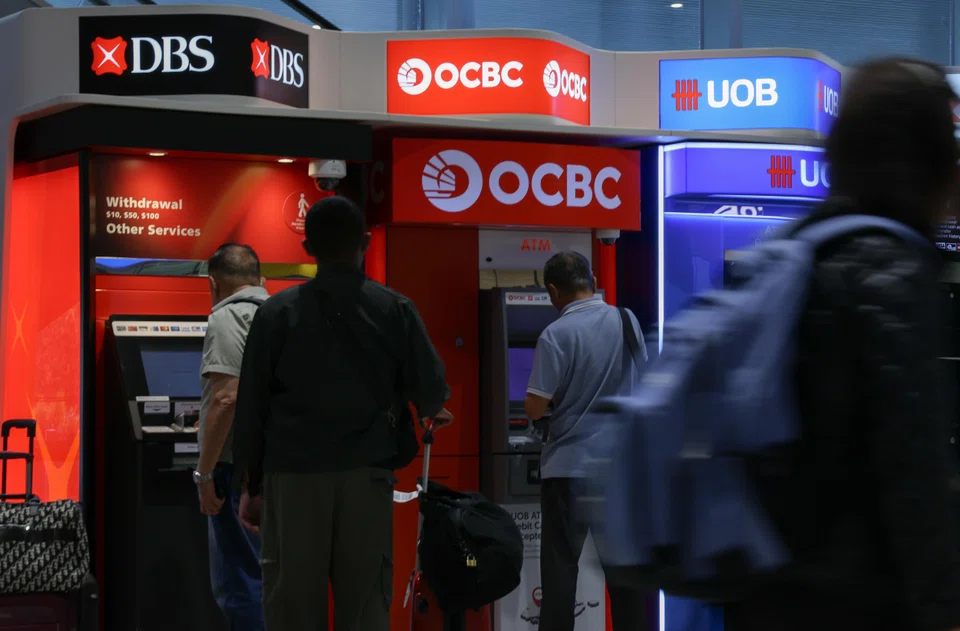
[SINGAPORE] Wealth management and other fee income are becoming increasingly important earnings buffers for Singapore banks, and analysts expect non-interest income to continue offsetting expected declines in net interest income amid a falling interest-rate environment.
This trend came through in the first-quarter results of DBS , OCBC and UOB , which all beat analysts’ consensus estimates for the three months ended Mar 31, 2026.
The three lenders’ combined non-interest income rose to a record S$5.16 billion in Q1, from S$4 billion in the preceding quarter and S$4.78 billion a year earlier, the Singapore Exchange’s (SGX) research team indicated in a market update last Friday (May 8).
This accounted for 39 per cent of the banks’ total income.
At the same time, the trio reported combined net interest income of S$8.04 billion in Q1 – breaching S$8 billion for the 14th straight quarter – though this was down from S$8.24 billion in the previous quarter and S$8.44 billion in the year-ago period.
“The pivot to fee income-led growth to bolster profitability amid rate pressures stood out,” said Rena Kwok, senior credit analyst at Bloomberg Intelligence.
In the quarters ahead, “Singapore banks are likely to double down (on) their strategies to sustain wealth management fee momentum amid rate headwinds”, she added.
“Safe-haven inflows amid global uncertainties, driving new money for the lenders, is another lever.”
But she also said that the key risks ahead could include severe risk-off sentiment that hurts assets under management-based fees, or margin calls on lending to wealth clients during adverse market scenarios.
Wealth growth
The chief executives of all three lenders struck a bullish tone on their wealth management businesses during their respective earnings briefings, citing plans to recruit more wealth talent such as relationship managers.
For DBS, efforts to grow its wealth management franchise are “bearing fruit”, said CGS International (CGSI) Securities Singapore analysts Tay Wee Kuang and Lim Siew Khee in an Apr 30 note.
DBS led the three banks in wealth fee income, with record fees of S$907 million, up from S$724 million the year before.
The lender on Apr 30 posted a net profit that edged up 1 per cent to S$2.93 billion, higher than the S$2.88 billion consensus estimate in a Bloomberg survey of analysts.
This was as its non-interest income grew 10.3 per cent to S$2.45 billion in Q1, cushioning a 5 per cent fall in net interest income.
The CGSI analysts upgraded the counter to “add” from “hold”, with a new target price of S$63.80. The revision was due partially to stronger wealth management fee growth, which could allow DBS to “eke out” earnings growth in the 2026 financial year, they said.
In a May 4 report, RHB maintained its “buy” rating on DBS, with a new target price of S$64, up slightly from S$63.50 previously. This was partly on expectations of earnings being higher by 2 per cent a year until FY2028 from stronger non-interest income.
Over at OCBC, wealth management fees climbed 34 per cent to S$422 million. This helped to lift non-interest income by 23 per cent to S$1.61 billion and offset a 5 per cent decline in net interest income.
Net profit rose 5 per cent to S$1.97 billion, exceeding the S$1.88 billion consensus estimate.
Tay and Lim of CGSI maintained “hold” on the counter, also keeping their target price of S$23.30 unchanged, in a May 8 report.
Integration costs from the lender’s acquisition of HSBC’s wealth and retail business in Indonesia, which is expected to close in Q2 2027, could “weigh on” the franchise’s profitability post-acquisition, the analysts said.
RHB on May 11 kept its “buy” rating on OCBC with a target price of S$24.65, after raising its earnings forecasts for the lender until 2028, on expectations of higher non-interest income.

Meanwhile, UOB is betting on wealth management to become a larger contributor to its earnings over time.
The bank’s wealth fees registered a modest 2.8 per cent increase to S$219 million, from S$213 million in the year-ago period.
This was despite an overall decline of 11.9 per cent in non-interest income, alongside a 4 per cent fall in net interest income. This brought net profit down 4 per cent to S$1.44 billion, although this still beat expectations.
UOB's profitability could improve only in the second half of FY2026, the CGSI analysts said in another report on May 8.
They cited support from higher wealth management fees from new product launches, as well as other measures to drive new-money inflows following its acquisition and integration of Citigroup’s consumer banking franchise.
They maintained “hold” on the stock, with a target price of S$38.70.
Also on May 8, RHB kept its “neutral” rating on UOB, with S$39.50 as the target price. The brokerage believes “its valuation is decent and fairly reflects asset-quality risks and the lower provision coverage level (versus) the sector”.
Commenting on UOB’s target of doubling wealth income to at least S$2.5 billion by 2030, Morningstar equity analyst Kathy Chan noted that the business is still “a relatively small contributor”. She estimates that it would make up 15 per cent of the top line in that year.
However, she raised her forecast for the lender’s non-interest income growth rate to 6 per cent a year from 5 per cent annually for FY2026 to FY2030.
Credit quality
Beyond wealth management, the SGX research team noted that non-interest income growth across the three lenders was “broad-based” and also reflected stronger contributions from fee income, treasury customer sales, trading income and insurance.
Still, analysts cautioned that – amid the ongoing Middle East conflict – credit risks remained key to watch.
Bloomberg’s Kwok said that credit costs are “likely to be within guidance for Singapore banks in 2026”, given their “sound asset quality” and “already ample provision coverage”.
While second and third-order effects such as higher logistics and material costs stemming from the Iran war could have a broad impact on businesses, the Singapore banks’ “tight underwriting record” should allow them to absorb potential credit losses if headwinds worsen, she added.
Shares of DBS closed Tuesday 0.6 per cent higher at S$59.10, while those of OCBC fell 0.8 per cent to S$22.33. UOB rose 0.3 per cent to finish at S$37.11.
In the year to date, the counters are up 7.8 per cent, 16 per cent and 7.9 per cent, respectively, on a total return basis.
TRENDING NOW

Once staunchly pro-China, Malaysian Chinese businesses are now distancing themselves from Beijing

Grab CEO’s wife Chloe Tong on life with Anthony Tan and finding her purpose

Could stablecoins be the future of money?

ST Engineering opens tech-focused aircraft maintenance facility in Changi; to create over 500 jobs

