

More volatility, uncertainty for markets in H2 as chances of Trump presidency increase: analysts
They note that return of former US president could have an impact on trade tariffs, Treasury yields and gold market

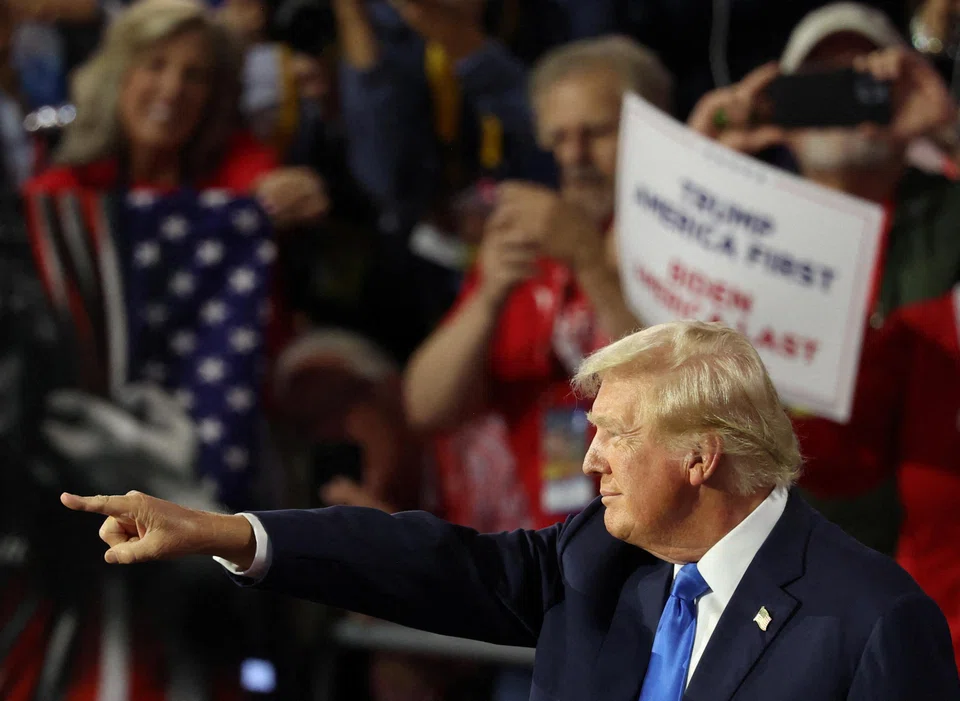
WITH the chances of a Trump presidency seeming increasingly likely, market watchers warn of greater volatility and uncertainty in global markets ahead of the United States elections later this year.
And while the Singapore stock market has performed relatively well in the first half of this year, protectionist policies adopted by a potential Trump administration could affect its performance going forward, say analysts.
With the US elections looming in November this year, political observers are placing their bets on former president Donald Trump to beat incumbent President Joe Biden at the polls.
Trump’s chances have been boosted after he survived an assassination attempt at a rally last Saturday (Jul 13). This is on top of Biden’s poor performance during a televised debate last month against Trump.
Biden’s performance has led to calls for him to drop out of the presidential race.
Potential outcomes
There is “a very strong likelihood” of Trump winning the next election, said Carmen Lee, the head of OCBC investment research.
Lee noted that the outcome of the US elections itself will not have a significant impact on the Singapore market. The US is not as significant a market for Singapore as it was about two decades ago, and Asia is a bigger market for Singapore now.
Moreover, many local listcos are also domestically focused, and not dependent on revenue from the US.
“So this whole diversification to Asia... has in some ways insulated against volatility (from US politics),” added Lee, in a briefing to the media on Thursday on OCBC’s market outlook.
However, if the US and China enter a trade war due to protectionist measures adopted by a Trump administration, Singapore’s market will also be affected, pointed out Lee.
She noted that China’s gross domestic product could drop by about 2 per cent if Trump goes ahead with his proposal to impose tariffs of at least 60 per cent on Chinese goods if he wins.
While China will bear the bulk of the tariffs, the rest of the world will also “not be spared that much”, pointed out Lee, noting that Trump has also proposed a 10 per cent tariff on all imports into the US.
However, Lee was of the view that Trump might limit any punitive measures to foreign companies, rather than US-listed ones.
This is because the former president had referred to the strong performance of the US stock market during his previous term, from 2017 to 2021, as a testament to his political performance.
Bonds and gold
Bank of Singapore’s (BOS) chief economist, Mansoor Mohi-uddin, also said that the US elections are “a key risk” for the financial markets.
Speaking at the bank’s mid-year outlook on Wednesday, Mansoor noted that a Trump presidency will impact US Treasury yields and the gold market.
Although the US Federal Reserve is expected to cut interest rates this year, long-term bond yields may start to rise under a Trump administration, he said.
The former president tends to impose inflationary policies.
For example, Trump favours large tax cuts and tariffs.
He also prefers to cut down on immigration which will tighten the US labour market, said Mansoor. Such policies will push longer-end yields higher, he added.
Trump’s vice-president pick, JD Vance, who is an isolationist, will also create uncertainty in the market with his policies. So, Mansoor noted, investors will still need to have an allocation towards gold as it is an asset class that does well in uncertain environments.
Inflation to stay
Overall, Mansoor thinks long-term interest rates and inflation will remain high for the next few years.
“One thing that’s really concerned us has been the rise of populism. Far-right parties get into power and increase spending excessively on social programmes and also turn their economies inward... now all of these forces are inflationary,” he explained.
Other forces, such as geopolitical tensions between the US and China, as well as conflicts in Europe and the Middle East, will also contribute to the continuation of high interest rates, he added.
STI’s performance
The Singapore equities market has “not (been) too sloppy” compared with its regional peers, with the the Straits Times Index (STI) posting a year-to-date returns of around 8 per cent, said Lee.
However, performance has been mixed across sectors, she added. While higher-for-longer interest rates have led to the financial sector leading gains on the STI, the property sector has not done as well.
If the US Fed does not impose any more rate cuts, it will be “another record year” for the performance of Singapore banks. All three posted record profits last year.
However, if there is a rate cut this year, banks will see a muted performance in the second half of this year, with their earnings eventually taking a hit next year, Lee added. The next round of gains for the STI will probably come from the property sector as real estate investment trusts stand to gain from rate cuts, she said.
On whether Singapore’s general election, which is due by November 2025, will have an impact on the local market, Lee noted that it is likely to be quite minimal as Singapore’s policies tend to remain stable even after elections.
TRENDING NOW

Could stablecoins be the future of money?

Once staunchly pro-China, Malaysian Chinese businesses are now distancing themselves from Beijing

Global expertise and tailored solutions: How affluent S’poreans can grow and manage wealth across markets
GIC-backed Bank Jago sees wealth management as next growth engine as Indonesian investor base grows

