Nasdaq 100 losing momentum as AI trade divides
WALL Street enters the week on the back foot, with the technology leadership that drove the autumn rally now in question. The Federal Reserve held its policy rate at 3.75 per cent to 4 per cent on Oct 28, a widely expected pause after September’s hike, though the decision came on a split vote with multiple dissents. Chair Kevin Warsh struck a balanced but hawkish tone, playing down any influence from this week’s midterm elections and leaving a December increase on the table. Thursday’s data gave the hawks little to argue with: third-quarter GDP grew at a 3.4 per cent annualised pace, its fastest in over a year, headline PCE inflation accelerated to 3.6 per cent in September, and jobless claims held near multi-decade lows. Strong growth and sticky prices have pushed the 10-year Treasury yield back towards 5 per cent.
For the Nasdaq, the dominant story is earnings, and the AI trade has increasingly divided along a single distinction: who is spending and who is earning. Alphabet suffered a record post-results fall of around 10 per cent as search growth disappointed and cash burn mounted, dragging the index down roughly 1.6 per cent on Thursday, its steepest session in weeks. In contrast, Microsoft was rewarded earlier in the week for converting AI investment into cash. Investors are no longer paying up for AI exposure indiscriminately; they are separating the earners from the heavy spenders, and questioning whether vast capital budgets will pay off. With that doubt unresolved and yields elevated, the index ended sharply lower on Friday, a sign the selling pressure has yet to clear.
On the charts
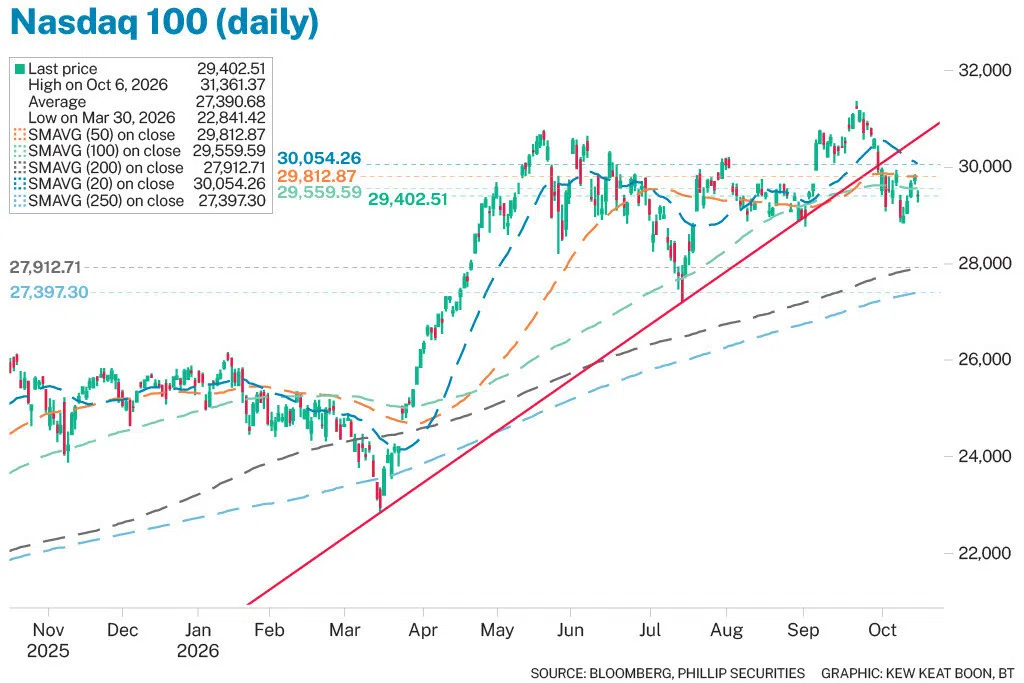
The picture has turned since September. After setting a record high near 31,300 in mid-October, the index reversed sharply and has slipped below its simple moving averages (SMAs) - the 20-day (30,050), 50-day (29,812) and 100-day (29,559) - which had supported the advance and now sit overhead as resistance. Momentum has rolled over, and the rejection from the highs carries the look of a near-term top. The primary uptrend, though, is not broken. Price remains well above a rising 200-day SMA at 27,912, and the run of higher highs (30,700 in June, 31,300 in October) and higher lows since the April trough keeps the longer structure intact. For now, this reads as a correction from overbought rather than a trend reversal, but the onus is on the bulls to prove it.
Key levels ahead
The immediate task for the bulls is to reclaim the moving-average band between 29,559 and 30,050; until they do, rallies are likely to be sold. Above it, 30,500 and then the 31,200 level are the hurdles. On the downside, the late-October swing low near 28,800 is the first line of support; a break below would expose the 28,000 region and, subsequently, the 200-day at 27,912, a test that would call the uptrend itself into question.
The balance of risks
The bull case is supported by a resilient economy, strong corporate earnings and an intact long-term uptrend. Investors may see any pullback towards support as a buying opportunity. The bear case is that persistent inflation and a 10-year Treasury yield near 5 per cent continue to pressure technology valuations, while markets are becoming less willing to overlook heavy AI spending that lacks a clear return on investment.
Looking forward, the calendar sharpens the tension. The US midterm elections on Nov 3, the ongoing earnings season and a scheduled Trump-Xi meeting during the Apec summit in Shenzhen on Nov 18-19 all have the potential to influence market sentiment. With the US-China trade truce set to expire on Jan 10, investors should be prepared for increased volatility.

For now, the Nasdaq 100 has lost its short-term footing while its long-term trend holds. The prudent course is caution: treat the 29,559 to 30,050 band as resistance and the 28,800 low as the line to watch and expect wider swings through the elections and the remaining results. A decisive reclaim of 30,000 would suggest the pullback has run its course; a clean break of 28,800 would warn it has further to go.
The writer is dealing manager at Phillip Securities
Decoding Asia newsletter: your guide to navigating Asia in a new global order. Sign up here to get Decoding Asia newsletter. Delivered to your inbox. Free.
Share with us your feedback on BT's products and services