New initiatives to revive SGX timely and targeted, but structural issues remain




WITH a dearth of tech names on its local bourse, Singapore has been missing out on the chance to capture a slice of what has become one of the hottest themes in global equity markets.
This could begin to change with the city-state's move to set up two new funds which tie funding for late-stage startups with a view to a listing on the Singapore Exchange (SGX), startups, investors and analysts have told The Business Times. They described it as a timely move which addresses the need for strong anchor investors and quicker pathways to public markets.
Change could come soon, with SGX chief executive officer Loh Boon Chye revealing yesterday that the exchange's first Spac (special purpose acquisition company) listing could materialise in a matter of weeks.
But market watchers also caution that long-standing structural issues, such as low liquidity and underwhelming valuations, cannot be solved easily in the near term.
On Friday morning, the government unveiled several initiatives for high-growth enterprises to raise pre-IPO (initial public offering) and IPO funding in Singapore, as well as to defray listing costs.
Chief among them is the establishment of Anchor Fund @ 65, a new co-investment fund by the Singapore government and Temasek, that will support high-growth companies in tapping Singapore's equity market. Notably, this is not limited to primary listings, but can also secondary and dual listings.
Separately, EDBI, the investment arm of the Singapore Economic Development Board, intends to establish a new Growth IPO Fund to invest in later-stage companies. Beyond helping them to grow their operations in Singapore, EDBI will work with the companies towards an eventual listing here.
Darius Cheung, chief executive of property portal 99.co, believes the government's timing is right, as more strong IPO candidates take centre stage.
"The Hong Kong Stock Exchange is an increasingly unattractive option. Many (startups) are still too small-cap for the Nasdaq or the New York Stock Exchange, and a US listing is expensive and painful due to factors such as compliance. SGX might just turn out to be a good option once it's built up," he said.
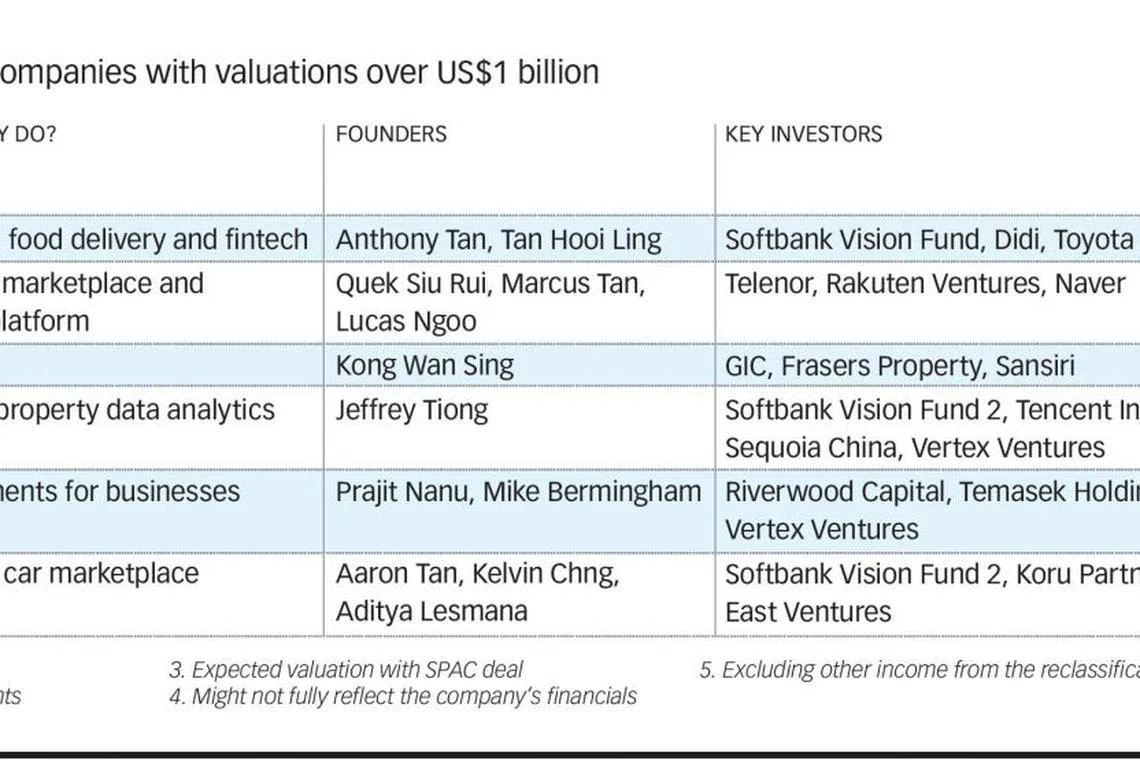
As Minister for Trade and Industry Gan Kim Yong noted on Friday, four local startups - PatSnap, Carro, Nium and Carousell - have this year been valued as unicorns, with valuations of at least US$1 billion.
Nium chief executive Prajit Nanu said the company is hoping to do a secondary listing in Singapore after a potential listing in the US in the next 15 to 21 months. "We will certainly consider tapping into this scheme if the time comes," he said.
Singapore's new initiatives go beyond looking for a "silver bullet", reckons Chua Kee Lock, managing partner at Vertex Ventures. The two new funds take into account the funding gap that many late-stage startups face, addressing the issue more thoughtfully than in the past, he said.
Likewise, PatSnap's founder and chief executive Jeffrey Tiong added that SGX initiatives are "a good start". Anchor @ 65, for instance, could benefit a lot of local startups which do not have access to overseas funding, he said.
"Singapore has robust funding initiatives for early- to growth-stage startups. If we can complete the chain all the way to a startup's IPO or even post-IPO, this will make for a more vibrant market."
But there are still perennial concerns to tackle. Ultimately, startups deciding on a listing location will look at how liquid the market is and how attractive a valuation they can get.
Vertex's Mr Chua added: "Startups are trying to create returns for their investors so naturally, they are very valuation-sensitive."
Oanda senior market analyst Jeffrey Halley is thus not convinced the initiatives will entice unicorns to switch to listing in Singapore.
"Quite simply, Sea and Grab have headed (to the US) because the valuations they can achieve, and the liquidity, are exponentially higher," he said. Nevertheless, the initiatives could encourage secondary listings in Singapore, which would increase turnover on SGX, he added.
High-quality tech companies might not need money from the Anchor Fund anyway, remarked Christopher Quek, managing partner of Trive Venture Capital. These companies are likely to have their own interested investors and might not be keen to have additional covenants requiring them to list in Singapore.
Mr Quek also highlighted the issue of brand perception - SGX has long been regarded as a bourse for manufacturers and property-related companies from Singapore and China.
"To be a tech IPO hub, it will require an intensive re-branding exercise to attract and lure high-quality tech institutional funds to increase trading activity and liquidity, which are key components to having a closer match of intrinsic and market valuations," he said.
Huanmin Huang, chief of staff at cashback startup ShopBack, believes startups will be receptive to a domestic listing as a condition to funding, as long as the terms are not too inhibitive.
These conditions could allow for dual listing, flexibility on timelines, and continued support post-listing to fuel the companies' growth aspirations and long-term capital needs.
Importantly, SGX needs to be cognisant of the competition it is up against. The US markets have woken up to the opportunities in South-east Asia and are now furiously hunting for the next Grab, said Shauraya Bhutani, co-founder of Capital Connect Advisors.
"SGX is now competing with the best for their best. If they chose to cooperate, which is quite likely, it'll be interesting to see how they will do so on the secondary and dual listings to provide a compelling proposition to tech companies," he said.
Investor education is another important factor for Singapore to succeed as a tech listing destination, said David Gowdey, managing partner at Jungle Ventures.
This "requires a strong base of investors, retail and institutional, who will reward growth, accept risk, trade actively and provide the company with a valuation that is comparable to other exchanges", he said.
But some are less convinced that the initiatives would move the needle much for SGX.
Terence Chua, analyst at Phillip Securities, said: "It's a step in the right direction, obviously, but it's just too small to cause any meaningful move in the stock market."
He noted that S$1.5 billion is roughly 1.5 days of trading volume on SGX, and the funds would also be targeted at a very selected group of companies.
Maybank Kim Eng analyst Thilan Wickramasinghe believes it is "too premature to look at this as a re-rating catalyst" for SGX.
"There are a number of unknown unknowns in terms of the execution, pipeline of potential listings as well as the type of clusters that will eventually 'stick'," he said.
SGX shares climbed 0.3 per cent on Friday to close at S$10.08.
- With additional reporting by Raphael Lim
READ MORE: