

New ocean basin facility paves way for tackling challenges in marine, offshore engineering

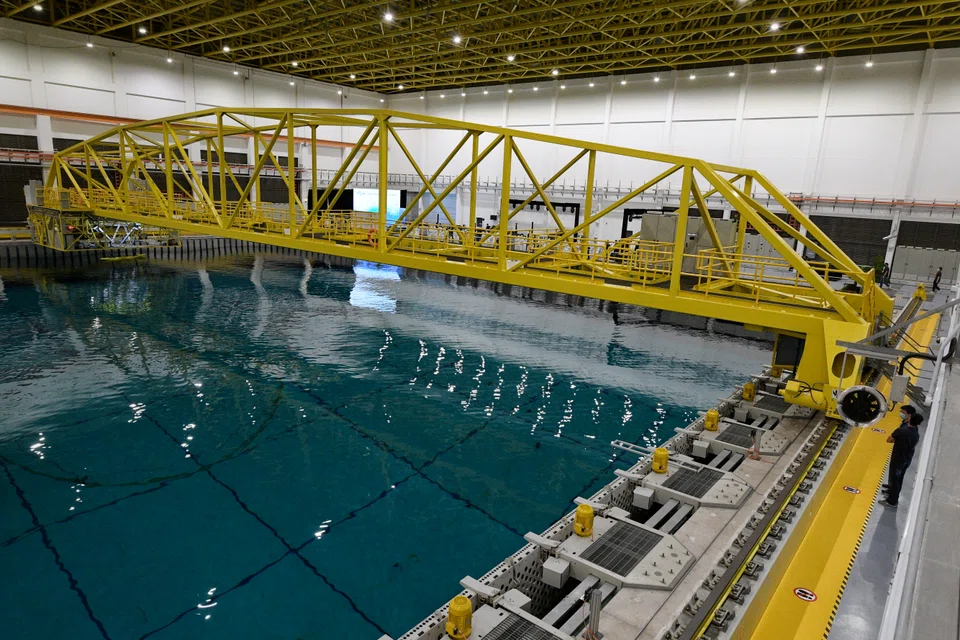
SINGAPORE’S first ocean basin facility for simulating real-world ocean operating environments opened on Tuesday (Jul 26). Through industry partnerships, it will co-create, stress-test and validate solutions to challenges in the marine and offshore engineering sector, as well as novel concepts of future ocean systems and infrastructure.
The facility was opened by the Technology Centre for Offshore and Marine, Singapore (TCOMS), a national research and development (R&D) centre set up by the Agency for Science, Technology and Research (A*Star) and the National University of Singapore.
TCOMS is supported by the Singapore Economic Development Board and the Maritime & Port Authority of Singapore.
The facility was previously slated for completion in 2019, but was delayed by the pandemic. Its ocean basin has an effective test area of 60 by 48 m and a variable depth of up to 12 m, holding enough water for 15 Olympic-sized swimming pools.
It can simulate operating environments in shallow, intermediate and deep waters. At the centre is a 50 m-deep pit – “one of the deepest in the world”, said TCOMS – allowing the simulation of ultra-deepwater environments of up to 3,000 m.
A 180 flap-type wave-generation system can generate waves up to 1 m high, while 6 layers of flow control allow the simulation of complex water-current flows. The facility also has a 2,500 kg capacity towing carriage and a movable floor.
These simulations enable researchers to understand complex marine environments and validate and enhance the design and performance of their solutions.
Sembcorp Marine, for example, is working to bring floating wind structures further offshore — to 500 km from the coastline, where stronger winds can increase the amount of energy generated. It signed an agreement with TCOMS to “elevate the technology readiness for marketing by carrying out validation tests” on its floating wind structures, said senior manager of R&D Jason Chia.
The new facility can integrate wind and waves to realistically mimic the environment, unlike traditional facilities where waves and wind are tested separately, he added.
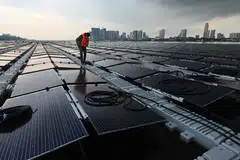
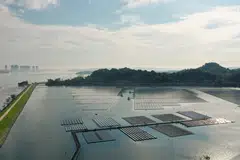
Senior Minister and Coordinating Minister for National Security Teo Chee Hean, who attended the opening virtually, said that TCOMS will be a key part of Singapore’s R&D efforts in ocean engineering, taking the lead in catalysing innovation as well as building partnerships and long-term capabilities.
The marine and offshore engineering sector is important and rapidly evolving, with more than 80 per cent of the world trade carried by sea, and more than 90 per cent of the world’s communications travelling via fibre optic submarine cables, he added.
New technologies are needed to make the oceans more accessible as a sustainable resource for energy, transportation, food, minerals and as a habitat, he noted.
TCOMS leads a multi-institution research programme comprising A*Star, local universities and industry players Keppel Offshore & Marine and Sembcorp Marine, and has established partnerships with overseas research institutes.
Among its partners is the Singapore Institute of Technology, with which it aims to build long-term capabilities and grow Singapore’s pool of professionals, making the ocean basin available for students’ learning. Frederick Chew, A*Star’s chief executive officer, said: “The TCOMS triple-helix collaboration between academia, public sector and industry enables co-innovating of solutions for the marine and offshore engineering, maritime and other ocean-related sectors.”
Decoding Asia newsletter: your guide to navigating Asia in a new global order. Sign up here to get Decoding Asia newsletter. Delivered to your inbox. Free.
Copyright SPH Media. All rights reserved.






