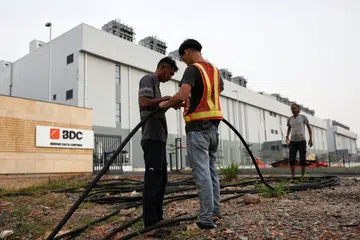
New Tuas Nexus facility can be poster child for regional foray into waste and water treatment
Project could spin off many similar concepts elsewhere but few other nations likely to be ready yet, add experts
Singapore
THE construction of the new Tuas Nexus facility may very well open doors for companies involved in the development to carry out similar projects elsewhere in the region, as interest for such integrated facilities start to gain traction, said industry experts The Business Times spoke to.
On Sept 8, the National Environment Agency (NEA) and PUB announced that the first phase of construction of Tuas Nexus - an integrated waste and water treatment facility - had begun, and is set to be completed in phases from 2025 onwards.
Said to be the "world's first integrated waste and water treatment facility to be conceptualised and planned from the ground up", the facility is a co-location of two mega facilities - the Tuas Water Reclamation Plant (Tuas WRP) and the Integrated Waste Management Facility (IWMF).
The agencies said the facility is also expected to result in carbon savings of more than 200,000 tonnes of carbon dioxide annually - equivalent to taking some 42,500 cars off the roads, and will result in land savings of up to 2.6 hectares.
David Pegg, director of infrastructure at Arup, said that while integrated facilities "do exist around the world in different variants", it would be "challenging to compare the facilities directly as the variants are determined by the strategic needs, constraints and policies of a country or city".
However, he noted that the co-location of water and waste treatment plants is less common, especially at the scale proposed for Tuas Nexus, which is "unusual unless deliberately planned".
While the "typical synergy" would be to "provide co-treatment of organic waste and sewage sludge to generate biogas for energy production", Tuas Nexus "differs in that all water and waste process modules are co-located at a single site and enable a broad range of co-treatment and inter-process linkages", added Mr Pegg.
As countries step up their efforts to combat climate change, industry experts are expecting more such projects to be seen in the near future.
Mark Davies, project director of the IWMF, said the Tuas Nexus facility has "stirred a lot of interest in the global waste management industry and used water treatment industry", and believes that it will "spin off many similar concepts elsewhere".
Additionally, managing director Tan Seng Chuan and associate director Lee Tuck Wai of Tembusu Asia Consulting said that the "pressures on infrastructure to be better optimised and embrace resource circularity more strongly to provide enhanced value for investment" have been "increasing steadily".
This presents opportunities for companies with the relevant experience to undertake more such projects in the future.
The NEA in April said that it awarded the main engineering, procurement and construction contract for the IWMF to a consortium comprising Keppel Seghers Engineering Singapore, China Harbour (Singapore) Engineering Company and ST Engineering Marine. The total value of the contract is about S$1.5 billion.
As for the Tuas WRP, a total of four major construction contracts have been awarded by PUB as of July. The first was awarded to McConnell Dowell to carry out site development works in January 2019. A joint venture between Koh Brothers Building and Civil Engineering Contractor as well as China Harbour (Singapore) Engineering Co was then appointed in July 2019 to build the influent pumping stations. SembCorp Design and Construction won the third contract for the plant's biosolids treatment facility in March 2020.
Finally, in July, Sinohydro Corporation Ltd (Singapore Branch) clinched a S$449.6 million contract to construct the civil and structural components of domestic liquids modules for the Tuas WRP.
Additionally, PUB said another seven construction tenders worth S$1 billion will be called before the end of 2021. These will include the plant's industrial liquid modules that will treat industrial used water.
IWMF's project director Mr Davies said: "Any company involved in a project of such scale would have a noticeable track record reference which will enable them to bid and execute similar projects in other countries."
For a similar project to be carried out elsewhere, there are a few considerations to take into account.
The duo from Tembusu Asia Consulting said this includes a "robust collection system" for both solid waste and used water, along with a "selection of best in-class technologies to leverage synergies". Additionally, there should also be an "assessment or mitigation of potential external impacts", such as on the environment or on adjacent facilities.
"The concept is doable in other countries in the region; it can be replicated in other cities having similar parameters such as population density," they added.
But given the complexity and cost of building such a facility, Ravi Krishnaswamy, senior vice president of energy, sustainability and industrial at Frost & Sullivan Asia-Pacific, noted that "many other countries may not really be ready yet".
He said: "They may have different agencies which look at water and waste separately... In Singapore, the NEA and PUB coordinate everybody." (amendment note)
Additionally, other countries may look at such facilities in "silos", resulting in "different budgets and different priorities".
Regardless, in the short run, Mr Krishnaswamy noted that the "lessons learned" from the construction of Tuas Nexus can be applied to independent facilities. And with more smart cities coming up, integrated facilities done on a smaller scale could also become more commonplace.
He said: "Singapore is always a good (reference) for any company for projects in the region... So experience in this project can clearly help both Singaporean and foreign companies to bid for and expand their (portfolios)."
Amendment note: Both the NEA and PUB coordinate the management of waste and water treatment in Singapore, not just the NEA alone. The article has been amended to reflect this change.