

Nio shares surge over 20% in early trade in SGX mainboard debut

Tan Nai Lun &
Michelle Zhu
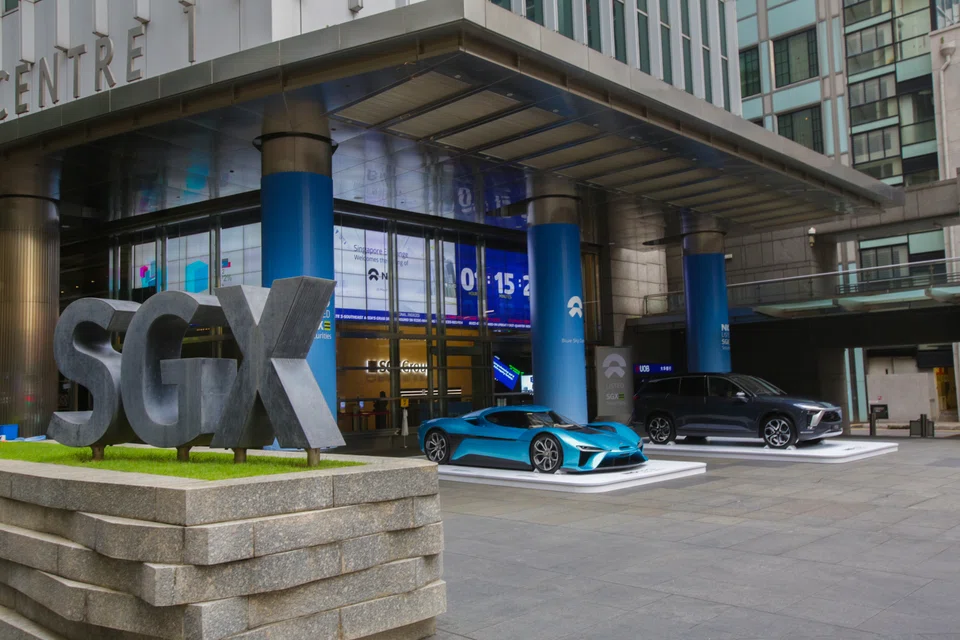
CHINESE electric vehicle (EV) maker Nio expects its unique battery swapping technology will help grow its market share as it expands globally.
Nio founder and chief executive William Li believes the company's battery swaps are a unique attraction because EV drivers can spend less time at charging stations. They can also choose different battery capacities to suit their own needs.
Li said Nio will build basic battery swapping facilities in all the markets it enters, before it starts selling its cars. The company used this go-to-market plan in its first global expansion to Norway last year. Similar plans are already in motion in Germany, the Netherlands, Sweden and Denmark.
Li made these remarks in a call with the media after the EV maker launched its secondary listing on the Singapore Exchange (SGX) on Friday (May 20) morning.
Opening at US$16.90 apiece on its first day of trading, the counter rose as much as 20.1 per cent or US$3.39 to trade at US$20.29 at 9.13 am, with over 5,000 shares traded.
At the midday break, it eased slightly to US$17.20, which is US$0.30 or 1.8 per cent higher than its opening price. The counter closed at US$17.30 on Friday.
The price was above Nio's close in the US at US$16.66 on May 19. Nio has a primary listing of American depositary shares on the New York Stock Exchange (NYSE).
It has listed in Singapore by way of introduction, which is a form of listing that does not require selling new shares or raising funds.
Its Class A ordinary shares on the SGX are fully fungible with its NYSE-traded shares.
In March, Nio had also listed by way of introduction in Hong Kong – adding to the trend of “homecoming listings” from US-listed Chinese companies that were facing delisting risks due to US compliance standards.
Li said Nio opted for another secondary listing in Singapore as the Republic is an increasingly important location to attract investors not just in South-east Asia but also globally. He noted Nio’s ties with Singapore: government-owned investment managers GIC and Temasek have invested funds in the EV maker.
Nio is also opening a research and development centre in the Republic for artificial intelligence and autonomous driving. Li did not provide details but said hiring has begun for this centre.
Nio has announced plans to enter 25 new markets by 2025, and part of its expansion includes the launch of a new brand that would cater to mass-market customers.
Nio said it was also exploring options to sell its cars without batteries – allowing customers to add their preferred batteries to their purchases.
In response to a question on when Nio would begin selling its vehicles here, Li noted that every market has its own set of concerns. This could include steering controls – whether left or right – and the need for Certificates of Entitlements.
On the possibility of delisting in the US, Li said Nio would await solutions set out by the authorities in the US and China. Meanwhile, it intends to focus on turning profitable instead.
Nio, which is seen as one of Tesla’s closest competitors in China, has plans to break even by FY2024.
The company reported a net loss of 2.1 billion yuan (S$448 million) for its fourth quarter ended Dec 31, 2021, amid supply chain disruptions and rising costs. Revenue for Q4 increased 49 per cent from a year earlier to 9.9 billion yuan.
As for the 3 months ended Mar 31, Nio said in a business update that it delivered 25,768 vehicles in the quarter, up 28.5 per cent on year to reach a new quarterly record.
Li noted that demand for EVs is still rising in the key markets of China, the US and Europe, despite disruptions from supply chain shortages as well as lockdowns in China amid the Covid-19 pandemic.
He remains optimistic on the industry and Nio’s growth potential in the long run, and expects the disruptions to be temporary.
TRENDING NOW
Singapore identifies 7 firms responsible for haze fires, notices issued urging action: Grace Fu
DBS remains analysts’ pick ahead of Q3 earnings after Singapore banks’ share slump

High Court rules against Julius Baer’s Singapore trust arm in US$50 million family trust dispute

Could stablecoins be the future of money?

