No big push yet for restructuring of Temasek's portfolio: analysts
They say a number of factors stand in the way of brokerage CLSA's suggestion that reorganisation could revitalise Republic's equity market
Singapore
COULD a reorganisation of companies under state investment firm Temasek's portfolio revitalise Singapore's equity market?
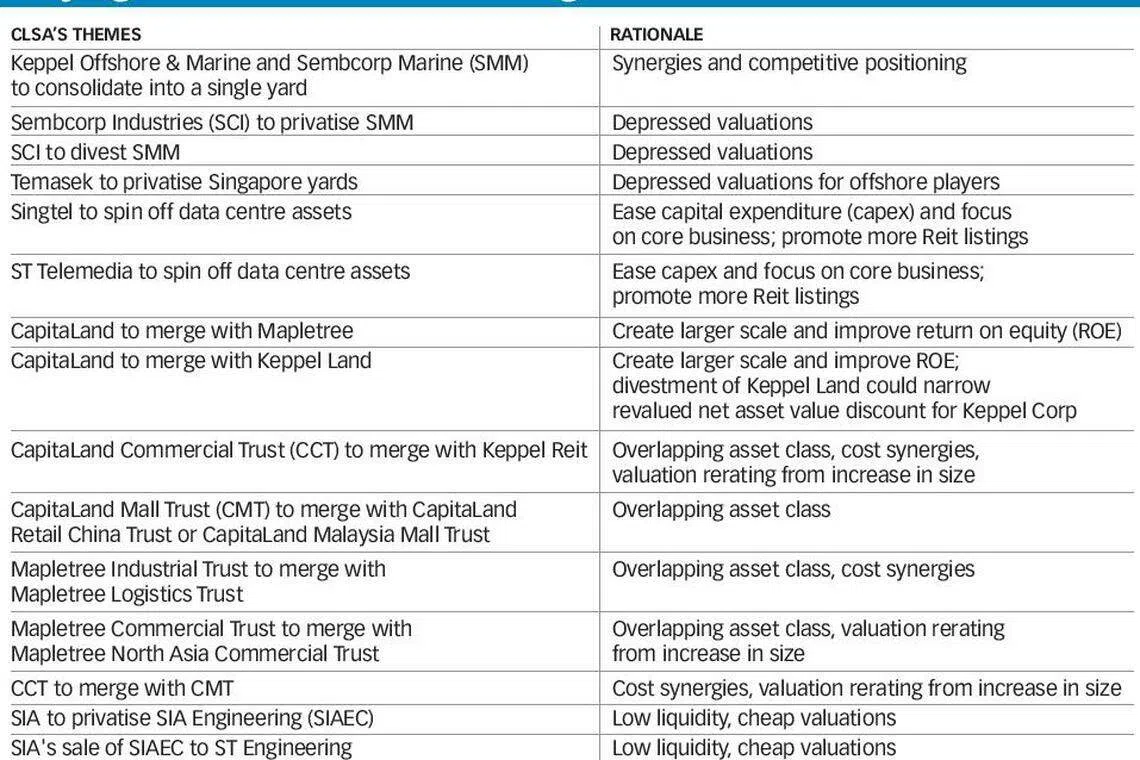
CLSA thinks so in a recent study. But other industry watchers point out obstacles to the brokerage's proposals, which range from the much-discussed merger of the offshore and marine businesses of Keppel Corp and Sembcorp Marine; to the potential spin-off of data centres from Singtel and Temasek unit ST Telemedia; mergers of property titans, CapitaLand with Mapletree Investments or Keppel Land; the consolidation of Reits under Temasek-linked sponsors; and the potential privatisation of SIA Engineering (SIAEC).
Market watchers say it's challenging to find a win-win proposition to appease all shareholders, and timing is tricky, especially when valuations may not make sense at the moment. There is also insufficient impetus to warrant these corporate actions.
Another issue is ego. In every merger, there is the inevitable rationalisation of management structure; one leader usually has to step down. If there is no need to ruffle feathers unnecessarily, Temasek usually wouldn't, said one analyst.
Another said the study was done "very academically, textbook style", but "not everything that can be merged should be merged, and staying as separate entities can keep all shareholders happy, as mergers can be complicated".
CLSA believes that restructuring within Temasek's portfolio of companies is essential to drive higher return on equity (ROE) in the Singapore market, given the Republic's dismal returns post-2008 crisis, coupled with rising regional competition and a pick-up in corporate delistings.
Market returns have underperformed the MSCI Asia ex-Japan index, with subdued ROE averaging less than 10 per cent in the past five years.
In addition, the 3.4 per cent compounded annual growth rate of MSCI Singapore's earnings per share from 2009 to 2018 pales against other regions - such as the 9.4 per cent growth rate of the MSCI World index, and 6.1 per cent of the MSCI Asia ex-Japan.
Temasek in particular can play a critical role to reverse this, given that Temasek-linked companies account for 13 per cent of the benchmark Straits Times Index and 18 per cent of the MSCI Singapore index, CLSA said.
In response, a Temasek spokesman said, when contacted: "We do not comment on market speculation or reports around our intentions with respect to our portfolio, nor do we speak on behalf of our portfolio companies.
"We'd expect that disclosures around specific corporate actions will be made by the respective companies in line with regulatory requirements and market practice, if and when they occur."
Temasek International CEO Dilhan Pillay Sandrasegara did, however, say in July that the state investor will not look to consolidate subsidiaries for "the purpose of trying to figure out if there's activity", which doesn't work out in the long run. Instead, Temasek would focus more on adding value to these companies where it can, to help them deliver a "long-term sustainable trajectory".
CLSA noted that Singapore also seems to have lost its lustre as a primary listing destination in Asia, with Singapore tallying US$1 billion of proceeds across 15 initial public offerings (IPOs) in 2018, while Hong Kong secured a whopping US$37 billion in proceeds via 218 IPOs.
Consequently, Temasek's one-year total shareholder return for FY19 fell to 1.49 per cent, from 12.2 per cent a year ago. Temasek alluded this to market volatility in its latest financial review in July this year, and warned that returns will likely remain tepid over the long term on global growth worries.
To be sure, CLSA also noted that Temasek seems to have slowed its investment pace and has been stepping up on efforts to optimise its own assets since last year. Over the years, it has also progressively diversified out of Singapore. The Republic now makes up about a quarter of its portfolio, down from 52 per cent in 2004.
Not all of CLSA's restructuring ideas are new; in fact, most have been bandied about from time to time.
"Themes that are most likely to pan out in the near term include the consolidation of the CapitaLand Reits, as well as Singtel's divestments of its data centre portfolio and SIAEC privatisation," the brokerage said.
"Potential concerns for Singapore companies include their ability to remain viable amid structural weakness in their industry, as well as (the need) to stave off intense competition from peers... Particularly, the restructuring would allow Singapore companies to respond to changing market conditions, and to improve its scale and scope."
CLSA thus believes Singtel could spin off its data centre assets into Reits, following the trend of similar spin-offs by Western telcos, given stiff competition from the market dominance of Amazon, Microsoft, Google and IBM globally.
Recent consolidation of shipyards in South Korea and China could also inspire a similar merger between Keppel's offshore and marine unit and SembMarine, as overcapacity and price wars amid weak freight rates continue to plague the sector.
This is by no means a new idea, but a mismatch in valuation has likely kept this from happening. CLSA thinks it would be difficult for SembMarine, trading at about one times book value, to acquire its Keppel counterpart which is more richly valued at about 1.9 times price-to-book as at end-August. Shareholder approval is another big impediment to the success of the deal.
CGS-CIMB analyst Lim Siew Khee agrees that there is little incentive for Keppel O&M to acquire SembMarine, given that the latter is heavily-geared, loss-making and its orders have been weak. If it is a move to compete against regional players, the directive will need to come from Temasek, she adds. Otherwise, Keppel has other pillars such as property, infrastructure and investments to lean on.
In another proposed scenario, she says there is also no incentive for Sembcorp Industries to launch another privatisation bid for its offshore and marine subsidiary, after its failed attempt in 2002.
In June, Sembcorp Industries had thrown a lifeline - a S$2 billion on-lending to SembMarine - to the struggling shipbuilder, comprising an issuance of S$1.5 billion five-year bonds, which will be taken up in large part by Temasek.
As for CLSA's ideas on merging certain intra-sponsor Reits, they appear theoretically possible, given similar asset classes. For example: CapitaLand Mall Trust, CapitaLand Retail China Trust and the Bursa-listed CapitaLand Malaysia Mall Trust. But this would defeat the original purpose in the first place, which was to classify assets by their geography. "In all this, you also need to see the pricing and valuations," says Ms Lim.
Justin Tang, head of Asian research at United First Partners, a special situations investment and advisory firm, also feels that a CapitaLand-Mapletree is unlikely, given the huge potential for bruised egos, as mergers often leads to a rejig at the leadership level.
"There are major egos at play... They won't occur unless there is a massive competition issue, an 'either we merge or we die' situation, but there's nothing like that in this case."
He added that there is a lack of a real impetus to undertake major restructuring. History has shown examples of Temasek stepping in only when the company is in serious trouble, such as STATS ChipPAC, SMRT, and Neptune Orient Lines (NOL).
In 2015, Temasek exited STATS ChipPAC through a billion-dollar deal with China's Jiangsu Changjiang Electronics Technology. The same year, Temasek sold its entire stake in NOL to French container shipper CMA CGM. A year later, it launched a S$1.18 billion buyout offer for SMRT.
The one time Temasek showed itself to be more proactive is probably CapitaLand's recent acquisition of Ascendas-Singbridge for S$6 billion, morphing the developer into the largest diversified real estate group in Asia, said Mr Tang.
He said it is a numbers game at the end of the day: in terms of the right valuation to take a company private, or the accretion to distribution per unit or net asset value with every acquisition.
Meanwhile, macroeconomic volatility and the threat of recession will make it hard to consider executing any major "transformational effort". Until those blow over, the market should be quite "happy to wait things out".
Not everyone opposes the proposals, however. Terence Wong, CEO of Azure Capital, believes in an eventual merger of Singapore's two largest shipyards to form a "global champion", but at the right time, probably with some push from the parent.
And DBS analyst Sachin Mittal agrees that Singtel and ST Telemedia should divest their data centre assets to unlock their true value. "The merged data centre operations of Singtel and ST Telemedia will create the largest data centre Reit in Singapore, with sizeable operations in the US and Australia."
He adds that the capital stuck in data centre operations for telco operators can be diverted to their core-network operations and new enterprise services such as cybersecurity and niche services targeting specific sectors such as shipping and transport.
Pure-play data centre operators also fetch higher values: an average enterprise-value-to-EBITDA valuation of 18 to 21 times, while telcos fetch a valuation of 6 to 8 times, suggesting a 60 to 70 per cent undervaluation of assets if they continue to be held on the telcos' books.