

No pot luck for Singapore investors
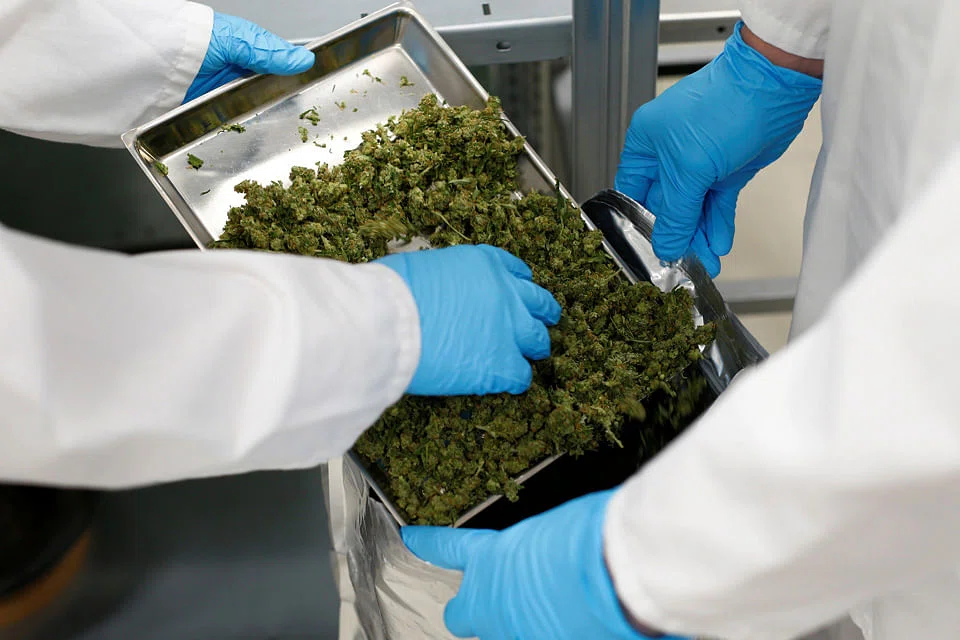
IN SOME parts of the world, official attitudes towards cannabis have shifted markedly in the recent past and its use has been legalised under a number of jurisdictions.
Come July, the legalisers will include Canada, and so it was only to be expected that there would be companies that would step up to the opportunities presented by the market now available among millions of consumers who no longer need to buy the drug illicitly.
And where the companies appear, investors are bound to follow.
Cannabis is the scientific name of the plant and marijuana is the Spanish "nickname". The word was popularised by Harry Anslinger, the first commissioner of the US Treasury Department's Federal Bureau of Narcotics who was widely credited with single-handedly starting America's War on Drugs in the 1930s.
According to reports, nine US states, including California, have now legalised recreational weed while many more allow limited use of medical marijuana under certain circumstances.
"Medical marijuana" has provided those companies now interested in marketing cannabis with their start in the legal cultivation and manufacturing of pharmaceutical products based on the cannabis plant.
The pharmaceutical industry is said to be pouring billions of dollars of investment into developing medical cannabis.
A January report said Greece is expected to approve the medical use of cannabis as the move would attract investments to the country.
Deputy agricultural development minister Yannis Tsironis told AFP that the legalisation of medical cannabis could attract investments of 1.5-2 billion euros (S$2.4-3.2 billion), with Greek, Israeli and Canadian companies already expressing interest.
The deputy minister, along with other government officials, also attended Greece's first medical cannabis trade fair held near Athens.
Over a dozen EU countries have authorised the use of medical cannabis, the report added.
That there may be health benefits does not seem to be in dispute. Concerns rather focus on any accompanying adverse effects and whether cannabis use might escalate into consumption of more harmful drugs.
Also in January The Straits Times reported that Singapore scientists hope to unlock the therapeutic potential of cannabinoids - chemical compounds found in the cannabis plant - with none of the negative side effects and social ills.
Cannabinoid-based medication can, among other things, help to counteract the nausea and vomiting associated with chemotherapy.
Cultivation of the cannabis plant, whose leaves are usually smoked by drug abusers, is illegal in Singapore. A new Synthetic Cannabinoid Biology Programme, however, will identify cannabinoid genes for the sustainable production of medicinal cannabinoids - without the need to grow the plant.
The programme is part of a new research initiative announced by the National Research Foundation. The initiative, a S$25-million Synthetic Biology Research and Development programme, will span five years, and help boost Singapore's research into synthetic biology. This refers to the science behind the production of natural products through engineering biological systems.
Handsome rewards
In the meantime, while scientists here work to develop the cannabiniods with the eventual aim to commercialise production, some investors are already reaping handsome rewards from investing in Canadian listed cannabis companies like Cronos Group and Aurora Cannabis. There's even an ETF or exchange traded fund - US incorporated Alternative Harvest ETF - which tracks companies likely to benefit from increasing global acceptance of various uses of the cannabis plant, according to Bloomberg.
Listed on the Toronto Stock Exchange since last July, Aurora Cannabis, which counts a soon-to-be-completed 800,000 sq ft production facility conveniently located at Edmonton International Airport for global distribution, has gained some 300 per cent. Since its inception in December 2015, Alternative Harvest ETF - listed on the NYSE Arca, the world's leading ETF exchange - has risen almost 70 per cent as of end-January.
As Singapore investors are a pretty global lot, many of whom also trade on the Internet and frequently appear among the top Asian investors in the US, it would not be surprising if some may be eyeing some of these securities.
But given Singapore's harsh drug laws which include the death penalty for trafficking and possession of more than 500g of cannabis, potential investors should tread carefully.
Asked if Singapore investors who buy cannabis stocks or related ETF could get into trouble, a Central Narcotics Bureau spokesman said cannabis remains a controlled drug under international drug control conventions. Singapore adopts a zero-tolerance approach towards illicit drugs. The Misuse of Drugs Act (MDA) prohibits the unauthorised importation, manufacture, cultivation, trafficking, possession and consumption of controlled drugs, including cannabis.
"Investors should exercise caution and responsibility with regard to the nature of their investments. CNB will not hesitate to take enforcement action against anyone who commits any offence under the MDA," he added.
When consulted on investors' position with regard to investments in cannabis securities, Senior Counsel Thio Shen Yi said there is nothing in the Act which explicitly prohibits investing in cannabis-related stocks. For ETFs, the connection may be even more remote if the ETF is synthetic and there are no underlying assets.
"But the Act is very broadly drafted, and has extra-territorial effect," he said. For example, section 13(b) states that it shall be an offence for a person to do an act outside Singapore which if committed in Singapore would constitute an offence under this Act.
So the issue is whether investing in a cannabis-related stock would be something which helped that company further an act which, if carried out in Singapore, would be an offence, said Mr Thio.
"A grammatical or literal reading could suggest that investing in such a stock could contravene the Act. However, as a matter of public policy, one can also argue that the Act is not intended to prohibit this sort of behaviour or there are no public order implications, and that if investments are caught under the Act, the Act has to say this explicitly to avoid a situation where members of the public unwittingly commit an offence."
Maybe this means that there will be no rush of investors into companies that produce and market cannabis, but if their business booms, it's bound to be a tempting proposition.
As a major financial centre, with a thriving fund asset management sector where locally-based managers looked after S$2.7 trillion last year, perhaps the authorities could look at clarifying the stand on cannabis securities investments.






