
‘No real surprise’ as US Fed funds rate stays unchanged; analysts remain bullish on Asian markets

Yong Jun Yuan
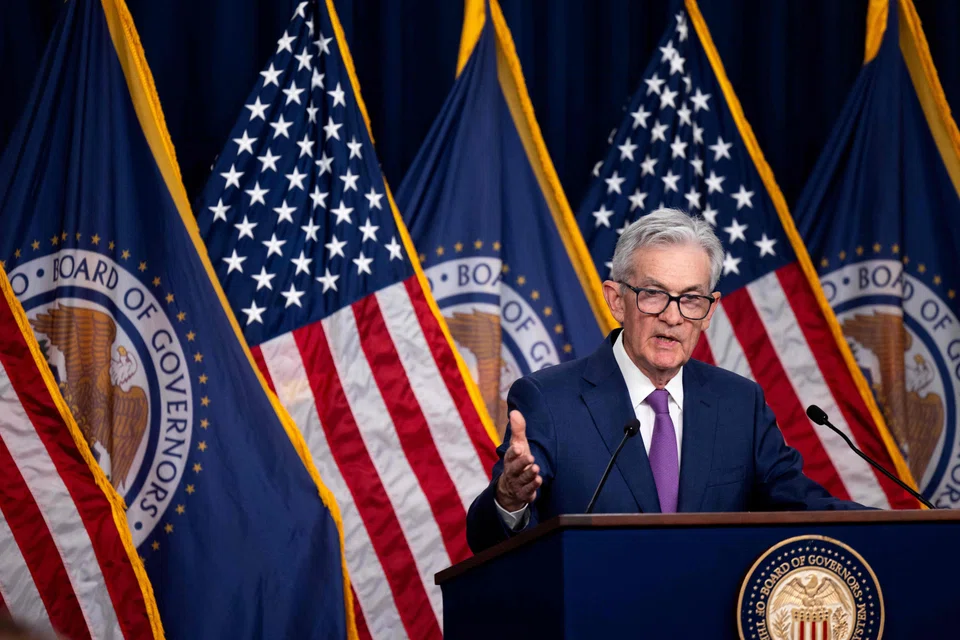
ANALYSTS are staying bullish on Asian equities and bonds, as expectations of a “soft landing” for the United States economy rose after the Federal Reserve overnight on Wednesday (Jan 31) decided to leave interest rates unchanged for the fourth consecutive time.
JP Morgan Asset Management Asia-Pacific chief market strategist Tai Hui said that the Federal Open Market Committee’s (FOMC) decision to leave the funds rate at 5.25 to 5.5 per cent was “widely anticipated”, but also noted that the committee has adjusted its statement language.
“Given the underlying strength in the economy, and the ability for labour markets to seemingly shrug off higher interest rates, the Fed remains more focused on its inflation mandate than on the job market.
“It does appear that the balance of risks is skewed towards inflation remaining sticky rather than the economy falling into recession,” he said.
During a news conference on Wednesday, Fed chair Jerome Powell said: “Based on the meeting today, I would tell you that I don’t think it’s likely that the committee will reach a level of confidence by the time of the March meeting.”
Abrdn investment director of multi-asset Raf Choudhury also said that the Fed’s decision was “no real surprise”.
“We continue to expect three rate cuts to take place in 2024, with the first cut taking place mid-2024, followed by subsequent cuts each quarter,” he noted, adding that markets have been pricing in five or more cuts as soon as March, which seems ambitious.
In a note on Feb 1, Nomura analysts said that they saw the FOMC as being “slightly more hawkish” than pre-meeting expectations as Powell pushed back on rate-cut expectations in March.
They continue to expect the first rate cut to start in May of this year, with a total of 100 basis points of rate cuts in 2024.
Bullish on markets
Despite the potentially longer wait for rate cuts, JP Morgan’s Tai remains constructive on US and Asian markets as he believes that the US will be able to achieve a soft landing.
Furthermore, while developed-market government bonds have delivered consistent returns regardless of whether the US economy sees a hard or soft landing, he said that investors could also generate strong returns from corporate bonds given their level of yield. “History suggests that both equities and bonds can deliver positive returns when the Fed cuts rates as a precaution to engineer a soft landing, rather than reacting to a financial crisis or a severe recession.”
Abrdn’s Choudhury expects to see the continued redeployment of cash on the sidelines into bonds and equities.
“We also expect Asia equity markets to improve as US growth moderates while Asia growth remains resilient. We expect regions such as India with strong resilient growth relative to the US to do well,” he said.
As the rate differential narrows between US and Asia, he expects that this will benefit currencies that have high beta and are higher yielding, such as the South Korean won, New Taiwan dollar and Thai baht.
As for real estate investment trusts (Reits), DBS analysts said in a note on Feb 1 that they see any pullback as an opportunity to add.
“Be it March, May or June, the bottom line is that rate cuts are coming and the waiting time for the first cut is shorter with each passing month,” they said, noting that the FTSE ST All-Share Reits Index has fallen to levels seen prior to the Fed’s more dovish stance in mid-December.
Their top picks are Mapletree Pan Asia Commercial Trust , CapitaLand Ascott Trust , Frasers Logistics and Commercial Trust and Lendlease Global Commercial Reit .
Nomura analysts noted that while markets may have reacted negatively to the Fed’s more hawkish stance, other events overnight, such as big tech companies performing below expectations, could also have weighed on stock indices.
Still, they believe that recent US data continues to show that the US economy could see a soft landing, which would be positive on equities, especially in larger markets such as Korea and India.
“Any pre-emptive Fed rate cuts, which are induced not by significant weakening of the US economy but continued disinflationary trends in the US, should be a positive outcome for stocks, as they reduce the chance of a sudden weakening of the US economy,” the analysts said.
For Asian stocks, the analysts added that investors would also be focused on whether China “eventually capitulates” and puts out a bigger stimulus package to support its economy and financial markets some time this year.
TRENDING NOW
He built the Vingroup empire. Now South-east Asia’s richest man is handing some key roles to his sons
Developers rush to build homes on Vietnam’s breathtaking coast, testing a new urban model
US dollar falters after Iran’s offer to reopen Hormuz sends oil lower
Tokyo reverses baby bust with AI matchmaking and generous subsidies



