

Non-linear thinkers are what a world in flux needs: Temasek CEO
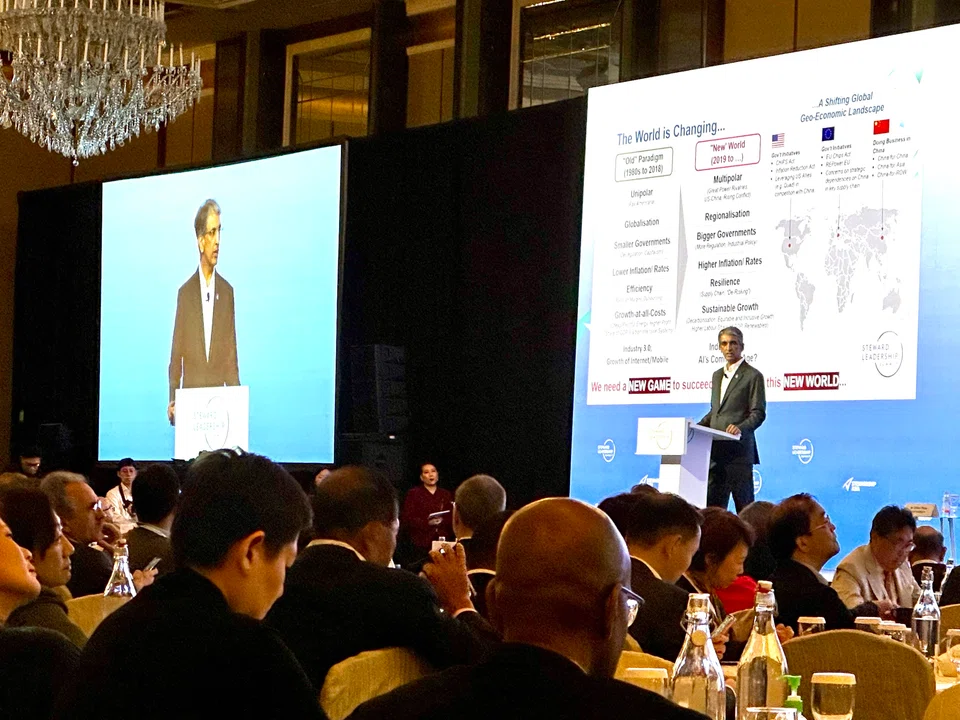
TEMASEK Holdings recruits not just people with a finance or investment background, but also those with an ability to think in a non-linear way, said the state investment company’s chief executive officer Dilhan Pillay.
These “out-of-the-box thinkers who are always challenging the paradigm” are not traditionally accepted as most people think linearly, but they are needed in a Vuca world, he said at the Steward Leadership Summit on Tuesday (Nov 21).
Pillay had mentioned the term Vuca – a popular acronym used to describe the volatility, uncertainty, complexity and ambiguity present in today’s operating realities – a number of times in his speech.
He was responding to Insead Emerging Markets Institute executive director Vinika Devasar Rao, who had proposed that Vuca does not cut it anymore, with new terms such as Bani, Rupt and Tuna catching up in relevance among her students.
Bani stands for brittle, anxious, non-linear and incomprehensible, and Rupt refers to rapid, uncertain, paradoxical and tangled. Tuna is turbulent, uncertain, novel and ambiguous.
Dr Rao asked Pillay about his approach to build the resilience required in Temasek’s workforce to face these new economic realities. He responded by saying the “C” in Vuca is interchangeable with “chaotic”. This goes to show that it is “most important” today to build an adaptable organisation that is able to “roll with what the world comes at you with” and deal with shocks, he added.
For Temasek, this entails making sure that its talent pool is the best, he said, while noting that this would have to stem from a much broader way of looking at meritocracy.
“The meritocracy that we have to think about might be much broader than we’d been used to, in order to bring different sorts of people under the tent,” said Pillay. “Because the skill sets you need today in an organisation are multifaceted.”
He added: “Ten years ago, as an investment house, we would look for people with just a finance background, investment expertise, maybe investment banking. Today, that’s not good enough. Today, we created teams of people with an ability to think in a non-linear way.”
He also said that, without such diversity in thought, “you’re never going to be able to canvass the list of issues which are relevant, or think of solutions that may not occur to you if you’re just looking at a linear way of projecting the future… or the strategy you have”.
Pillay later steered the conversation towards the need to include “neurodiverse” talent in the workplace. Neurodiversity is a concept arguing that diversity in human cognition is normal.
A number of prominent companies have reformed their hiring processes to access such talent, who might have conditions such as autism, dyslexia, attention-deficit/hyperactivity disorder and social anxiety disorders.
“Historically, neurodiverse people have found it difficult to assimilate into organisations. But we believe organisations should be broad enough to accept all sorts of people, be inclusive in the way we look at meritocracy, and be more inclusive in the way we build our workforce,” said Pillay.
Neurodiverse people bring a lot of talent, he added, pointing out that Temasek’s cyber business is fielded by such individuals with excellent pattern recognition.
Earlier in his speech, Pillay said it is necessary for modern talent pools to include those who have disabilities, or those who would otherwise be disenfranchised from the working world.
He also stressed the need for resilience to be at the forefront of company strategies. The past three years have shown that a company needs to have a strong balance sheet, a strong core business, and an intense focus on positioning for growth to be resilient, he noted.
To this end, companies need to focus on talent attraction, talent retention, talent management and talent development amid technological disruption. Companies also need to bank on partnerships, said Pillay.
“Someone once told me ‘knowledge is good, know-how is better, but know who is best’,” he shared.
He also covered the importance of addressing the “S” pillar in ESG, which stands for environmental, social and governance.
“At the end of the day, if you want to invest in a business, you have to be very clear as to what we believe as a principle, which means that we should only invest in businesses where the value of a human being is taken into consideration significantly,” he said.
“If a company does not embody proper workplace practices, which could lead to possible accidents or the loss of a human life, we will not invest, because the reputational effect of that is so high on us.”
Reputational risk is the “number one” concern, not financial risk, he added.
TRENDING NOW

Once staunchly pro-China, Malaysian Chinese businesses are now distancing themselves from Beijing

Stocks to watch: HPL, Aims Apac Reit, Zico, Advanced Systems Automation, ComfortDelGro
‘How many will survive?’: Bubble fears arise as China’s humanoid robotics face reality check
Smaller board lots can’t fix a market run by three banks

