The human edge in the AI age: Why critical thinking still matters
NTUC LearningHub is helping companies build that capability through programmes that equip employees to ask sharper questions, identify gaps and evaluate AI-generated outputs

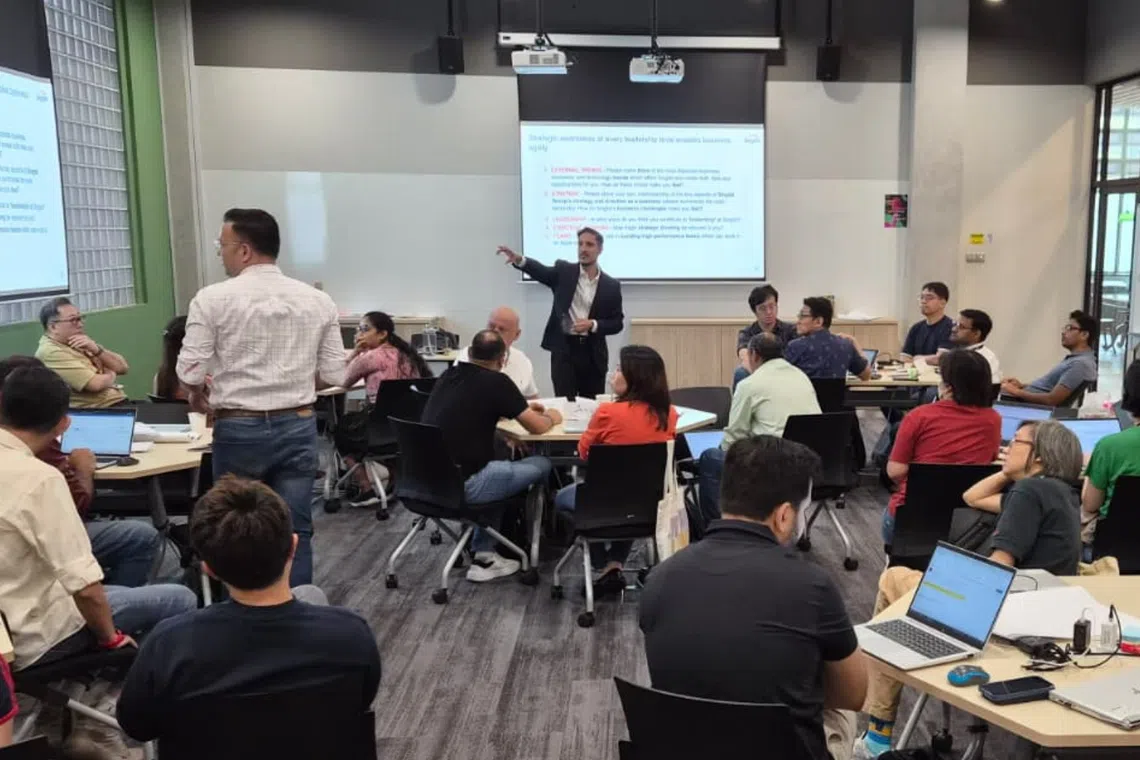
IN A RECENT training session, a group of Singtel employees watched as a generative artificial intelligence (Gen AI) tool instantly mapped out solutions to a hypothetical operational challenge within the telco company.
On the surface, the responses seemed coherent and comprehensive. However, the real exercise only began when an NTUC LearningHub trainer challenged the group to look beyond the AI’s confidence and probe its results – testing its assumptions, examining its logic and identifying what might be missing.
The objective was to shift mindsets: from seeing AI as a shortcut to using it as a disciplined “thinking partner”.
By applying critical thinking frameworks, they began to peel back the layers – identifying logical inconsistencies and inaccuracies that the AI tool had missed. The exercise showed that while AI can produce plausible answers, critical thinking is still essential to spot gaps and weaknesses in its responses.
The exercise was part of the two-day WSQ Display Critical Thinking and Analytical Skills powered by Wiley course. It was offered by local leading continuing education and training provider NTUC LearningHub. The course was customised in close consultation with Singtel.
It taught participants to analyse case studies, identify assumptions and biases, and evaluate information and arguments, with exercises centred on real-world workplace scenarios.
“Critical thinking is what turns AI from a shortcut into a true thinking partner. At its core, our approach is about helping people think more clearly, make better decisions, and feel confident tackling complex problems. We equip learners with practical frameworks to break down issues – including AI-generated outputs, question assumptions and biases, and rigorously evaluate information,” says Amos Tan, NTUC LearningHub’s assistant chief executive and chief core skills officer.
“In doing so, they learn not to take answers at face value, but to probe deeper, identify gaps, and strengthen the quality of their thinking. That’s what ultimately enables individuals and organisations to use AI more effectively, not just to move faster but to think better,” he adds.
As industries contend with the upheavals associated with rapid technological change, companies are placing greater emphasis on sharpening employees’ critical thinking to navigate volatile situations and to drive innovation.
“We are seeing growing demand from organisations looking to strengthen human skills such as critical thinking, creative thinking and problem solving across their workforce as a way to support workforce transformation at scale,” says Tan.
“As AI and automation become more embedded in the workplace, these capabilities are becoming even more important. Employees need to be able to question information, connect ideas, solve complex problems and make sound decisions in fast-changing environments.”
A customised learning solution for each organisation
One key feature of NTUC LearningHub’s programme is its tailored approach.
NTUC LearningHub works with each client to understand its operational context, challenges and strategic priorities before adapting the course content accordingly. Case studies and exercises are aligned with real-world business scenarios so participants can better relate them to their work.
For Singtel, this meant incorporating scenarios linked to its operational and organisational landscape. Learners also used customised forms to assess their proficiency in specific mental tasks, such as pinpointing logical flaws, and track their progress throughout the course. Digital collaboration tools also enabled peer learning across cohorts.
The trainers bring a mix of industry and consulting experience with deep expertise in corporate strategies, problem-solving, facilitation and organisational development. Many have worked with a wide range of institutions, from government agencies to multinational corporations.
“They’re not just subject matter experts. Our trainers bring real-world context into the classroom, draw out diverse perspectives, challenge learners’ thinking constructively and create a safe environment for discourse where different viewpoints can be explored,” explains Tan.
When AI meets critical thinking
A key component of the course is the integration of Gen AI tools, including platforms such as ChatGPT and Google’s Gemini, with the thinking modules.
Learners gain hands-on experience with the tools while also learning how to engage with them critically – from refining prompts and exploring different perspectives to assessing the reliability of AI-generated answers.
Tan says: “Our view is that AI does not diminish the importance of human skills, rather it heightens them. While AI can generate responses at speed, it still takes human judgment to ask the right questions, evaluate the quality of the answers and decide how those insights should be applied.
“In an AI-enabled workplace, the differentiator is not simply access to technology, but the ability to think critically, exercise discernment and bring context, creativity and judgment to complex situations. That is where NTUC LearningHub’s programmes are focused: helping workers sharpen the human capabilities that allow them to use AI effectively, responsibly and with confidence.”
Singtel Singapore chief executive officer Ng Tian Chong notes that connectivity, digital services and AI-driven innovation are the future, and the company’s long-term success depends on equipping its workforce with the skills, mindset and adaptability to thrive in an AI-enabled economy, hence its partnership with NTUC LearningHub.
“As we lean further into AI-powered digital solutions, cybersecurity, cloud, data analytics and advanced connectivity, roles across Singtel will continue to evolve. It’s a change we embrace, because it lets us deliver faster, more secure and more personalised outcomes for customers while creating higher-value work for our people,” says Ng.
For Singtel, AI will handle repetitive, high-volume tasks, freeing its staff to focus on high-touch work, such as understanding customers’ needs, interpreting data to inform decisions and solving complicated issues.
“For this, we need people who can think critically, challenge assumptions, adapt quickly and learn continuously, and use AI as a disciplined tool, not a crutch,” says Ng.
Tan adds that the course can supplement firms’ internal training by providing a different way of thinking about problems and solutions.
“With our approach, which goes beyond theory, employees can get practical tools to analyse and address obstacles and difficulties, make more informed decisions, and translate insights into action within their workplace.”
Singtel’s Ng emphasises the importance of people in the workplace: “The future we envision requires not only deep technical expertise in emerging technologies, but also unique human qualities no machine can replicate such as judgment, empathy, curiosity and creativity.
“Technology alone does not shape the future – people do.”
Find out how NTUC LearningHub equips professionals to think critically in an AI-driven world.

Share with us your feedback on BT's products and services