

OCBC conservative about FY2025 targets amid trade tensions, uncertainties
Bank’s Q4 net profit is up 4% at S$1.7 billion, while full-year earnings rise 8% to a record S$7.6 billion


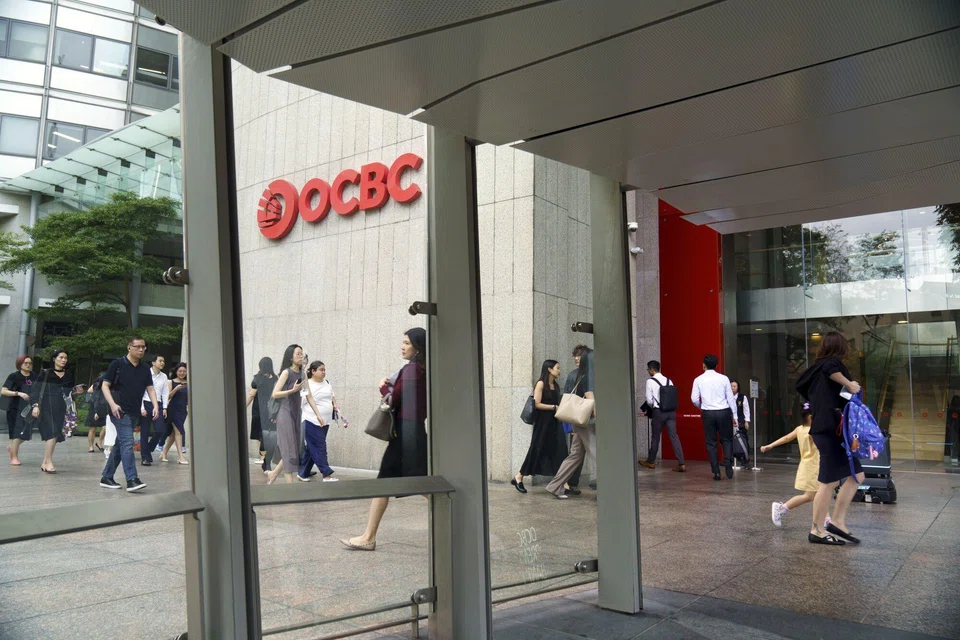
AFTER riding macroeconomic tailwinds to reach record earnings for 2024, OCBC’s management is staying cautious about the year ahead.
Notably, OCBC is maintaining a conservative view of three rate cuts for 2025 – compared with its peers’ expectations of one or two cuts for the year. It believes the volatile environment and heightened trade tensions could impede global growth even as Asean economies remain resilient.
For the financial year 2025, the lender is targeting a net interest margin (NIM) of around 2 per cent and mid-single-digit loan growth.
It also expects a cost-to-income ratio in the low 40 per cent range and credit costs of around 20 to 25 basis points.
“There’s always an upside, but we want to always follow prudence in our planning,” said OCBC chief executive Helen Wong at the lender’s fourth-quarter results briefing on Wednesday (Feb 26).
OCBC posted a net profit of S$1.7 billion for Q4 ended Dec 31, 2024, up 4 per cent from S$1.6 billion in the previous corresponding period.
The earnings fell short of the S$1.8 billion consensus forecast in a Bloomberg survey of five analysts.
Net interest income for the quarter was stable at S$2.5 billion, as a 6 per cent increase in average assets mitigated the contraction in NIM.
NIM for Q4 stood at 2.15 per cent, down from 2.29 per cent in Q4 2023, and 2.18 per cent in Q3 2024. This was a result of loan yields tightening at a faster pace than the fall in deposit costs, amid US rate cuts in the second half of 2024.
Meanwhile, non-interest income rose 18 per cent year on year to S$961 million from S$811 million, boosted by improved fee, trading and insurance income.
For FY2024, OCBC booked S$21 billion in net new money, bringing its total assets under management to S$299 billion as at December 2024.
The bank’s non-performing loan ratio as at end-December was 0.9 per cent, down 0.1 percentage point from the prior year.
Capital returns
OCBC announced plans to return S$2.5 billion of capital to shareholders over two years via special dividends and share buybacks – following similar moves by peers DBS and OCBC.
This comes on the back of the bank’s “sustained earnings growth and strong capital position”, OCBC said.
The capital return comprises special dividends amounting to 10 per cent of the group’s net profit for FY2024 and FY2025, with the balance of around S$1 billion via share buybacks over two years.
Wong noted that OCBC is delivering its returns faster, over two years, compared with its peers who each have a three-year programme.
“With a bit more commitment into the special dividend, we are passing the cash back directly to our shareholders,” she said.
“We will continue to look at our options; at this time, we decided it’s a combination of special dividend and share buyback, and we will continue to review this as we go along.”
For Q4, the lender has proposed a slightly lower final dividend of S$0.41 per share, from S$0.42 the year before, and recommended a special dividend of S$0.16 per share.
This brings the full-year dividend to S$1.01 per share, up from S$0.82 per share in the prior year, and represents a payout ratio of about 60 per cent of the group’s net profit.
Wong disagreed that the lender was lowering its dividends. Even though ordinary dividends for Q4 are down year on year, the final payout ratio of 60 per cent is higher than last year’s final payout of 53 per cent.
She said that a 60 per cent payout ratio is “not that ordinary”; OCBC is also going beyond its commitment of a 50 per cent payout ratio, with flexibility to pay more.
“You don’t pay a high special dividend every single year. So we’re sticking to what we promised and what we targeted,” she added.
The capital return plan is expected to bring the lender’s Common Equity Tier-1 (CET1) ratio down by one percentage point.
As at December 2024, its CET1 ratio stood at 17.1 per cent, from 17.2 per cent in September.
Based on fully phased-in final Basel III reforms, the CET1 ratio would have been 15.3 per cent.
OCBC is targeting its CET1 to be at around 14 per cent, which will give it a good credit rating and enough room to pursue further growth, Wong said.
Growth seen
For the full year, net profit rose 8 per cent to a record S$7.6 billion.
This translated to earnings per share of S$1.67 for the full year, from S$1.55 in the prior year.
NIM for the full year stood at 2.2 per cent, down from 2.28 per cent in the prior year. This was due to a rise in funding costs which outpaced the increase in asset yields.
Net interest income rose 1 per cent to S$9.8 billion, marking a new high. This was underpinned by a 5 per cent increase in average assets from customer loans, as well as high-quality assets which were income-accretive but lower-yielding.
Non-interest income grew 22 per cent to S$4.7 billion.
Wong also gave an update on the lender’s targets to add S$3 billion in revenue from its Asean-Greater China strategy by 2025; at the two-year mark, OCBC is now close to S$2 billion.
“So hopefully, if we continue with (our one-group strategy), this will translate to profit growth,” she said.
Shares of OCBC were down 1.9 per cent at S$17.27 as at 4.10 pm on Wednesday.
TRENDING NOW

World’s largest offshore wind platform by Seatrium consortium on track to be completed by 2028

Is stamp collecting enjoying an analogue revival or are its best days over?

GovTech retrenches another 38 staff in second round of layoffs

MBS adjusted property Ebitda falls 20.6% in Q3 with fewer high-roller visits, weaker hold

