

OCBC expects stronger net interest margin but stays watchful of slowing global growth


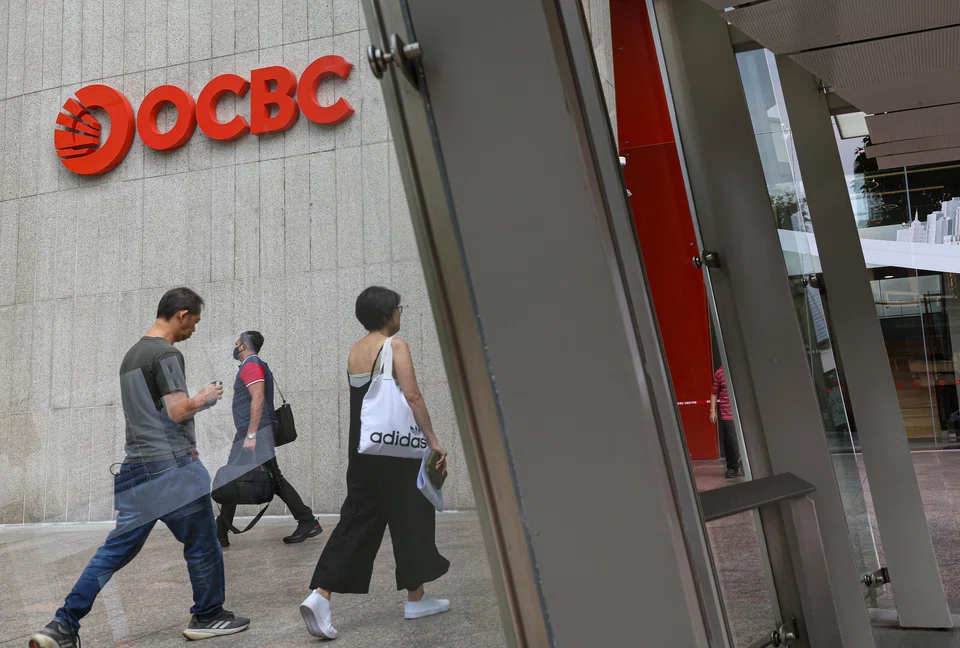
OCBC will likely deliver a stronger net interest margin (NIM) for 2023 than previously expected, but will stay prudent as the global growth momentum is expected to slow heading into 2024, said group chief executive Helen Wong.
Wong earlier guided NIM to be around 2.2 per cent. She now expects NIM will be above 2.2 per cent for 2023, and possibly be stable around this quarter’s NIM of 2.26 per cent.
The bank continued to raise its general allowances, however, as it takes on a prudent approach to guard against slowing global growth ahead, Wong said at the bank’s earnings briefing on Friday (Aug 4).
OCBC reported a net profit of S$1.7 billion for the second quarter ended June, up 34 per cent from a year earlier. This was driven by growth in net interest income (NII), while slightly offset by a spike in general allowances.
The net profit figure represented a slight miss from the S$1.8 billion mean estimate from four analysts polled by Refinitiv.
NII gained 40 per cent on year to S$2.4 billion amid asset growth and higher NIM, with NIM up 55 basis points to 2.26 per cent on the back of higher market interest rates.
While OCBC’s hike in NIM expectations is the lowest among the trio of local banks, group chief financial officer Goh Chin Yee noted that during the first quarter, the bank’s NIM guidance was the highest among peers.
Non-interest income grew 11 per cent to S$1.1 billion, mainly from net gains from the sale of investment securities and higher profit from insurance, partly offset by lower fee and trading income.
This resulted in total income rising 30 per cent on year to S$3.5 billion.
Fee income fell 10 per cent on year, largely due to weaker wealth, brokerage and fund management fees amid continued global risk-off investment sentiments.
But Wong noted that the bank continued to have strong net new money inflows, which were S$6 billion in the quarter.
In 2023, there were more net new money inflows in deposits, particularly fixed deposits, as investment sentiments remained weak, she said.
Deposits grew 7 per cent on year. The bank’s current and savings account ratio stood at 45.3 per cent for the second quarter, down from Q1’s 47.1 per cent.
Nevertheless, Wong expects net new money inflows to result in a wider asset under management base for its wealth management segment, which should be able to generate more fee income as the market turns more favourable.
“We welcome the net new money because it’s always good to have more business and new customers. But hopefully, investment sentiments will increase and interest rates stabilise… then customers can begin to put money into action,” she said.
Total allowances were S$252 million for Q2 – comprising S$200 million for non-impaired assets and S$52 million for impaired assets – even as the bank’s non-performing loans ratio fell to 1.1 per cent, from 1.3 per cent the previous year.
In comparison, total allowances were S$72 million in the same period a year earlier, and S$110 million in the first quarter of 2023.
Goh noted that general allowances were set aside for changes in risk profiles, macroeconomic variables updates and management overlays, but added that this was part of the bank’s consistent prudent approach.
This resulted in OCBC’s credit costs to stand at 31 basis points for the quarter, up from 12 basis points in the prior quarter. As at June 2023, its non-performing assets coverage ratio rose to 131 per cent, from 121 per cent as at March 2023.
As for loan growth, the bank kept its low-to-mid single-digit loan growth guidance, although Wong said it will “potentially (be) at the lower end”.
As at end-June, gross loans were down 0.2 per cent to S$297.4 billion as opposed to S$297.9 billion in the same period last year.
Wong said the bank still sees loan growth, with opportunities in the areas of energy, power and utilities; inflation-resilient assets such as purpose-built student accommodations and hospitality; as well as technology and digital infrastructure.
Annualised return on equity (ROE) was up 3.2 percentage points to 13.5 per cent for the quarter, from 10.3 per cent the year before. The bank is guiding for an ROE in the range of 14 per cent for the full year of 2023.
The lender has declared a higher interim dividend of S$0.40 per share for the period, up 43 per cent from S$0.28, to represent a payout ratio of 50 per cent of the group’s H1 net profit.






