OCBC Q4 profit falls 14% to S$973m; pays S$0.28 in dividends


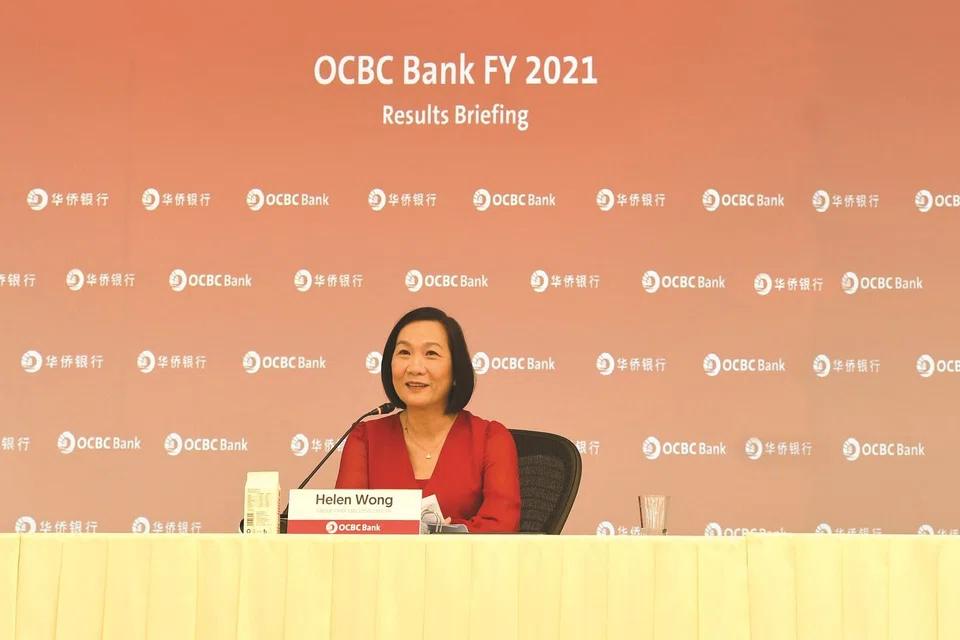
OCBC's O39 fourth quarter profit came in at S$973 million, down 14 per cent from S$1.13 billion a year ago, but its top executives reiterated during an earnings call on Wednesday (Feb 23) that the banking group's profitability is back to pre-pandemic levels.
Annualised earnings per share stood at S$0.85 for the quarter ended Dec 31, 2021, down from S$0.99 a year ago.
The bank's earnings missed the S$1.18 billion average estimate based on 4 analysts polled by Refinitiv.
Net earnings for the full year rose 35 per cent to S$4.86 billion, fuelled by growth in non-interest income and lower allowances, which offset a decline in net interest income amid a low interest rate environment.
The lender declared a final dividend of 28 Singapore cents per share. This brings the total dividend for FY2021 to 53 cents, in line with 2019 levels, and represents a payout ratio of 49 per cent.
OCBC chief executive Helen Wong said she is "cautiously optimistic" about economic recovery. "I do hope that Omicron is the final disruptive phase of this pandemic and Covid-19 evolves into a liveable endemic," Wong said, while noting that headwinds remain in the form of inflation, geopolitical tensions, supply-chain disruptions and rising energy prices.
For Q4 2021, OCBC's net interest income rose 4 per cent year on year to S$1.49 billion, driven by an asset growth of 6 per cent. Meanwhile, net interest margin was down 4 basis points to 1.52 per cent for the quarter due to lower asset yields, from 1.56 per cent from a year ago.
Non-interest income rose 1 per cent year on year to S$1.06 billion, due to fee income growth and higher profit from its life insurance business, although it was partly offset by a fall in trading income.
The bank's non-performing loans (NPL) ratio in Q4 was 1.5 per cent, unchanged from a year ago.
Meanwhile, total allowances were S$317 million for the quarter, up from S$285 million in the same period a year ago.The bank said it made allowances for impaired assets of S$387 million, mainly driven by project financing delays due to the supply chain disruptions in greater China and other overseas markets. Wong said she expects these disruptions to be ironed out as the global economy continues to open up.
"We expect the sponsors to continue to provide support to the projects. We have taken a conservative approach to look at how this financing has been impacted," she said, but declined to comment on specific projects when asked.
But it also had a write-back in allowances for non-impaired assets of S$70 million due to the refresh of the macroeconomic variables in the expected credit losses (ECL) model, and downgrade of accounts to ECL stage 3 allowances.
OCBC has extended over S$34 billion in sustainable financing to customers as at Dec 31 last year and have raised their target to grow its sustainable financing portfolio to S$50 billion by 2025.
On Wednesday, Wong also shared 4 growth priorities for the bank in the next 3 years. These include deepening wealth management capacities via hubs in Singapore, Hong Kong, Dubai and London; supporting increasing trade and investment flows between Asean and Greater China; investing in the new economy, such as digital assets and tokenisation capabilities; and tapping green opportunities as clients move into a low-carbon world.
The bank is targeting a more-than-10 per cent compound annual growth rate for its banking income and banking profits over the next 3 years.
The group expects its Common Equity Tier 1 ratio - a gauge of a bank's capital strength - to "fall slowly" over this duration, in supporting this organic growth.
Wong said growth in Asia will drive OCBC's trajectory in the coming years, and the lender will continue to establish its "niche" in capturing growing flows between Asean and China. "We are not a very big player yet, but I think there is still market share that we will continue to gain and business to build," she said.
The bank also expects the impending interest rate hike to provide a gradual uplift in interest income. A 1 per cent raise over the year will increase net interest margin by about 18 basis points, translating to close to S$700 million in income, Wong said.
Asked about the implications from the ongoing Russia-Ukraine crisis, OCBC's head of global treasury Kenneth Lai said rates are expected to continue going up, even as global markets have started to see a deleveraging of risk. "We believe the hikes will continue because I think the Fed is behind the curve on this. The question is whether we will see 6 hikes this year, or not... Obviously, (this will take) into account how badly the equity markets sell off, and whether there will be some sort of consideration or support to the equity markets."
For 2022, the bank has guided for net interest margin to come in at about 1.5 to 1.55 per cent. It expects loan growth to be in mid-to-high single digits and has guided for credit costs to be maintained within 20 to 25 basis points.
OCBC shares ended Wednesday at S$12.56, down 4.56 per cent or S$0.60.
READ MORE: