

Offshore yuan seen tumbling to new low against dollar in China selloff
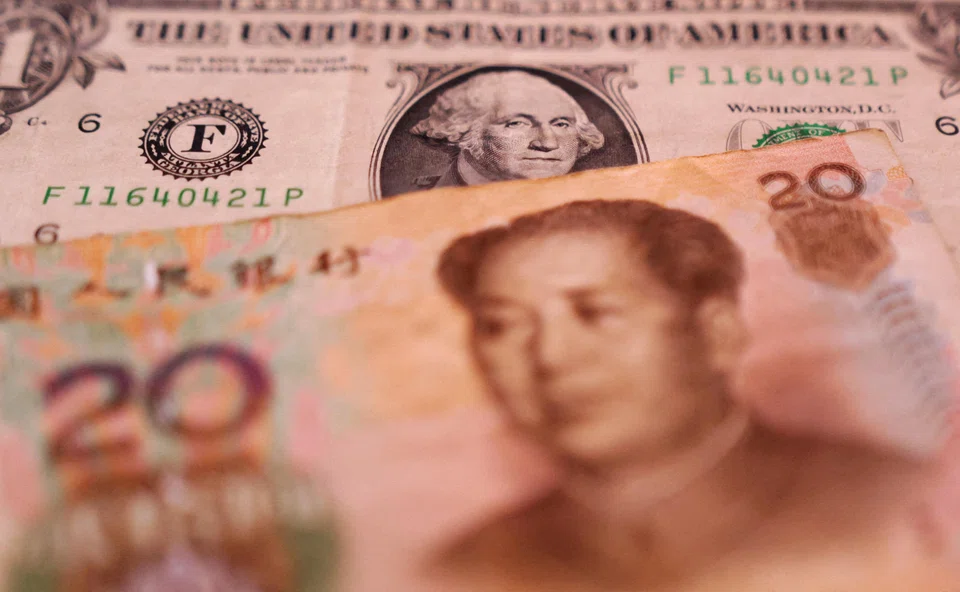
GLOBAL investors have little confidence that China will succeed in shoring up its financial markets, predicting that mounting economic stress will drive the yuan’s offshore exchange rate to historic lows.
The yuan traded internationally is seen depreciating to 7.6 per dollar before the end of the year, according to the median estimate by 455 respondents in the latest Markets Live Pulse survey. That implies a drop of 4 per cent from Friday’s close of 7.29 and would be a record low for the offshore currency.
Underlining the country’s bearish outlook, just 19 per cent of survey participants plan to increase their China exposure over the next 12 months, while 24 per cent plan to reduce their holdings. That’s a shift from March, when 25 per cent of investors said they would boost exposure.
Beijing intensified efforts to halt a rout in the nation’s assets in recent days. Authorities urged financial institutions to buy stocks and the yuan, made it more expensive to short the offshore yuan through higher funding costs, and told mutual funds to stop selling equities. On Sunday officials announced plans to cut the stamp duty on stock trades and slow the pace of initial public offerings.
While the earlier efforts briefly lifted markets, foreign funds continued to sell at a record pace amid concern over China’s struggles with falling prices, a slumping property market and soaring local government debt. Wall Street analysts are also turning more downbeat, with Morgan Stanley and Goldman Sachs Group lowering their targets on Chinese stocks in the past week.
China’s easier monetary policy at a time when the rest of the world is tightening is adding pressure on the yuan, as investors turn to higher-yielding US assets. Two-year US Treasuries yield is almost 3 percentage points more than the Chinese equivalent, the biggest premium since 2006.
The central bank’s “policy response to support the yuan hasn’t been effective in changing the trend and won’t be,” said Kiyong Seong, a strategist at Société Générale in Hong Kong.
Unlike in 2008, when China unleashed massive spending programmes to bolster growth, few expect the country to launch large-scale measures this time round to save the economy. Only 11 per cent of MLIV Pulse respondents expect policymakers to unveil “bazooka-like” stimulus, with the majority predicting moderate measures targeting specific industries. Another 32 per cent said any policy rescue will be too little, too late.
While authorities have issued plenty of rhetoric in support of the economy, specific action has been limited. During his presidency, Xi Jinping has sought to end the reckless debt-fuelled expansion that typified the years in the wake of the 2008 stimulus blitz and fuelled heady economic growth.
“Things are coming,” said David Loevinger, a managing director at TCW Group, about the stimulus. “But it seems like there’s an internal debate about what you need to do in the short term without losing sight of your long-term policy objectives.”
While US President Joe Biden labeled China’s economic woes a “ticking time bomb” for the world and Treasury Secretary Janet Yellen called them a “risk factor” for the US, investors see limited spillover risk right now.
About 31 per cent of MLIV Pulse respondents said the MSCI China Index would need to drop another 20 per cent in the next month to trigger a global rout, while another 33 per cent said Chinese equity losses won’t lead to any significant contagion.
Chinese stocks started Monday by surging after authorities took a raft of steps to bring investors back, but most of the gains were gone by the end of the session, with foreign funds extending what’s set to be a record outflow this month.
Similarly, a majority of market participants – 56 per cent of respondents – said China’s slowdown won’t have a significant impact on actions by other key central banks such as the Federal Reserve.
Because major economies have limited export and banking exposure to China, “a debt-induced economic downturn in China likely would not trigger another global financial crisis à la 2008,” Wells Fargo & Co. economists including Jay Bryson wrote in a note. BLOOMBERG
Decoding Asia newsletter: your guide to navigating Asia in a new global order. Sign up here to get Decoding Asia newsletter. Delivered to your inbox. Free.
Share with us your feedback on BT's products and services
TRENDING NOW

The only common thing in S-E Asia is that we all eat rice: Cisco’s Asean president

‘How many will survive?’: Bubble fears arise as China’s humanoid robotics face reality check
Green fuels, autonomous ships: How Singapore is future-proofing its shipping industry

Could stablecoins be the future of money?

