

Oil rout gives Asian currencies some breathing room – if Middle East ceasefire holds
But lower prices alone may not be enough to drive a sustained recovery, analysts say

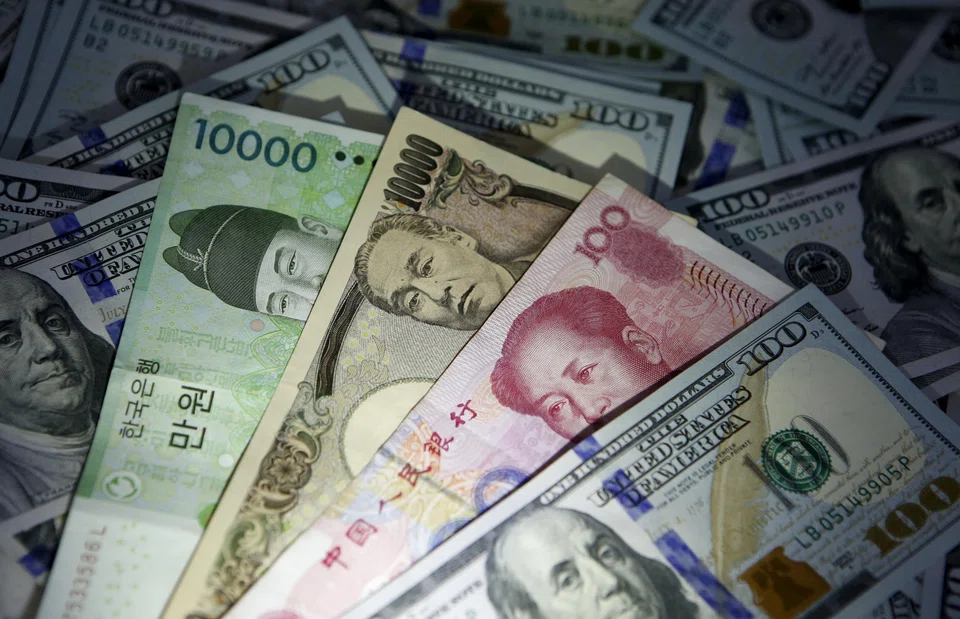
[SINGAPORE] Asian currencies could see a modest rebound in the coming weeks if a fragile ceasefire between the United States and Iran holds, analysts told The Business Times.
Crude oil prices – which had surged since the conflict began on Feb 28 – posted their biggest one-day drop since April 2020 on Wednesday (Apr 8), falling back below the US$100 a barrel mark after news of a two-week ceasefire and the resumption of shipping through the Strait of Hormuz.
But the situation remains volatile. Less than a day later, an Iranian news agency reported that oil traffic through the key chokepoint had been halted again, hours after tankers were allowed to pass, following Israeli strikes on Lebanon.
If the ceasefire takes hold – with peace talks expected over the weekend – and oil prices moderate further, currencies of large net energy importers in Asia are likely to strengthen, analysts said.
“Large net energy importers, such as Thailand, South Korea and the Philippines, are likely to see some reversal of recent weakness in the near term,” said Vishrut Rana, senior economist at S&P Global Ratings.
Saktiandi Supaat, head of FX research at Maybank, said that in foreign-exchange terms, the main beneficiaries of lower oil prices would be those with “relatively larger energy import burdens or more fragile external balances”.
“This includes currencies such as the Indian rupee, Philippine peso, Thai baht and Korean won,” he added.
Oil shock mechanics
Net energy importers – economies that rely on imports to meet domestic energy demand – tend to see their currencies weaken when oil prices rise.
This is because higher oil prices widen trade deficits, increase demand for US dollars to pay for imports and place downward pressure on local currencies. At the same time, geopolitical tensions typically drive safe-haven flows into the US dollar, compounding the weakness.
The Middle East accounts for about 40 per cent of Asia-Pacific energy imports, while roughly 90 per cent of crude oil shipped through the Strait of Hormuz – which before the war handled about 20 per cent of global daily oil supply – is bound for Asia.
Over the past month, oil prices have largely traded above US$100 a barrel. Brent crude, the global benchmark, was at US$97.20 as at 3 pm on Thursday, up 2.6 per cent on the day.
Before the conflict, crude prices were in the US$60 to US$70 range.
Against this backdrop, several Asian currencies have weakened against the US dollar over the past month, including the Thai baht (minus 1.2 per cent), Vietnamese dong (minus 0.5 per cent), Philippine peso (minus 1.2 per cent), Indian rupee (minus 0.8 per cent), Indonesian rupiah (minus 0.9 per cent) and Japanese yen (minus 0.3 per cent).
Net energy importer Malaysia’s ringgit has declined 1.1 per cent over the same period, while the Singapore dollar, seen as a relative safe haven, has appreciated 0.7 per cent. The South Korean won is up 0.2 per cent, largely due to a sharp one-day rally following news of the ceasefire.
Greenback still key
Even so, lower oil prices alone may not be enough to drive a sustained recovery in Asian currencies.
“While falling oil can drive the first-order move, a sustained recovery in Asian FX ultimately depends on the broader dollar backdrop, financial conditions, US Federal Reserve pricing and portfolio flows,” said Christopher Wong, a foreign-exchange strategist at OCBC.
“If the US dollar remains firm and rate differentials continue to favour the US, then the rebound in Asian currencies may prove shallow even if oil prices stay off their highs,” he added.
Saktiandi said that if the ceasefire proves short-lived and oil prices remain volatile, divergences across Asian currencies could become more pronounced.
“Currencies like the Singapore dollar and Malaysian ringgit are likely to remain relatively resilient regardless, supported by structural factors such as policy credibility (and) investment flows,” he said.
Wong noted that, on the other hand, higher-beta currencies – typically those more sensitive to global risk sentiment – in net oil-importing economies such as the won, peso and baht may come under renewed pressure.
Asian central banks are also expected to remain cautious, even as easing oil prices reduce near-term inflation pressures.
“Policymakers are unlikely to assume the shock is over as the ceasefire remains fragile and physical energy markets remain strained,” Wong said. “Recent policy signalling in the region still warrants vigilance, not complacency.”
TRENDING NOW

Once staunchly pro-China, Malaysian Chinese businesses are now distancing themselves from Beijing

Grab CEO’s wife Chloe Tong on life with Anthony Tan and finding her purpose

Could stablecoins be the future of money?

ST Engineering opens tech-focused aircraft maintenance facility in Changi; to create over 500 jobs

