

Olam cooks up a storm with major reboot
Rejig of Olam's humongous portfolio and plans to spin off two meaty assets mark firm's most impactful endeavour in over a decade.

Singapore
BIG is no longer beautiful.
The break-up of Olam International - a mammoth agri-food empire that sources, processes, packages and merchandises everything from edible nuts, spices, cocoa, coffee to grains across Africa, Asia, the Americas and Australia - into two (relatively) bite-sized entities ought to be one proof of that.
The rejig of Olam's humongous portfolio and "full-fledged" spin-off for the food ingredient and agri-business assets mark the firm's most impactful endeavour to woo the market to raise growth capital, some nine years after it got roasted by US-based short seller Muddy Waters. Olam was down for awhile but not out.
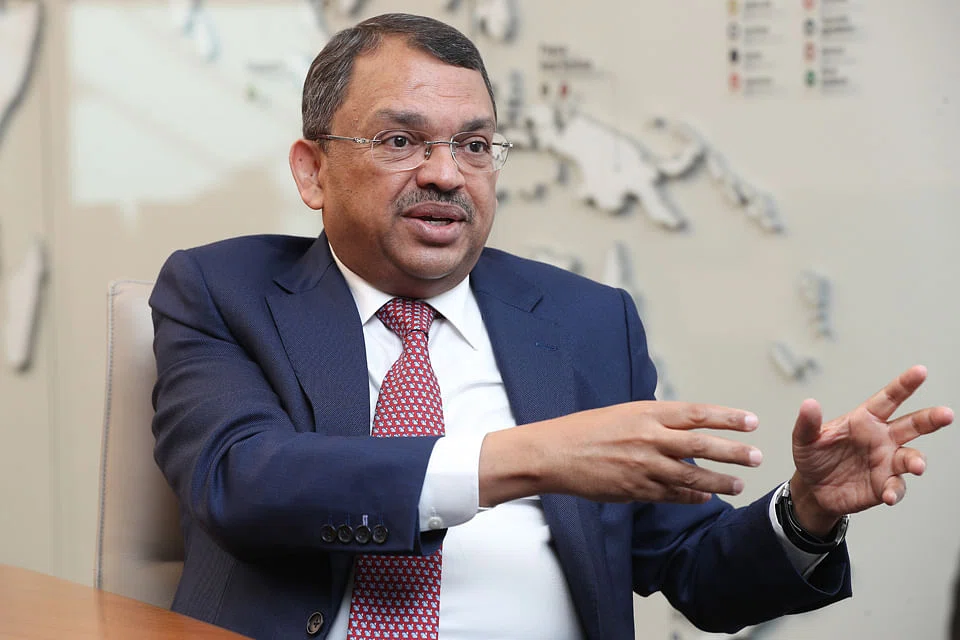
Olam's group chief executive Sunny Verghese's enthusiasm is hard to miss even with his all-too-familiar measured and reflective despatch. "It's an exciting opportunity to create world-class businesses that will be true market leaders," he told The Business Times in an interview.
"We expect significant value to be unlocked for the businesses in this two to three-year process but more importantly, the potential for more sustained long-term value creation. We are looking forward...to making this happen," he added.
The agri-giant, majority owned by Temasek Holdings and founded by Mr Verghese more than 30 years ago with roots as a cashew trader in Nigeria, has spent the past year compartmentalising its complex structure into Olam Food Ingredients (OFI) and Olam Global Agri (OGA) to tap on-trend themes such as plant-based food and sustainable and traceable raw materials.
It's a prelude to an eventual de-merger and listing of first, OFI - the much bigger, more established entity that brings sweeter margins - by as early as April next year, to be followed a year later by OGA.
It's no small task - this slicing and dicing of a firm with presence in 67 countries that spans a network of five million farmers and 25,000 customers worldwide.
Both OFI and OGA now boast their own operating models, organisation structures and management and functional teams. Their results have also been segmented in the reporting of the group's financial performance for investors to better unpack the businesses, which in turn, has led to improved disclosure.
OFI comprises Olam's existing supply-chain businesses in cocoa, coffee, nuts, spices and dairy while OGA involves grains, animal feed and protein, edible oils, rice, cotton and commodity financial services.
In terms of group revenue of S$35.8 billion, OFI and OGA contributed 35 and 60 per cent respectively.
The companies have slightly different growth profiles. "The OGA business is a high-return business because it's a very asset-light model and it's focused on high-growth emerging markets. The OFI business is focused on developed markets. So there are some very critical differences in their structural and underlying themes," Mr Verghese explained.
OFI's massive "food-print" is positioned in a sweet spot to take advantage of new consumer trends. Mr Verghese said: "By bringing in new investors and growth capital, we have a game plan on how we can fit this business into a further value-added ingredients and solutions business.
"As a result of raising growth capital and investing it, we have got a very solid growth algorithm for OFI in terms of top line and volume growth, and more importantly, margin growth, and how it drives total shareholder returns. We think this package is extremely attractive."
Eager beaver
Acquisitions have been fast and furious, chiefly to speed up OFI's transformation from a food raw materials supplier and processor into an ingredients and solutions company. Olam has spent US$400 million in a few months to snap up US-based green chile pepper business and dehydrated onion ingredients business and greenfield investments such as a coffee facility in Brazil and a dairy processing plant in New Zealand
"We have a lot of such interesting projects in the pipeline which will accelerate OFI's transformation. Because the IPO is going to raise a lot of growth capital for us, we will definitely pick up the pace of these investments. And that will unfold over the course of 2021 and beyond," he said.
The Singapore-listed firm, whose small-float stock has largely been neglected by analysts for many years, is evidently eager to please. Based on market feedback, the firm has picked a slightly different set of key performance metrics including earnings before interest and taxes (EBIT) and invested capital (IC) to better show their prospects.
Olam also plans to release a healthy chunk of the shares or free float for the listings. "We want a meaningful, sufficient free float...(because) if there is low free float, no liquidity, then there will be no price discovery. We think the sweet spot is around 25 per cent but it could be 25-30 per cent...somewhere in that range."
In a year riddled by losses on the back of the toll so many businesses have suffered from the Covid-19 pandemic, Olam has displayed resilience, owing in no small part to its varied operations. "Covid has impacted us differently in the various platforms and business units. So it shows the momentum of these businesses and it shows the diversified nature of these businesses to be able to navigate through a pandemic like Covid, which has been an extraordinary set of circumstances," said Mr Verghese.
Olam's operational PATMI (profit after tax and minority interests) grew 36 per cent last year to S$678 million and 90 per cent for the second half to S$476 million.
A bulk - or 80-85 per cent - of Olam's revenue stems from the food category which is by and large deemed recession proof. But here too, the impact was varied. While the pandemic-led lockdown led to higher demand for at-home food consumptions, it hurt the group's edible oil business as 45 per cent of the demand stems from consumption in restaurants and in foodservice segments.
The cotton business was the most impacted as activity in textile mills in China, India, Pakistan, Bangladesh, Vietnam and Indonesia ground to a halt through much of last year although Mr Verghese pointed out that capacity utilisation has since come back up significantly.
Feast for the future
As a result of the carve-out and separation of the two businesses, Olam International Ltd or OIL is left with managing three segments or rather, tasks - the divestment of de-prioritised assets; nurturing the gestating businesses to full potential; and the incubation of new engines and platforms for growth.
Mr Verghese says the fate of OIL will be determined at a later stage, post listings of the two key entities."We can decide to keep it listed. We can decide to privatise it. We have got all the strategic options. But right now, that is not the most important focus. It is only 10 per cent of our business today. We want to first extract that value 90 per cent," he said.
In the past decade, Olam has fast become one of a few forceful Asian players in the global agri-food commodities space dominated by the "ABCD quartet" of Archer Daniels Midland (ADM), Bunge, Cargill and Louis Dreyfus. Beginning next year, the Singapore-based firm is set to bring more to the table with the major business re-set that will culminate in the gradual listing of two key assets.
Mr Verghese said: "This is the best way to create long-term sustainable value...it's about creating profitable growth, attracting new investors and pivoting to value-added businesses. That's when big value will be realised".
TRENDING NOW

Motoring tycoon Peter Kwee is back in court: Here are his previous legal battles

Demand, tech capabilities position Apac and AI as Skyscanner’s next growth frontiers: CEO Bryan Batista

Beyond the greenback, Vietnam’s big borrowers turn to Asian-currency bonds

Nvidia’s outlook cut to stable by Moody’s on governance concerns

