Olam H2 profit falls 83.4% to S$38.4 million; pares proposed dividend to S$0.03 per share
Company blames earnings slide on higher net finance costs, exceptional losses in a ‘tough year for the industry’


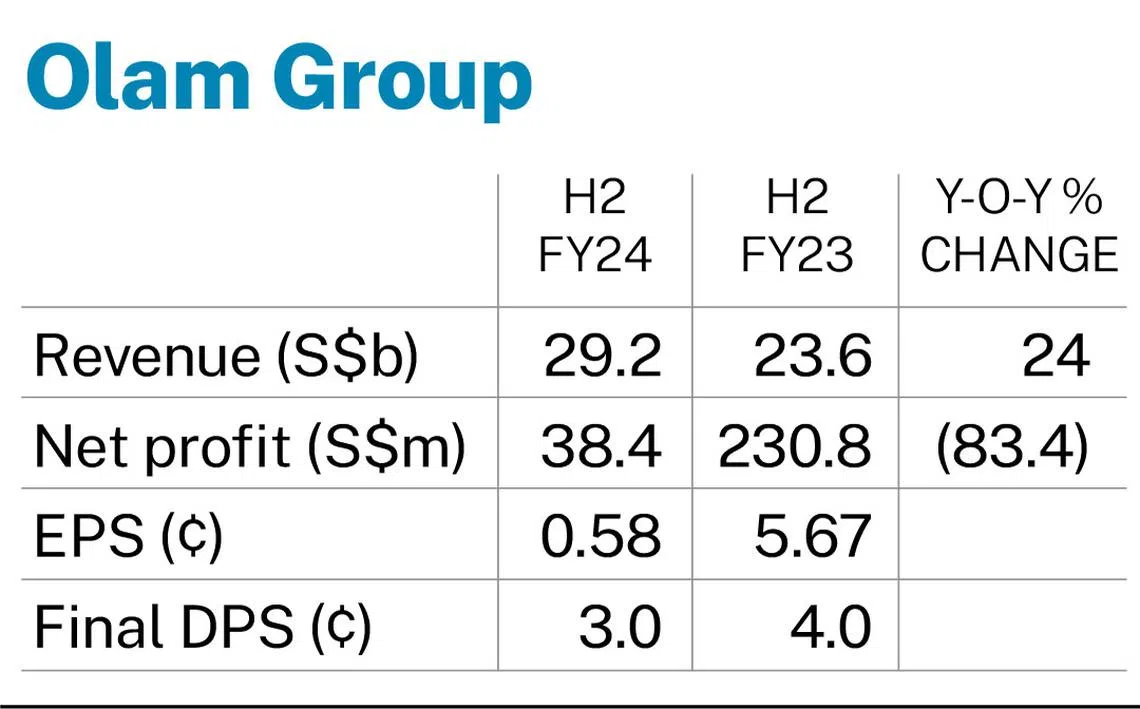
AGRIBUSINESS giant Olam Group on Friday (Feb 28) reported a net profit of S$38.4 million for the second half ended Dec 31, down 83.4 per cent from S$230.8 million in the previous corresponding period.
This translated to earnings per share of S$0.0058 for the half-year period, down from S$0.0567 the previous year.
Earnings declined as earnings before interest and tax (Ebit) growth was offset by “a significant increase in net finance costs and higher net exceptional losses”, noted the group.
Finance costs for the half year rose to S$933.3 million from S$684.9 million.
The exceptional losses were mainly from the temporary cessation of operations at its food ingredients unit ofi’s onion and parsley processing plant, as well as the lease surrender and exit of two non-strategic almond orchards in the US.
Excluding these exceptional items, underlying profit fell 47.9 per cent on the year to S$142.8 million.
Revenue for the period, however, rose 24 per cent to S$29.2 billion from S$23.6 billion.
Sales volume for H2 grew 11.2 per cent and Ebit was up 10 per cent at S$1 billion, led by strong growth from the group’s ofi and Olam Agri units, which offset higher losses from the remaining Olam group.
Olam’s board proposed a final dividend of S$0.03 per share, down from S$0.04 per share the prior year. This takes the full-year dividend to S$0.06 per share, down from S$0.07 per share the year before. The dividend will be paid on May 14, following the record date of May 6.
For the full year, net profit declined 69 per cent to S$86.4 million from S$278.7 million. This was because Ebit growth was offset by the significant increase of S$445.7 million in net finance costs, which was driven by elevated net debt levels from price-led working capital increases.
Revenue, however, climbed 16.3 per cent to S$56.2 billion from S$48.3 billion, due to high revenue growth from ofi, on the back of input price increases.
Challenging price condition
Net gearing at end-2024 increased to 2.79 times from 1.73 times at end-2023, which Olam’s co-founder and group chief executive officer Sunny Verghese attributed to “extraordinary price situations” of commodities such as cocoa and coffee in 2024, during a results briefing on Friday.
A Shekhar, ofi’s CEO, noted that 2024 saw increased volatility, record price peaks and supply challenges across several key products.
“It’s been the toughest year to manage and balance all these constituencies and stand by them... it’s been tough for the whole industry,” he said.
As ofi has been directing capital towards global sourcing, total invested capital increased significantly to S$17.4 million in 2024, up 47.5 per cent from S$11.8 million in 2023. Shekhar added that the capital growth is reflected in “higher readily marketable inventories”, which will keep its factories running.
Full-year sales volume was up 12.5 per cent at 49.6 million tonnes, with 90.9 per cent contributed by its departing unit, Olam Agri.
On Feb 24, Olam said that it had entered into a conditional sales and purchase agreement with Saudi Agricultural and Livestock Investment Company (Salic), to dispose of all its remaining shareholdings in Olam Agri in two tranches, while focusing on unlocking value for the remaining Olam group businesses and ofi, including an ofi IPO.
The first tranche involves 44.58 per cent of the stake, which Salic will acquire for about US$1.8 billion. This implies an equity valuation of US$4 billion of the whole of Olam Agri.
Following that, Salic’s stake in Olam Agri will be raised to a controlling 80.01 per cent, from the current 35.43 per cent.
Within three years of the completion of the first tranche, the group will sell the remaining 19.99 per cent stake in Olam Agri via a call/put option.
Including the initial sale of a 35.43 per cent stake in Olam Agri in 2022, Olam would have raised total gross proceeds of US$3.9 billion, and accreted US$2.7 billion to its equity reserves, from the 100 per cent divestment of Olam Agri.
Continued volatility
Verghese expects continued volatility stemming from geopolitical tensions, US trade policies, and a potential revival of interest rate hikes amid uncertain inflation outlook.
He noted that Olam, as one of the few players in both upstream and downstream commodity businesses, has faced the “full brunt of this market volatility”.
While the group continues navigating the “exceptional circumstances”, Verghese highlighted that it will focus on pushing through the divestment of Olam Agri, and reducing losses of the remaining Olam group.
“We will hopefully make some progress in selling some of the exiting assets that have been earmarked for divestment,” he added.
Shares of Olam closed 3.8 per cent or S$0.04 lower at S$1.00 on Friday.