

Olam in a very good place today: CEO
It has refocused its strategy after a shortseller attack three years ago and is now back on its growth trajectory
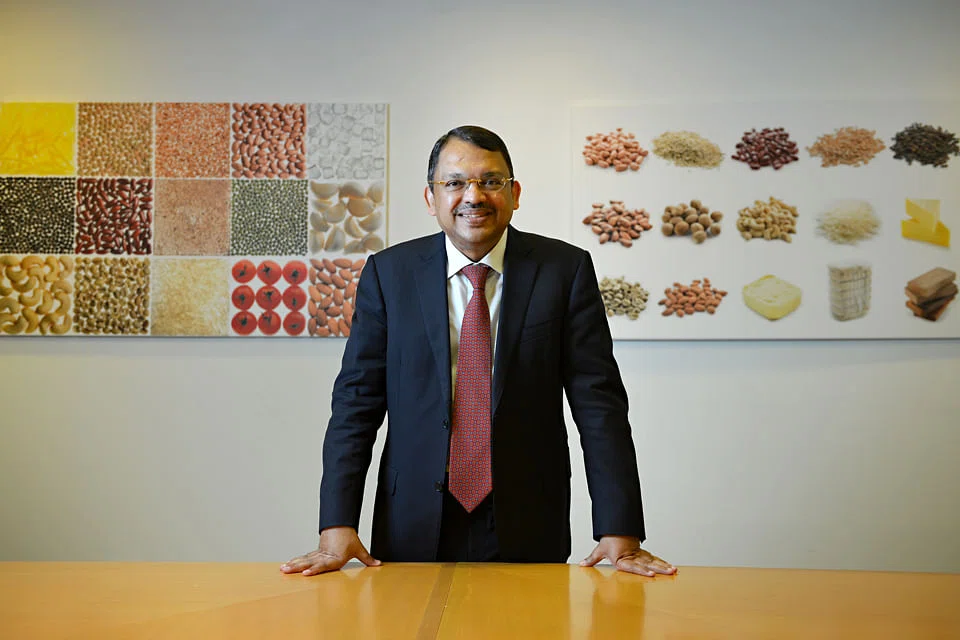
Singapore
THREE years after a damaging shortseller attack sent shares of Olam International spiralling to unseen depths, the company has firmly emerged from the shadow of the crisis and is now set on the growth trajectory again.
This comes after the firm refocused its strategy and changed "several things" following the saga.
Chief among these were efforts made to realign its shareholder base, Olam's CEO Sunny Verghese told The Business Times in an interview.
"We had a situation three years ago where a significant part of our shareholders had very short shareholding periods - they typically held our stock for five to six months, but the average tenure of our strategy was seven years. So we had a mismatch between the average tenure of our strategy and the holding period of our shareholders," he said.
This has since been changed following two main events. In March last year, Singapore investment firm Temasek Holdings stepped in to make an offer - together with Olam's founding family and management - for all the shares of Olam. Then, in September this year, Mitsubishi Corporation bought a 20 per cent stake in the firm through two separate deals.
"Between all the major long-term shareholders (Temasek, Mitsubishi, the Kewalram Chanrai family and Olam's management) we now own about 85 per cent of the company," said Mr Verghese. "We have therefore successfully completed that objective."
The sale of a 12 per cent stake in Olam through newly-issued shares also raised S$915 million, which would help to support growth in Olam's prioritised product platforms.
Along the way, the firm has deepened capabilities in its existing businesses, and renewed its board and governance processes, Mr Verghese added.
Even as the rest of the commodity sector sinks into a tailspin on the back of sluggish growth in China, Olam is insulated from it as its products are not recession-sensitive.
While there have been excess supplies in certain agri-commodities due to good weather in the past few years, the world is now facing more uncertain weather because of El Nino, he said. "Therefore food prices are not likely to see much further downside . . . Given our differentiated model and prospects for the agriculture complex we feel quite pleased in terms of where we are."
Olam is now poised for growth, especially by continuing its move into adjacent businesses which share customer costs, capabilities and channels with existing businesses. The firm has, for example, expanded from cashew to peanuts, almonds and hazelnuts, and this year added pistachios and walnuts.
"As far as our competitive strategy is concerned, we have differentiated ourselves at the grower and supplier end by out-origining our competition. We've also differentiated ourselves at the customer end by providing value-added services and solutions."
The firm is now back on the acquisition path, but with a marked difference from the past when it had a "string of pearl" strategy of making many small transactions.
"We are migrating from doing a lot of transactions to doing fewer but larger transactions, but these have to be along our prioritised platforms and consistent with our corporate strategy."
The recently completed acquisition of ADM Cocoa is an example. While Olam has been a very large supplier of cocoa beans and also has strong proprietary knowledge of the supply and demand of cocoa, it does not have much processing capabilities. ADM Cocoa, on the other hand, not only has 600,000 tonnes of processing capacity (compared to Olam's 100,000), it also carries strong chocolate brands cultivated over decades.
With the acquisition, Olam becomes among the top three in the cocoa sector, and sees significant opportunities to grow the footprint further, said Mr Verghese, given its position among the largest global suppliers of certified traceable cocoa which is increasingly in demand by chocolate manufacturers. The firm expects to achieve between US$35 million and US$40 million worth of synergies by 2018 after integrating ADM Cocoa.
Additionally, Olam will further strengthen its competitive edge in Africa by investing across four investment themes: procuring agricultural raw materials and ingredients; processing and distributing food staples such as rice; selling branded food products; and investing in agriculture logistics and infrastructure such as silos and ports.
While it will also be investing in Latin America and in key Asian markets such as Indonesia, Vietnam and India, Africa will be important because Olam has an advantage there. "But we won't invest 70-80 per cent of our capital in Africa, we won't do that."
The firm last year launched a scholarship in celebration of its 25th anniversary, to support sub-Saharan Africa nationals who wish to pursue postgraduate studies in development economics, business management and public policy and administration. "We think it's a very important thing because we are focusing on African talent and we want them to be change agents and catalysts in African development," said Mr Verghese. "So we hope these people will come back and contribute in Africa."
Looking ahead, Mr Verghese sees a few long-term trends in the sector that Olam has to respond to.
On the demand side, not only is the global population growing, increasing urbanisation will also mean a shift in dietary habits from cereal carbohydrates to protein-based diets which require more feed and raw materials. The growth in the use of biofuels will also be another source of demand for agriculture.
At the same time, the amount of arable land per capita is shrinking, while water scarcity is a "huge" problem. These, coupled with infrastructure deficit and bottlenecks as well as food wastage, will result in a "growing imbalance" between the supply and demand for food, he said.
This is why Olam has chosen to differentiate itself by becoming a fully-integrated player. It has gone upstream in 21 crops in 26 countries, and extended the breadth of its procurement reach in various producing countries for all its commodities, said Mr Verghese. It is also investing in mid-stream processing assets and has built a downstream packaged food business.
"Our strategy is in response to those major trends and to take advantage of them. Therefore we feel that we're in a very good place as a result of that."
READ MORE: Olam CEO shares pointers on avoiding shortseller attacks
TRENDING NOW

Two Singapore-listed palm oil firms named in Greenpeace report on Indonesian plantation fires

Singapore Airlines flight returns to San Francisco after ‘unruly’ passenger incident

Singapore looking into which companies responsible for haze-causing fires: PM Wong

Deluge IPO 3.86 times subscribed ahead of SGX debut

