Olam races to rev up second growth engine
FOOD and agri-business giant Olam Group could soon be racing to a different beat.
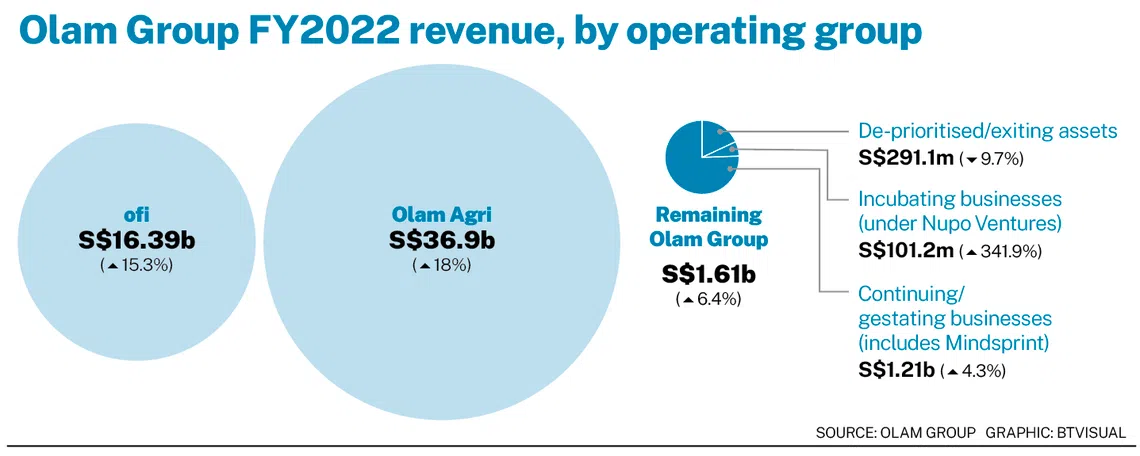
The group is set to lose its biggest revenue generators with the spin-off of Olam Agri and food ingredients subsidiary ofi. Its top line would then come down to the horsepower of its “Engine 2” businesses and startup growth initiatives.
It has been some four years in the making now with Olam’s second growth engine revving up nicely. In 2022, revenue from the group’s associated incubating business segment came in at S$101.2 million, a sharp jump from S$22.9 million the year before.
Engine 2’s man in charge, Suresh Sundararajan, said he has “very clear plans” on when the key pillars – farmer services platform Jiva, and carbon measurement and management platform Terrascope – will start generating cash.
Launched in 2020, Jiva generated more than S$70 million in revenue in 2022. Sundararajan has set his sights on Jiva becoming positive in its gross contribution this year.
He also aims for Terrascope, which was launched in June 2022, to double or treble its customer base over the next few years and become Ebitda-positive by the fourth year. Takings for Terrascope have moved from less than S$1 million by end-2022 to the “single-digit millions” currently, he divulged.
Sundararajan is the chief executive officer of Nupo Ventures, an independent startup foundry born in 2022, post the reorganisation of the Olam Group. While seemingly new, the work behind Nupo started in 2019 when Olam’s corporate innovation team incubated five new ventures.
How the Olam executive ended up taking the wheel after 28 years at the company was quite serendipitous. Back in late 2016, Sundararajan was put in charge of the group’s digital transformation journey, leading an internal task force that attempted to disrupt and transform the group’s own supply chains using technology.
Then, the efforts were mostly experiments. One concept that captured everyone’s imaginations was Olam Direct, which explored whether an agri giant such as Olam could buy cocoa directly from a South Sulawesi farmer with just one hectare of land.
This paved the way for Nupo’s first venture, Jiva, which today buys corn from more than 60,000 farmers across Indonesia. It is looking at covering other crops such as chilli, cassava, and coffee, and is considering an India expansion.
From Olam Direct, the group also derived the “boundary conditions” it would use to assess new ventures in a disciplined manner, said Sundararajan.
Climate tech
The idea that would become Terrascope came about in 2020, when Olam group CEO Sunny Verghese casually asked if the group could create a platform that compresses the time required to measure supply-chain emissions, known as Scope 3. For large enterprises, consultants were taking three to six months to make the computations.
By shortening the time needed, companies could spend more time on decarbonising efforts, Verghese reasoned.
Sundararajan was initially sceptical. But he would later go on to co-found Terrascope, which leverages machine learning to help companies cut through tens of thousands of emission factors to find the ones most relevant for their Scope 3 calculations. With the tool, Olam has managed to count its emissions in six weeks.
Despite only being a year old, the Singapore-headquartered venture, now staffed by around 100 employees, has attracted 20 paying customers, and announced an expansion into the Japanese market in June.
Names that have been onboarded include beverage giant Pokka, electric-vehicle battery startup noco-noco, food product wholesaler Mitsubishi Shokuhin, and MC Agri Alliance, a joint-venture company between Mitsubishi Corporation and Olam International.
Carbon measurement is a competitive space, with many climate tech startups in Europe and the United States attacking similar pain points. But Sundararajan believes the space is “still wide enough” for Terrascope to stand out.
In fact, he expects to see “convergence and disappearance”, given the ongoing funding winter for startups. “With capital drying up, those without a differentiated solution will probably disappear. Some may be bought over by large companies,” he remarked.
Terrascope is by no means a convenient tool for Olam to justify its emissions. In its first year using the tool, the group’s carbon footprint went up by 30 per cent. This upset Verghese, who wondered if Terrascope got it wrong, Sundararajan shared.
They soon realised that the result was a “very sharp reflection of the objective truth that many companies struggle” in getting their measurements right. Olam ended up recalibrating its targets with the more accurate set of emission figures indicated by Terrascope.
Farmer tech
Despite being the bigger venture hiring some 500 employees, Jiva has poor product recall in a city such as Singapore. But it has changed the lives of small-time farmers in Indonesia who reported fetching prices 10 per cent to 20 per cent higher than what they used to get through a middleman, Sundararajan tells BT.
Not only does the platform allow farmers to discover latest prices of their crops, it also provides on-demand advice for yield improvement, and access to micro-financing at cheaper rates.
These gave it its 60,000- to 70,000-strong following just eight corn seasons in. Of these, about 2,000 to 3,000 navigate the app on their own, while the non-tech savvy transact through its network of more than 5,000 micro-entrepreneurs, who earn commission directly from Jiva through a tiered reward system.
Before Jiva, these farmers would easily be caught in a vicious cycle of poor yields, low earnings and debt, as the fragmented supply chain makes it easy for middlemen to short-change farmers, Sundararajan said. For instance, farmers without any proper assessment of their creditworthiness could be faced with limited moneylending options, and end up borrowing at rates of up to 40 per cent per annum, he noted.
Jiva does not make transactions in India yet, but it is gaining clout through AgriCentral. The app, which shows daily price movements for 150 crops, has some 800,000 active users a month there.
This will remain the status quo for a while, as Jiva wants to strengthen its presence in Indonesia, before making its foray into India – a nation of over 130 million farmers, versus Indonesia’s 25 million – sometime in 2025.
Unlike India, which also has large conglomerates such as Alliance Group eyeing the space, the ground in Indonesia is “more exciting” to work on as competition is few and far between there, said Sundararajan.
But he is not fazed by the competition in time to come. “Eventually, people who understand agriculture, who can do this buying and selling effectively, will succeed,” he said.